Introduction
From 2017, a vast detention system took shape in China’s Xinjiang Uyghur Autonomous Region. Hundreds of thousands — by many estimates more than a million — Uyghurs, Kazakhs and other Turkic peoples were sent, without trial, into facilities the authorities called “vocational education and training centers.” Testimony from former detainees, investigations by human rights organizations and several troves of leaked official documents describe forced political indoctrination and pervasive surveillance inside, along with allegations of torture, sexual violence, forced labor, forced sterilization and the separation of children from their parents. The Chinese government denies all allegations of abuse, maintaining that the centers were schools for counter-terrorism and “de-extremification,” and announced in 2019 that all trainees had “graduated.” In August 2022, the UN Office of the High Commissioner for Human Rights (OHCHR) issued an assessment concluding that the scale and nature of arbitrary detention in Xinjiang “may constitute international crimes, in particular crimes against humanity.”
Background
Xinjiang, in China’s far northwest, is home to the Uyghurs, a predominantly Muslim Turkic people. Tensions persisted after the July 2009 Ürümqi riots, and a series of attacks followed in 2013–2014: a vehicle attack at Tiananmen in Beijing, a mass knife attack at Kunming railway station, and bomb and knife attacks at a railway station and a street market in Ürümqi. According to internal documents later disclosed by The New York Times, after Xi Jinping visited Xinjiang in April 2014, the leadership made combating “terrorism, infiltration and separatism” the core of policy. In May 2014, Xinjiang launched a “Strike Hard Campaign against Violent Terrorism.”
In August 2016, Chen Quanguo — previously party chief in Tibet — became Xinjiang’s Communist Party secretary. Human Rights Watch and other monitors recorded that Xinjiang recruited more than 90,000 additional police officers in 2016–2017 and built thousands of new police stations, while surveillance became all-encompassing. The police deployed the “Integrated Joint Operations Platform” (IJOP), a big-data system that flagged “suspicious” persons by algorithm. Human Rights Watch’s reverse-engineering of the system found that everyday circumstances — growing an “abnormal” beard, not using a mobile phone, using a back door, “unusual” electricity consumption, or having a flagged relative — could trigger detention. In March 2017 Xinjiang adopted a “De-extremification Regulation,” providing a local legal basis for mass internment; from the spring of 2017, detention facilities were built and expanded across the region and internment numbers climbed steeply.
How the detention system was built and run
The system operated outside the legal process: detainees were not charged, not tried and given no release date, and their families often received no formal notice. Former detainees told UN investigators, rights groups and journalists of days filled with political study, singing “red songs,” memorizing regulations and leaders’ speeches and compulsory Mandarin classes, under constant camera surveillance; rule-breakers described beatings, solitary confinement and deprivation of sleep and food. The OHCHR’s 2022 assessment interviewed 26 former detainees, two-thirds of whom reported treatment amounting to torture or other ill-treatment — including interrogation strapped into “tiger chairs,” forced medication, electric shocks and water cells — and found allegations of torture and sexual violence “credible.”
Alongside the camps, researchers documented two parallel tracks. The first was the formal prison system: large numbers of Uyghurs received long sentences for offenses such as “splittism” and “inciting ethnic hatred,” and sentencing records in the leaked Xinjiang Police Files show people imprisoned for religious activities such as studying the Quran and praying. The second was forced labor: the Australian Strategic Policy Institute (ASPI) estimated in 2020 that between 2017 and 2019 at least 80,000 Uyghurs were transferred to factories in nine other Chinese provinces, in supply chains linked to 83 global brands; rights groups say transferees worked under close surveillance and could not freely quit. Researchers and journalists also documented coercive birth control and child separation: an Associated Press investigation in 2020 reported that birth rates in Kashgar and Hotan fell by more than 60 percent between 2015 and 2018 amid mass IUD insertions and sterilizations, and scholars citing official Xinjiang documents estimated that some 497,000 minors were enrolled in boarding schools, many of them children of detainees.
In December 2019, Xinjiang chairman Shohrat Zakir announced that all trainees in the centers had “graduated.” But researcher Adrian Zenz and others argue that after the internment peak, detainees were funneled into formal prisons and forced-labor programs and many facilities were converted into prisons or factories; ASPI’s satellite monitoring likewise found camp construction continuing after 2019. Chen Quanguo left Xinjiang in December 2021 and was succeeded by Ma Xingrui.
The numbers: competing estimates
No exact count of the detained exists. China has never published a figure for the centers, and outside estimates differ sharply in method and scope; they must be kept separate:
- Chinese Human Rights Defenders (CHRD) extrapolated from interviews with residents of eight villages in southern Xinjiang and estimated that between mid-2017 and mid-2018 about 1.1 million people had been sent to internment camps, with a further 2.2 million subjected to compulsory daytime or evening “de-extremification” sessions — a cumulative two to three million in total.
- The UN Committee on the Elimination of Racial Discrimination (CERD), reviewing China’s record in August 2018, heard committee member Gay McDougall cite “credible reports” that around one million Uyghurs were held in the camps. Other estimates before the committee were more cautious: Human Rights Watch put the figure at at least tens of thousands, and Amnesty International at tens of thousands to hundreds of thousands.
- Adrian Zenz, drawing on leaked public-security data and Radio Free Asia reporting, estimated in 2018 “anywhere from several hundred thousand to just over one million”; in March 2019 he raised the figure to up to 1.5 million, and in July 2020 to a cumulative total of up to 1.8 million extrajudicially detained.
- The Chinese government has never disclosed how many people passed through the centers. A September 2020 white paper stated that an average of 1.29 million “workers” per year received vocational training in Xinjiang between 2014 and 2019, without specifying how many were inside closed facilities or how repeat attendance was counted. In January 2021, China’s mission in Geneva published an article attacking the Zenz and CHRD estimates as cobbled together and speculative.
- Formal imprisonment is a separate figure: Human Rights Watch estimated in 2025 that about 500,000 people sentenced to long prison terms in Xinjiang remain in custody.
The evidence
Because independent investigators cannot work freely in Xinjiang, outside knowledge of the system rests on four mutually reinforcing bodies of evidence.
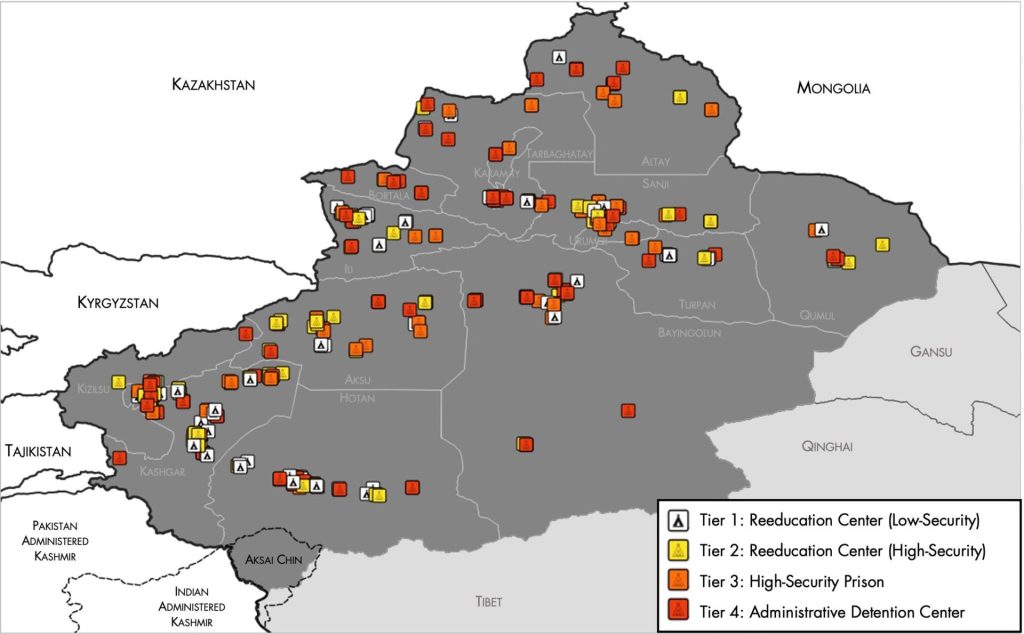
Satellite imagery and procurement records. Researchers and journalists used commercial satellite photographs to track construction. ASPI’s Xinjiang Data Project (September 2020), combining imagery, official tender documents and on-the-ground reporting, identified more than 380 suspected detention facilities, many with watchtowers, walls and internal segregation typical of prisons, and found construction continuing after officials claimed the program was winding down. An earlier 2018 analysis by the Jamestown Foundation of Xinjiang government procurement bids had likewise shown a surge in “re-education”-related construction contracts in 2016–2017.
Leaked documents. On 16 November 2019, The New York Times published the “Xinjiang Papers”: 403 pages of internal documents, including speeches by Xi Jinping and other leaders and directives on surveilling and detaining Uyghurs. The Times reported that the papers quoted Xi in 2014 demanding that the “organs of dictatorship” be wielded against terrorism with “absolutely no mercy”; they also included a scripted Q&A instructing cadres how to answer students returning home to find their parents gone, including telling them that their relatives’ release would depend on behavior — theirs and the students’ own. On 24 November 2019, the International Consortium of Investigative Journalists (ICIJ) and 17 media partners published the “China Cables,” centered on a 2017 classified telegram signed by Zhu Hailun, then Xinjiang’s political and legal affairs chief — the first known operations manual for the camps, ordering guards to “never allow escapes,” control all movement and run a points-based scoring system. Accompanying intelligence bulletins showed that in a single week in June 2017 the IJOP system flagged 24,412 “suspicious” people in southern Xinjiang, of whom 15,683 were sent to “education and training” and 706 were criminally detained. In May 2022, the “Xinjiang Police Files” — data hacked from police servers in Konasheher and Tekes counties and passed to researchers, then published by the BBC and a media consortium — contained 5,074 photographs taken between January and July 2018; analysts identified at least 2,884 of those pictured as detainees, aged 15 to 73. The files also showed that guards were instructed to shoot escapees dead if they ignored warning shots, and included internal speeches demanding that officials round up “everyone who should be rounded up.”
Testimony. Kazakh citizens such as Sayragul Sauytbay and Kairat Samarkand described the camps to foreign media and rights groups from 2018 onward, and exiled Uyghurs built networks to search for missing relatives. The OHCHR assessment itself rested on documentary review and interviews with 26 former detainees.
The Chinese government’s position
Beijing’s line shifted over time. At the August 2018 CERD hearing, China’s delegation denied that “re-education camps” existed. In October 2018, Shohrat Zakir gave the first official description of the centers to Xinhua News Agency, calling them schools teaching the national language, law and job skills to “de-extremify” trainees. The settled official position since has been that Xinjiang acted lawfully against terrorism and extremism; that the centers were schools, not prisons; that attendance was voluntary and rights were protected; that all trainees had graduated by late 2019; and that several years without a violent attack prove the policy worked. Allegations of torture, forced labor and forced sterilization are dismissed by the Foreign Ministry and other agencies as fabrications by anti-China forces — “lies of the century.” After the UN assessment appeared in 2022, China’s mission in Geneva declared it “illegal and null and void,” a product of manipulation by the United States and other Western countries, and attached a lengthy rebuttal by the Xinjiang regional government.
International reaction, determinations and legislation
Characterizations. On 19 January 2021, US Secretary of State Mike Pompeo determined that China was committing genocide and crimes against humanity against the Uyghurs; his successor Antony Blinken said he concurred. Legislatures followed with mostly non-binding motions: Canada’s House of Commons (February 2021), the Dutch parliament (February 2021), the British House of Commons (April 2021), Lithuania’s Seimas (May 2021) and France’s National Assembly (January 2022) all declared that a genocide was taking place. In December 2021, the independent Uyghur Tribunal in London concluded that China had committed genocide through birth-prevention measures, as well as crimes against humanity and torture. Human Rights Watch (April 2021) and Amnesty International (June 2021) concluded that the abuses amounted to crimes against humanity, without using the term genocide. On 31 August 2022 — the final day of High Commissioner Michelle Bachelet’s term — the OHCHR released its assessment, finding serious human rights violations and concluding that the extent of arbitrary and discriminatory detention “may constitute international crimes, in particular crimes against humanity,” and recommending that China release all those arbitrarily detained. Yet on 6 October 2022 the UN Human Rights Council voted 19 to 17, with 11 abstentions, to reject a draft decision merely proposing a debate on the situation — a rare instance in which the Council declined even to discuss a documented situation.
Sanctions and trade law. In October 2019 the United States placed 28 Chinese entities, including Hikvision and Dahua, on its export-control Entity List and imposed visa restrictions on officials. In June 2020 the Uyghur Human Rights Policy Act became law, and in July 2020 the US sanctioned Chen Quanguo, other Xinjiang officials and the Xinjiang Production and Construction Corps under the Global Magnitsky Act. On 22 March 2021 the EU, United Kingdom, Canada and United States acted in coordination; the EU’s sanctions on four Chinese officials and one entity were its first against China since 1989, and Beijing retaliated with counter-sanctions on European lawmakers, scholars and institutions. On 23 December 2021 the Uyghur Forced Labor Prevention Act was signed into US law; from 21 June 2022 it has applied a rebuttable presumption that all goods made wholly or in part in Xinjiang are produced with forced labor and barred from entry, unless importers can rebut the presumption with “clear and convincing evidence.” The European Union adopted its own Forced Labour Regulation in 2024, banning products made with forced labor from the EU market, with application from 2027.
Subsequent developments
Officially, the centers are closed. But rights organizations and researchers tracking Xinjiang conclude that the repression did not end; it shifted into the formal prison system, labor-transfer programs and pervasive surveillance. Detainees’ relatives abroad continue to seek word of the missing, while foreign governments and companies dispute how far supply-chain due diligence must go. The OHCHR’s 2022 recommendations — release of the arbitrarily detained, access for independent investigators — remain unimplemented, and despite repeated calls by UN experts, the Human Rights Council has taken no follow-up action. Marking three years since the assessment, Amnesty International reported in 2025 that arbitrary detention, family separation and intimidation of victims’ families in Xinjiang continue. Absent independent access, the competing figures and characterizations set out above are likely to remain unverifiable on the ground for the foreseeable future.
Sources
- UN Office of the High Commissioner for Human Rights, “Assessment of Human Rights Concerns in the Xinjiang Uyghur Autonomous Region, People’s Republic of China” (31 August 2022)
- UN Committee on the Elimination of Racial Discrimination, 96th-session review of China (August 2018)
- English Wikipedia, “Xinjiang internment camps,” “Persecution of Uyghurs in China,” “China Cables,” “Xinjiang Police Files” (consulted 2026)
- The New York Times, “The Xinjiang Papers” (16 November 2019); International Consortium of Investigative Journalists, “China Cables” (24 November 2019)
- BBC and media consortium, “Xinjiang Police Files” (24 May 2022)
- Australian Strategic Policy Institute, “Uyghurs for Sale” (March 2020) and Xinjiang Data Project (September 2020)
- Human Rights Watch, “Eradicating Ideological Viruses” (September 2018), “‘Break Their Lineage, Break Their Roots'” (April 2021), and 2025 assessments; Amnesty International, “‘Like We Were Enemies in a War'” (June 2021)
- Chinese Human Rights Defenders, 2018 report; Adrian Zenz, studies of 2018–2020
- Associated Press, investigation into birth rates and forced sterilization in Xinjiang (June 2020)
- Government of China: White Paper, “Vocational Education and Training in Xinjiang” (August 2019); White Paper on Xinjiang’s population development (2021); response to the OHCHR assessment and Permanent Mission in Geneva, “All the Lies on Xinjiang: How Have They Come About?” (2021)
- Cover image: Wikimedia Commons (see file page for license)