Introduction
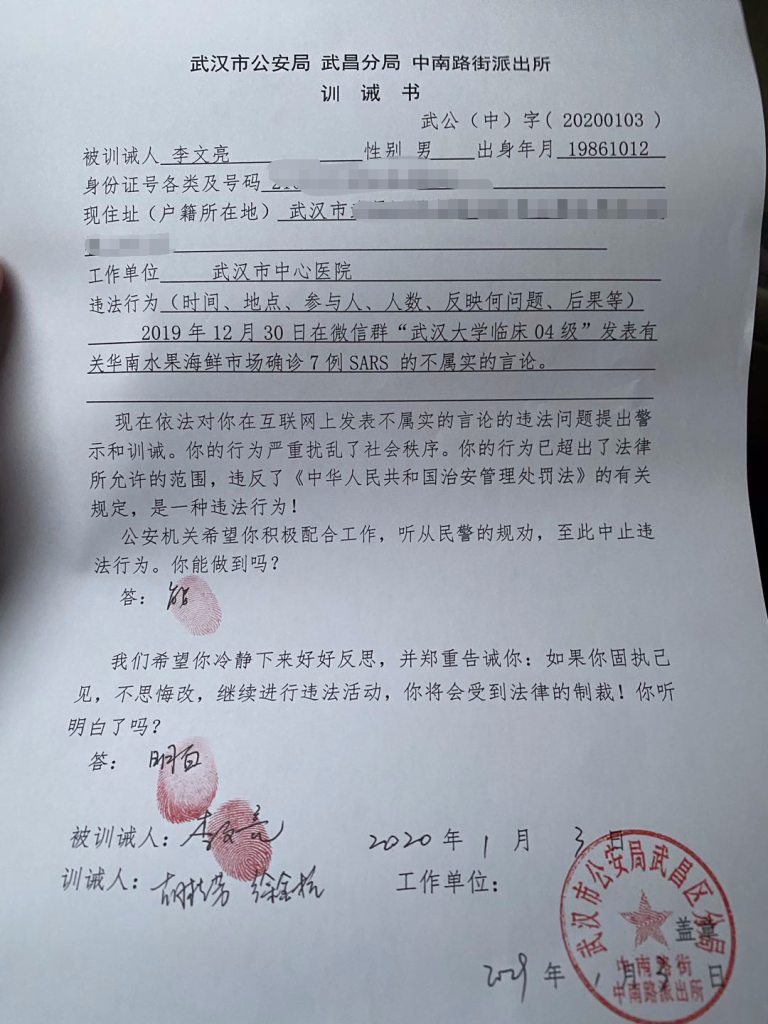
Li Wenliang was an ophthalmologist at Wuhan Central Hospital. On 30 December 2019, in a WeChat group of his university classmates, he warned fellow doctors that a SARS-like coronavirus had appeared at the Huanan Seafood Market. Four days later, officers at his local police station made him sign a letter of admonition stating that he had “published untrue statements on the internet” and “severely disrupted social order.” Just over a month later, in the early hours of 7 February 2020, he died of the very disease he had warned about. His death ignited the Chinese internet overnight and became the defining symbol of the information controls of the pandemic’s early phase. Six weeks later, an investigation by China’s National Supervisory Commission concluded that the admonition had been improper; Wuhan police revoked the letter and apologised to his family, and Li was posthumously named a martyr.
Even his birth year is recorded inconsistently: the admonition letter and many Chinese media give 12 October 1986, making him 33 at his death, while the English Wikipedia, the BBC and the United States Senate’s memorial resolution give 12 October 1985, making him 34. This article sets out both versions without adjudicating between them.
Background: The Early Outbreak in Wuhan
In December 2019, hospitals across Wuhan began admitting patients with pneumonia of unknown cause, many of them linked to the Huanan Seafood Wholesale Market. On 26 December, Dr Zhang Jixian of the Hubei Provincial Hospital of Integrated Chinese and Western Medicine identified an unusual cluster and reported it to her hospital and the disease-control authorities the next day; she was later hailed as the first doctor to report the outbreak through official channels. Around the same time, commercial sequencing laboratories had already detected a SARS-like coronavirus in patient samples (according to Caixin and other Chinese media). On 30 December, the Wuhan Municipal Health Commission circulated two internal emergency notices on the treatment of the unexplained pneumonia within the health system (according to the National Supervisory Commission’s investigation report).
The picture given to the public was very different. On 31 December, the Wuhan health commission issued its first public notice: 27 cases of viral pneumonia had been found, but there was “no clear evidence of human-to-human transmission” and no infections among medical staff. Official figures then moved slowly: 59 cases were announced on 5 January 2020; after test kits were distributed, the confirmed count was revised down to 41 on 11 January. During the provincial and municipal “two sessions” meetings of 11–17 January, Wuhan reported no new cases for days on end; on 14 January the city health commission was still saying there was “no clear evidence of human-to-human transmission,” though limited transmission could not be ruled out. Retrospective research later traced the earliest known case’s symptom onset to 1 December 2019 (a case study published in The Lancet in January 2020); the early official account said 8 December. Only on the evening of 20 January did Zhong Nanshan, China’s best-known respiratory specialist, confirm on state television that the virus was “certainly transmissible between people” and that medical workers had been infected. At 10 a.m. on 23 January, Wuhan was locked down. On 27 January, Wuhan’s mayor Zhou Xianwang admitted in a CCTV interview that the earlier disclosure of epidemic information had been “not timely.” It was in the gap between tightly controlled official information and clinicians’ private alarm that Li Wenliang sent his warning.
What Happened
30 December 2019: the warning. That afternoon, Ai Fen, director of the emergency department at Wuhan Central Hospital, received a laboratory report bearing the words “SARS coronavirus.” She circled the words in red, photographed the report and sent it to a former classmate; by that evening it had spread through Wuhan’s medical circles (according to Ai’s account in Renwu [Portrait] magazine). At around 5:30 p.m., Li received the material from a colleague. At 5:43 p.m., in a WeChat group of some 150 Wuhan University medical classmates, he wrote: “Seven cases of SARS have been confirmed at the Huanan fruit and seafood market,” attaching the test report and a patient’s lung CT images. At 6:42 p.m. he added: “The latest news is that coronavirus infection has been confirmed and the virus is being subtyped,” and “Don’t spread this around — let your families take precautions.” Screenshots soon escaped the group.
31 December, in the small hours: summoned. At 1:30 a.m., hospital managers took Li to the Wuhan Municipal Health Commission to be questioned; after he reported for work at daybreak, the hospital’s supervision office interviewed him again and made him write a statement of “reflection” (according to the National Supervisory Commission, he wrote a document titled “Reflection and Self-Criticism on the Spreading of Untrue Information”). The head of his department later comforted him and told him not to carry a psychological burden; the hospital ultimately imposed no sanction on him.
3 January 2020: the admonition letter. At about 1:30 p.m., accompanied by a colleague, Li walked into the Zhongnan Road police station of the Wuchang district Public Security Bureau. Officers questioned him, took a record, and issued a letter of admonition on the spot: he had “published untrue statements on the internet,” the content had “severely disrupted social order,” and if he continued such “illegal activity” he would face legal punishment. In the letter’s question-and-answer section Li wrote “I understand,” then signed and pressed his thumbprint. The letter was signed by officers Hu Guifang and Xu Jinhang; its full text is preserved on Wikisource.
8–12 January: infection and hospitalisation. On 8 January, Li treated an 82-year-old patient with acute angle-closure glaucoma. The patient, a stallholder at the Huanan market, developed a fever and pneumonia symptoms the next day. On 10 January Li himself developed a cough and fever; he first checked into a hotel alone to avoid infecting his family. On 12 January he was admitted to an isolation ward in the respiratory and critical-care unit of his own hospital’s Houhu campus. Repeated nucleic-acid tests came back negative until one finally returned positive on 30 January; on 1 February his diagnosis was confirmed and announced on his Weibo account. His parents and several colleagues were also infected; his parents later recovered and were discharged.
31 January: he goes public. From his hospital bed, Li told journalists how he had been summoned and admonished, and posted a photograph of the admonition letter on Weibo. In a text interview with Caixin he said: “I think there should be more than one voice in a healthy society, and I don’t approve of using public power for excessive interference.” He added that he had feared the hospital might punish him for “spreading rumours,” and had felt relieved only after the Supreme People’s Court spoke up; once he recovered, he intended to return to the front line (according to Caixin’s interview, published on 7 February).
The Admonition and the Control of Speech
Li was not the only early warner the authorities came for. On 1 January, the Wuhan police announced on their official Weibo account that eight “law-breakers” had been summoned and dealt with for posting and forwarding untrue information; on 2 January, CCTV News reported that “eight rumour-mongers have been dealt with according to law,” and the label stuck. Whether Li was actually one of those eight is disputed: he signed his admonition only on 3 January, and outlets including Shangyou News and Caixin noted that he may not have been among the eight summoned on 1 January — Li himself said he did not know whether he counted as one of them. Most reports, including Xinhua and The Beijing News, simply listed him as one of the eight. Both versions are presented here.
Other early warners known to have been summoned or interviewed include Xie Linka, an oncologist at Wuhan Union Hospital who warned a doctors’ group on the evening of 30 December to “stay away from Huanan (market) for now” and was spoken to by police in early January; and Liu Wen, a neurologist at Wuhan Red Cross Hospital who warned colleagues in a group chat and was interviewed by his hospital and the police in early January (according to multiple media reports). Ai Fen, the source of the original report, was summoned by her hospital’s disciplinary office and subjected to what she called an “unprecedented, extremely severe reprimand,” accused of “spreading rumours as a professional.” She later told Renwu: she was not the whistleblower — she was “the one who handed out the whistle.” When the magazine published her account on 10 March 2020, it was deleted within hours; netizens relayed it in emojis, Braille, Morse code, vertical traditional characters and other forms — one of the most famous episodes in China’s censorship wars.
The controls extended to protective equipment itself. According to multiple media reports, in January 2020 Wuhan Central Hospital allowed only emergency, respiratory and intensive-care staff to wear N95 masks; ophthalmology and other departments were barred from masking on duty. Two deputy directors of Li’s own department, Mei Zhongming and Zhu Heping, were later infected and died (March 2020).
A belated signal of correction came on 28 January, when the Supreme People’s Court’s official social-media account published an article by a judge addressing the eight people dealt with by Wuhan police. What they had posted, the article argued, was “not entirely fabricated,” adding: “If the public had believed this ‘rumour’ at the time and, out of fear of SARS, had worn masks, disinfected rigorously and avoided wildlife markets, that might have been a fortunate thing for our efforts to control the new pneumonia today.” Enforcement, it said, should be tolerant of information that is substantially true and posted without malice.
Death and the Public Outpouring
Li’s condition deteriorated from 5 February. On 6 February he told a friend by phone that his blood oxygen saturation had fallen to 85 percent.
The night of 6–7 February: a death announced, retracted, and announced again. According to the National Supervisory Commission’s report: at 6:55 p.m. on 6 February, Li was transferred to the intensive-care unit at the Houhu campus; from 7:20 p.m., as he became confused and his heart rate and blood pressure fell, doctors intubated him, placed him on a ventilator and performed continuous chest compressions; at about 9:30 p.m. a mechanical CPR device was applied; at about 10:40 p.m., ECMO (extracorporeal membrane oxygenation) was started, using a machine borrowed from Wuhan Asia Heart Hospital; at about 11 p.m., specialists sent from Beijing joined the effort; and at 2:58 a.m. on 7 February his ECG flatlined and he was declared clinically dead.
The public record of that night, however, flipped several times. At around 9:30 p.m., word spread that his heart had stopped, and outlets including China Newsweek reported that it had stopped at that hour. At 10:40 p.m., the People’s Daily-affiliated Life Times announced that he had died at 9:30 p.m. — a report that was then deleted or altered. The hospital insisted he was still being rescued, posting on its official Weibo at 12:38 a.m. that he was “in critical condition and being rescued with all-out effort.” Only at 3:48 a.m. did the hospital formally announce that he had “died at 2:58 a.m. on 7 February 2020 despite all-out rescue efforts.”
The two accounts coexist to this day. The hospital and the National Supervisory Commission maintain that resuscitation continued until 2:58 a.m. But The New York Times, in a 2022 investigation based on first-hand medical records provided by a doctor who was present, reported that an echocardiogram at about 9:10 p.m. already showed his heart had stopped, and that the doctor believed death could have been declared then under normal procedure; hospital leadership, he said, wanted ECMO used to show the rescue had been exhaustive. At the time, many members of the public suspected the announcement was delayed because officials were unprepared for the reaction. No independent inquiry has adjudicated the dispute.
That night, tens of millions of people stayed by their phones; one livestream page following his status drew more than 17 million viewers (according to Caixin and other media). Once the death was confirmed, grief and anger erupted together. The hashtag “#WeDemandFreedomOfSpeech#” briefly topped Weibo’s trending list and drew about two million views before being deleted (according to a scholarly article); many users reposted the text of Article 35 of the Chinese Constitution, which promises freedom of speech. On 7 February, Wuhan residents laid flowers outside the hospital’s Houhu campus; that evening, Hong Kong’s Alliance in Support of Patriotic Democratic Movements held a candlelight vigil for him in Central, and overseas Chinese communities held memorials in several cities. On 8 February, legal scholars Zhang Qianfan and Xu Zhangrun and others signed an open letter to the National People’s Congress Standing Committee demanding that constitutionally guaranteed free speech be honoured; some signatories were later summoned by police and pressed to withdraw their signatures.
The World Health Organization posted a tribute on social media on 7 February, saying “we all need to celebrate work that he did” on the virus; the National Health Commission, the Hubei provincial health commission and the Wuhan city government issued condolences the same day, and Wuhan’s human-resources bureau recognised his death as a work-related injury that day.
The Official Investigation and His Rehabilitation
At noon on 7 February, the National Supervisory Commission announced that, with central approval, it was sending an investigation team to Wuhan to look into the issues concerning Li; the team arrived the next day. After more than forty days, on the evening of 19 March, the team published its findings: the admonition letter issued by the Zhongnan Road police station had been “improper in handling, wrong in its application of law, and irregular in procedure.” The team said it had advised Wuhan’s supervisory organs to supervise a correction, and had urged the police to revoke the letter and hold those responsible to account. It also affirmed that Li had posted the information out of a wish to alert his classmates and colleagues, and that it had “objectively served to promote attention to the epidemic and strengthen prevention and control.”
At about 8 p.m. that evening, the Wuhan Public Security Bureau announced that it was revoking the admonition letter and offered a “solemn apology” to Li’s family for the error; responsible personnel were disciplined — according to multiple media reports of the bureau’s notice, the station’s deputy chief Yang Li received an administrative demerit and the case officer Hu Guifang an administrative warning. The same day, Xinhua published a question-and-answer with the investigation team that accused “hostile forces” of using Li to “incite confrontation with the Party and the government.” Many internet users judged the punishment of two local officers grossly insufficient and noted that no decision-making level above them had been held responsible (according to multiple media reports).
Official honours then arrived in quick succession. On 4 March, the National Health Commission and two other agencies decided to name Li and 33 other medical workers who had died in the epidemic “National Advanced Individuals in COVID-19 Prevention and Control in the Health System” (the list was published on 5 March). On 2 April, the Hubei provincial government named Li and 13 others the province’s first group of martyrs. On 4 April — Qingming, the traditional day of mourning — the State Council proclaimed a national day of mourning: flags flew at half-mast, and at 10 a.m. the whole country observed three minutes of silence, with the Party and state leadership in attendance in Beijing. On 20 April, Li was posthumously awarded the 34th China Youth May Fourth Medal. In May 2020, when the national “two sessions” convened, the opening meetings of the Chinese People’s Political Consultative Conference (21 May) and the National People’s Congress (22 May) began with all participants standing for a minute of silence for the martyrs and compatriots who had died in the epidemic.
Impact and Aftermath
The “wailing wall.” Li’s final Weibo post, published on 1 February, became a rare public space of remembrance on the Chinese internet: people left comments reporting that they were safe, apologising, unburdening themselves, as if writing on a wall. By the evening of 3 April 2020 the post had accumulated more than 830,000 comments; by 19 June, they passed one million, and Hong Kong’s Initium Media called it “China’s wailing wall.” Users later noticed that comments could no longer be sorted by popularity, making the earliest messages nearly impossible to find again.
International commemoration. On 11 February, US senators Tom Cotton, Bob Menendez, Ed Markey and Cory Gardner — Republicans and Democrats together — introduced a resolution commemorating Li’s life; the Senate passed it on 3 March, honouring him and calling on the Chinese government to increase transparency about the epidemic. American lawmakers later introduced sanctions legislation bearing his name (the Li Wenliang Global Public Health Accountability Act) and a proposal to rename the street outside the Chinese embassy in Washington “Li Wenliang Plaza.” On 30 May 2020, Li’s widow Fu Xuejie issued a statement opposing such moves: Li, she said, was a Communist Party member who deeply loved his country, and “if he could know, he would never allow anyone to use his name to harm his country.”
In another direction, Taiwan’s epidemic response was directly triggered by him: in the small hours of 31 December 2019, Lo Yi-chun, deputy director-general of Taiwan’s Centers for Disease Control, saw screenshots of Li’s warning on an online forum and judged them credible; Taiwan began onboard screening of direct flights from Wuhan that same day. On 16 April 2020, Lo publicly thanked Li at a press conference.
Institutional echoes. On 25 September 2020, Beijing’s municipal legislature adopted the Beijing Regulation on Emergency Response to Public Health Emergencies, which expressly gives any organisation or individual the right to report public-health hazards to the government — a clause netizens dubbed the “Li Wenliang clause.” A similar Shenzhen regulation took effect on 1 October. In October 2020, the National Health Commission published a draft revision of the Law on the Prevention and Treatment of Infectious Diseases adding protections and rewards for people who report outbreaks, widely dubbed the “Li Wenliang law.”
The contest over memory continues. The national commendation conference for the fight against COVID-19 on 8 September 2020 made no mention of Li, and CCTV’s documentary series United in Fighting the Epidemic, aired the same month, did not mention him in recounting the outbreak’s origins — omissions that drew online criticism, with some bereaved families accusing the authorities of rewriting history (according to reports compiled by Wikipedia). China’s embassy in France, for its part, published articles arguing that calling him a “whistleblower” was a “political label,” stressing that he was a Party member. Ai Fen, who had first “handed out the whistle,” suffered severe loss of vision in her right eye after treatment for a retinal detachment in late 2020 and was for a time unable to work (according to Radio Free Asia, 2021). And Zhong Nanshan, in a Reuters interview on 11 February 2020, wept as he spoke of Li: “I think the majority of the people think he is a hero of China. I’m really proud of him — he told people the truth in late December.”
A warning sent by an eye doctor to a classmates’ chat group became a footnote to an era: the virus that killed him was the one he had warned about, and the letter of admonition he was made to sign remains one of the most cited documents in any discussion of information control and speech in China.
Sources
- Chinese Wikipedia, “Li Wenliang” and “Enforcement controversies in the Hubei COVID-19 outbreak”; English Wikipedia, “Li Wenliang”
- National Supervisory Commission investigation team, Report on the Investigation into Issues Concerning Dr Li Wenliang Raised by the Public (19 March 2020, released via Xinhua), with the accompanying Q&A
- Wuhan Public Security Bureau notice of 19 March 2020 (revocation of the admonition, apology, and personnel measures), as reported by multiple media outlets
- Caixin Media, “COVID-19 ‘Whistleblower’ Li Wenliang: The Truth Matters Most” (7 February 2020); Caixin reports of 31 January–1 February 2020 on Li’s admonition and diagnosis
- Renwu (Portrait) magazine, “The Woman Who Handed Out the Whistle” (10 March 2020), Ai Fen’s oral account
- Supreme People’s Court official social-media article of 28 January 2020 on the Wuhan “eight rumour-mongers” case
- Life Times, evening of 6 February 2020 (report of Li’s death, later deleted/altered); Wuhan Central Hospital official Weibo posts of 12:38 a.m. and 3:48 a.m., 7 February 2020
- The New York Times, October 2022 investigation into Li’s final medical records and resuscitation
- Reuters interview with Zhong Nanshan, 11 February 2020; BBC and Associated Press reports, February–March 2020
- US Senate resolution commemorating the life of Dr Li Wenliang (introduced 11 February 2020, passed 3 March 2020) and sponsoring senators’ statements
- Citizen Lab, University of Toronto, research on WeChat’s blocking of “Li Wenliang”-related keyword combinations (2020)
- Journal of Bioethical Inquiry article recording the #WeDemandFreedomOfSpeech# hashtag’s roughly two million views before deletion
- Wikisource: full text and English translation of the Zhongnan Road police station’s letter of admonition
- Cover image: Wikimedia Commons (see file page for license)