Introduction
Li Wangyang was a factory worker from Shaoyang, Hunan, and chairman of the Shaoyang Workers’ Autonomous Federation in 1989. Imprisoned twice for his role in that year’s movement, he spent about 21 years behind bars — longer than almost any other participant in the 1989 pro-democracy movement — and the years of imprisonment and abuse left him blind in both eyes, deaf, and barely able to walk. One year after his release, in the early hours of 6 June 2012, he was found dead in his room at Daxiang District People’s Hospital in Shaoyang: a strip of white cloth was tied around his neck and fastened to a window bar, yet his feet were on the floor. Just four days earlier, Hong Kong’s i-Cable television had broadcast an interview in which the frail 61-year-old said he would keep demanding vindication of the June 4 movement “even if I were beheaded.” Shaoyang authorities declared that he had hanged himself; his family, and public opinion in Hong Kong and abroad, strongly disputed that account, and tens of thousands marched in Hong Kong to demand a full investigation. A Hunan provincial police investigation upheld the suicide finding, but no independent inquiry has ever been conducted, and there is still no agreed answer to how Li Wangyang died.
Who Li Wangyang Was
Li Wangyang was born on 12 November 1950 in Shaoyang, Hunan. From 1966 to 1988 he worked in ceramics, glass and cement factories in the city. According to the Chinese Wikipedia, inspired by Beijing’s Democracy Wall, he founded a Workers’ Mutual Aid Association in Shaoyang in 1983 and published a paper, the Zijiang Minbao — making him one of mainland China’s earliest independent labour organisers. When the 1989 pro-democracy movement erupted, he became chairman of the Shaoyang Workers’ Autonomous Federation and mobilised workers in support of the students.
Two Prison Terms
The first term (1989–2000). According to the English Wikipedia, after news of the Beijing crackdown reached Shaoyang, Li pasted a big-character poster on a traffic sign in the city’s People’s Square on 4 June 1989 calling on all workers to strike immediately in support of Beijing; on 6 June he organised a memorial attended by thousands for those killed. He was arrested on 9 June and prosecuted for “counterrevolutionary propaganda and incitement.” The Chinese Wikipedia records that he was first sentenced to ten years, but that the term was raised to thirteen after he appealed. He served in Longxi Prison and Yuanjiang Prison in Hunan and on the Yueyang labour farm. He later told i-Cable that he had been locked more than twenty times in a punishment cell barely one metre wide, two metres long and 1.6 metres high, for one to three months at a time, and that during force-feeding after hunger strikes his teeth were knocked out. Li attributed his blindness to nerve damage from repeated beatings to the head; Human Rights in China (HRIC) likewise alleged that he was tortured in custody, losing his sight and hearing. Granted medical parole in June 1996, he was returned to prison in 1997 after Deng Xiaoping’s death, when authorities feared he would use his freedom to call for vindication of June 4. By 2000 he suffered from serious heart disease, hyperthyroidism and spinal disease, was blind in one eye — later in both — and nearly deaf; his sentence was reduced on health grounds and he was released on 8 June 2000.
The second term (2001–2011). After his release, Li demanded compensation from the prison authorities for the torture that had disabled him, backing the demand with hunger strikes. He was criminally detained again on 6 May 2001, and on 11 September 2001 the Shaoyang Intermediate People’s Court sentenced him to ten years for “inciting subversion of state power,” plus four years’ deprivation of political rights, with the term running to 5 May 2011. In total he spent about 21 years in prison — the English Wikipedia describes this as the longest imprisonment served by any activist of the 1989 movement, while the Chinese Wikipedia counts 22 years of imprisonment and related measures. Amnesty International designated him a prisoner of conscience.
When he completed his sentence on 5 May 2011, Li was completely deaf and unable to care for himself; he was carried home and then admitted to Daxiang District People’s Hospital for treatment of heart disease and diabetes. According to the English Wikipedia, his younger sister Li Wangling lived about seven kilometres from the hospital and brought him meals twice a day. The Chinese Wikipedia records that a bank account opened to receive donations for his medical care was frozen, that police obstruction prevented outside doctors from treating him, and that the city refused him a retirement pension on the grounds that his file could not be found, leaving him a subsistence allowance of 300 yuan a month.
The Interview and His Death
22 May 2012. With the help of friends, Li slipped away from surveillance and was interviewed by Lam Kin-sing, a reporter with Hong Kong i-Cable’s China desk. Blind and deaf, he communicated by having words traced on his palm. In the interview he urged Ding Zilin of the Tiananmen Mothers to persevere, and summed up his refusal to repent in a line that was widely quoted afterwards: for the country to enter a democratic society soon, “even if I were beheaded, I would not turn back.”
2 June. The interview was broadcast, drawing attention overseas. Hong Kong’s Apple Daily reported that state security police then stepped up surveillance, with a team of around ten officers watching him around the clock.
4 June. The Independent Federation of Chinese Students and Scholars in the United States presented Li with its Spirit of Freedom Award.
6 June, early hours. Li was found dead in his hospital room. The accounts diverge on the details. Shaoyang authorities said that patients sharing the ward had seen him “acting strangely” by the window at around 3 a.m.; that surveillance footage showed no one suspicious entering the ward that night apart from fellow patients and medical staff; that the door had not been forced; and that there were no injuries on his body other than to his neck (as reported by The Standard, citing the city authorities). According to Amnesty International, at about 6 a.m. the hospital telephoned his brother-in-law Zhao Baozhu; Zhao and Li Wangling reached the ward about an hour later and found Li standing by his bed, a white strip of cloth tied tightly around his neck and connected to a window bar above — with both feet still on the floor. Photographs released by the family also showed one of his hands resting on the window. The room was undisturbed and he left no note. Although the family had forbidden photography, stills and a video of the body circulated online.
6 June, about 10 a.m. According to Amnesty International, police removed the body from the hospital despite the family’s objections. The family never had access to it again.
7 June. Li Wangling and Zhao Baozhu were taken away by local authorities and held in a hotel, cut off from contact with the outside world, according to HRIC and multiple media reports.
8 June. An autopsy was performed. Shaoyang authorities said it was conducted by four pathologists from Sun Yat-sen University, videotaped in full, in the presence of local NPC and CPPCC members and media. The family said they had agreed to an autopsy only in the presence of a lawyer of their choosing, Tang Jingling, who was not there, and that they had never consented to the procedure.
9 June. The body was cremated at the Shaoyang funeral home. Whether the family consented is flatly disputed: city authorities maintained that the cremation was carried out at the family’s request and that the ashes were buried under the supervision of Li Wangling and her husband; the Information Centre for Human Rights and Democracy, a Hong Kong-based monitoring group, quoted funeral-parlour staff as implying that the government had ordered the cremation. When Ming Pao reporters finally located the couple in early September 2012, after weeks in which they had effectively disappeared, the two stated plainly that they had never consented to the autopsy, never consented to the cremation, and never accepted the suicide verdict.
The Dispute over the Cause of Death
The accounts of Li Wangyang’s death have never converged.
The official account: suicide. Shaoyang authorities announced immediately that Li had “hanged himself,” citing the surveillance footage, the unforced door and the absence of other injuries. Both the English Wikipedia and Radio Free Asia record that, after the autopsy, the city’s stated cause of death was at one point revised to “accidental death,” although in public statements the city continued to insist on suicide. Under pressure from Hong Kong public opinion, the Hunan Provincial Public Security Department conducted an investigation from 19 June to 9 July 2012 and published its report on 12 July, upholding the suicide finding. On 30 July, Hunan party secretary Zhou Qiang stated publicly that Li had “died by suicide, with conclusive evidence.” On 30 October 2012, in a formal reply to the UN Human Rights Council’s special procedures, the Chinese government again maintained that Li Wangyang had committed suicide by hanging.
The family’s account: suicide was impossible. Zhao Baozhu told the Associated Press that Li had seemed normal at dinner the night before; that through more than twenty years in prison and all his suffering he had never talked of killing himself; and that “he was always very strong.” The family pointed out that Li was blind, nearly deaf, that his hands shook so much he could barely hold a bowl, and that he needed help to walk — how could such a man find a strip of cloth, tie it to a window bar and hang himself unaided, let alone under round-the-clock surveillance by as many as ten police officers? Li’s friends and local activists concluded that he had been “suicided” — bei zisha, a bitter neologism that spread rapidly online — and formed a “Committee in quest of the truth about Li’s death.” Dissident Hu Jia and others launched an “I will not commit suicide” declaration campaign, urging frequently detained activists to notarise statements in advance that they had no intention of killing themselves.
Medical and legal doubts. Ten lawyers from the mainland and Hong Kong subsequently wrote to the Standing Committee of the National People’s Congress demanding a reinvestigation. As reported by Radio Free Asia, they argued that a man with almost no vision, in extremely frail health, could not have performed the “complicated movements” the official account required, that the autopsy conclusions were illogical, and that cremating the body in haste over the family’s objections violated China’s criminal procedure law. Hong Kong’s Ming Pao noted that the forensic pathologist assigned to Li’s autopsy was the same one who had pronounced that Xue Jingbo, who died in custody during the Wukan protests, had died of “cardiac failure” — and questioned the credibility of official autopsies on that basis. The Information Centre for Human Rights and Democracy raised a further possibility: that the security guards monitoring Li had tortured him to death and staged a suicide.
To this day, no independent body has published an investigation into the death. The body was cremated; the most important physical evidence no longer exists; and the competing accounts can never be tested against it — which is precisely why the dispute cannot be resolved.
Reactions in Hong Kong and Abroad
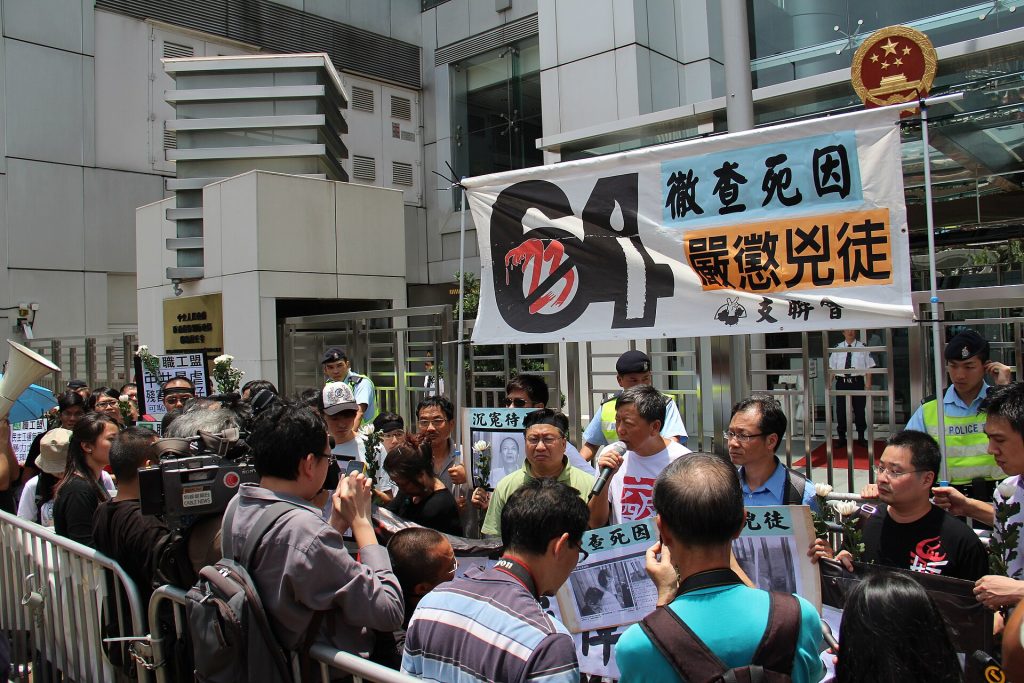
Hong Kong. The shock in Hong Kong was what propelled the case. On 7 June, groups were already protesting outside the central government’s Liaison Office. On 10 June, a large crowd marched to the Liaison Office to demand a full investigation: organisers put the turnout at 25,000, police at 5,400, and several outlets described it as the largest protest ever held at the Liaison Office’s main entrance. On 13 June — the seventh day after Li’s death, traditionally marked in Chinese mourning — about 1,500 people held a candlelight vigil outside the former Legislative Council building. A number of Hong Kong deputies to the National People’s Congress and CPPCC members, including pro-establishment figures such as Miriam Lau, Maria Tam and Michael Tien, took the unusual step of publicly urging Beijing to investigate. Health Secretary York Chow was the first minister to voice scepticism about the suicide claim; on 15 June outgoing Chief Executive Donald Tsang said he had doubts about the case and understood the public’s views; on 16 June Chief Executive-elect C. Y. Leung observed a minute’s silence for Li at a public function but maintained it would be inappropriate to comment on the death itself. Editorials in Hong Kong’s major newspapers almost uniformly called the death “suspicious” and demanded a transparent central investigation. The new editor-in-chief of the South China Morning Post, Wang Xiangwei, was accused by his own staff and by other journalists of cutting coverage of the death when it first broke, sparking a citywide controversy over press self-censorship. Commentators widely held that the outcry put pressure on Beijing because it came just before CCP General Secretary Hu Jintao’s visit to Hong Kong on 1 July for the fifteenth anniversary of the handover. In Macau, three pro-democracy legislators wrote to Premier Wen Jiabao and others accusing the Shaoyang police of “destroying the evidence” by cremating the body, and demanded an investigation.
Internationally. By the day after the news broke, more than 2,700 people, including the artist Ai Weiwei, had signed an online petition for an independent investigation, according to Reuters. Amnesty International issued a statement on 7 June urging the Chinese government to investigate the death thoroughly and to take seriously the family’s claims that it was not suicide; it later expressed scepticism about the Hunan autopsy investigation report, and reported that at least twenty dissidents in Hunan had been detained, harassed or intimidated in connection with Li’s death, five of them missing. On 11 July 2012, the UN Working Group on Arbitrary Detention and several special rapporteurs sent an urgent appeal to the Chinese government about the case; Beijing’s 30 October reply maintained the suicide conclusion. The Hong Kong Confederation of Trade Unions also launched a global online campaign through LabourStart.
Aftermath
Under the pressure, Li Gang, deputy director of the Liaison Office, announced in mid-June that the Hunan Provincial Public Security Department had ordered a criminal investigation into the death, with forensic experts from outside the province to take part; as noted above, that investigation still concluded suicide. After the report was published, Li Wangling and Zhao Baozhu remained unaccounted for until Ming Pao reporters found them in early September; the couple told the reporters that officials had privately urged them to “not bring up the past again.” The Ming Pao journalists were themselves detained by local police in their hotel for 44 hours during their reporting trip, drawing protests from Hong Kong’s press community.
Zhu Chengzhi, Li’s friend — who had visited him in hospital, helped arrange the i-Cable interview, and photographed the body at the scene — was detained by the Hunan provincial police in June 2012 after refusing to sign a pledge not to pursue the matter of Li’s death. His family received an arrest notice on 25 July stating that he was charged with “inciting subversion of state power.” According to the Rights Defense Network (Weiquanwang) monthly reports on prisoners of conscience, Zhu was later released, and no public trial or verdict in the case has been recorded.
Li’s ashes were buried in the Dashanling Cemetery in Shaoyang. Commemoration abroad has continued: on 6 June 2018 a six-metre-tall statue of Li Wangyang was unveiled at the Liberty Sculpture Park in Yermo, California, and on 27 May 2022 a bust of him was unveiled in Béziers, France. In his home city, his name — and the question of how he died — remain subjects that cannot be discussed in public.
Sources
- Wikipedia, “Death of Li Wangyang” (English) and 《李旺阳事件》 (Chinese)
- UN OHCHR special procedures communications database: reply of the Chinese government on the Li Wangyang case, 30 October 2012
- Amnesty International: statement of 7 June 2012; response to the Hunan autopsy investigation report; Urgent Action document ASA 17/015/2012
- Chinese Human Rights Defenders (CHRD), Li Wangyang prisoner profile; Human Rights in China (HRIC), Li Wangyang profile
- Radio Free Asia: reporting on the Hunan provincial investigation report (July 2012) and on the open letter by ten lawyers to the National People’s Congress demanding a reinvestigation
- Reuters; Associated Press reports (published by The Guardian); The New York Times; Los Angeles Times; BBC News — June 2012 reporting on the death and the Hong Kong reaction
- South China Morning Post; Ming Pao; The Standard; RTHK — June 2012 reporting on the Hong Kong march, vigil and official statements; Ming Pao’s September 2012 report locating Li Wangling and Zhao Baozhu
- Global Voices, “China: Dissident Prosecuted for Leaking ‘Staged Suicide’ Photo” (August 2012)
- Cover image: Wikimedia Commons (see file page for license)