Introduction
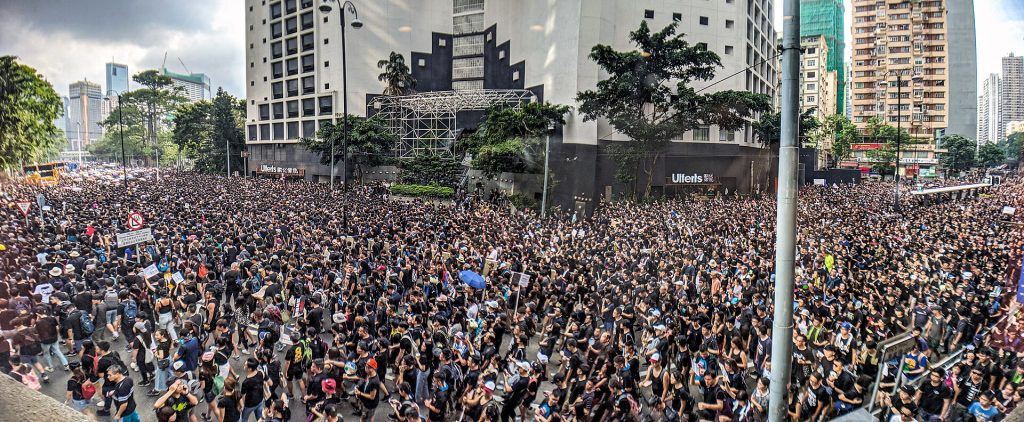
On 9 June 2019, more than a million Hong Kong people took to the streets to oppose the government’s proposed amendments to the Fugitive Offenders Ordinance. The organiser, the Civil Human Rights Front (CHRF), put the turnout at 1.03 million; police said 240,000 at the peak. A week later the record was broken again: the CHRF said “almost two million plus one” people marched, while police put the peak at 338,000. For a city of 7.5 million, such a share of the population marching at once is almost unheard of in peacetime.
What began as opposition to a single extradition bill lasted more than half a year and became the gravest political crisis since Hong Kong’s return to China. Clashes escalated week by week; police fired some 16,000 rounds of tear gas over six months (police figures) and arrested more than 10,000 people. The protesters’ “five demands, not one less” grew from withdrawal of the bill to police accountability and universal suffrage. The bill was eventually withdrawn, but the other demands were never met. In June 2020 Beijing imposed a national security law on Hong Kong directly, and the city’s political and civic landscape was transformed.
Background and Causes
The immediate trigger was a murder case. In February 2018, Hong Kong man Chan Tong-kai murdered his girlfriend Poon Hiu-wing in Taiwan and fled home; because Hong Kong had no surrender arrangement with Taiwan, he could not be sent there for trial. In February 2019 the Security Bureau proposed amending the Fugitive Offenders Ordinance and the Mutual Legal Assistance in Criminal Matters Ordinance so that the Chief Executive could approve case-by-case surrender of fugitives to any jurisdiction without a standing treaty — including mainland China.
The proposal provoked a fierce backlash. The legal profession warned that mainland China’s judicial system, with its record on fair trials and human rights, made the amendments a breach of the legal “firewall” between the two systems: anyone physically in Hong Kong, including travellers in transit, could potentially be handed over to the mainland. The Bar Association, business groups and foreign governments voiced concern, and even some pro-establishment business figures feared exposure to mainland legal risks. The CHRF’s first march on 31 March drew 12,000 by organisers’ count (police: 5,200 at peak); a second march on 28 April drew 130,000 by organisers’ count (police: 23,600). The government refused to back down, bypassed the usual bills-committee scrutiny, and scheduled the second reading for 12 June.
The deeper background was accumulated frustration: the failure of the 2014 Umbrella Movement to win genuine universal suffrage; the 2015 disappearances of Causeway Bay Books staff; a sense that the promises of “one country, two systems” were steadily eroding; and social grievances such as unaffordable housing and inequality. Many young protesters concluded that peaceful marching had been proven futile — a conclusion seemingly confirmed when the government responded to the million-strong march of 9 June by simply restating that the second reading would proceed.
What Happened
9–12 June: from a million marchers to the word “riot.” The 9 June march was peaceful; that evening the government said the second reading would go ahead as scheduled. On 12 June crowds surrounded the Legislative Council (LegCo) complex, the debate was postponed, and in the afternoon police cleared the area with tear gas, bean-bag rounds, rubber bullets and pepper spray. Police Commissioner Stephen Lo Wai-chung later said officers had fired about 150 rounds of tear gas, 20 bean-bag rounds and several rubber bullets that day; the Hospital Authority counted 72 people injured, including 22 police officers. That evening Chief Executive Carrie Lam described the day’s events as an “open and organised riot.” On 17 June, Lo clarified that he had not called the entire protest a riot and that only five arrestees faced rioting charges.
15–16 June: suspension, a death, and two million in the streets. On 15 June Lam announced the bill was “suspended” but refused to “withdraw” it. The same day, 35-year-old Marco Leung Ling-kit, wearing a yellow raincoat inscribed with protest slogans, fell to his death from scaffolding at Pacific Place in Admiralty — the first widely known death of the movement; crowds queued to lay flowers. On 16 June the CHRF marched again and claimed “almost two million plus one” — the “plus one” honouring Leung — while police put the peak at 338,000. On 18 June Lam apologised publicly but refused to resign.
The five demands were: (1) complete withdrawal of the extradition bill; (2) retraction of the “riot” characterisation of 12 June; (3) release of arrested protesters and dropping of their charges; (4) an independent commission of inquiry into police conduct; and (5) universal suffrage for the elections of both the Chief Executive and the Legislative Council — “five demands, not one less.” The movement was notably leaderless: with no recognised leaders, mobilisation ran through the LIHKG forum and Telegram, and the tactic of “be water” — fluid, hard to encircle, borrowed from Bruce Lee — shaped its street strategy.
1 July: the storming of LegCo. On the evening of the handover anniversary, hundreds of protesters broke into the Legislative Council building, vandalised facilities, defaced Hong Kong’s emblem and read a manifesto in the chamber before police cleared the area after midnight. Court proceedings later heard that repairs cost about HK$36 million. In February 2024 a court convicted four defendants, including actor Gregory Wong, of rioting over the break-in.
21 July: the Yuen Long attack. That night, more than a hundred men in white shirts, armed with wooden sticks and rattan canes, attacked residents, journalists and returning protesters in and around Yuen Long MTR station, indiscriminately beating people including passengers on a train. At least 45 people were hospitalised (Hospital Authority figures). Police were heavily criticised for arriving late, making no arrests on the spot, and being filmed walking alongside white-shirted men; allegations of police–triad collusion were widely voiced. Police denied collusion, saying resources were stretched by protests elsewhere. The attack was a turning point that shattered public trust in the police. In July 2021, the first seven white-shirted attackers were convicted of rioting and wounding offences and jailed for three and a half to seven years (Reuters, Associated Press). In a bitter twist, pro-democracy lawmaker Lam Cheuk-ting, who had been injured in the station that night, was himself convicted of rioting in December 2024 and sentenced in February 2025 to three years and one month — a verdict critics called the turning of a victim into a defendant.
Late July to August: confrontation becomes routine. On 28 July, fierce clashes in Sheung Wan ended with 44 people charged with rioting — the movement’s first mass rioting prosecutions. On 5 August a citywide general strike and rallies saw police fire around 800 tear gas rounds and arrest 148 people in a single day (police figures). On 11 August, a volunteer first-aider in Tsim Sha Tsui was reportedly hit in the eye by a bean-bag round, sparking days of sit-ins at the airport and mass flight cancellations. On 18 August the CHRF held a rally that flowed through Victoria Park; organisers claimed 1.7 million participants, police said 128,000 were in the park area at the peak; the day passed peacefully.
31 August: the Prince Edward station incident. On the fifth anniversary of Beijing’s restrictive electoral framework decision, police banned the CHRF’s march; large crowds defied the ban. Late that night, riot police and Special Tactical Squad officers stormed Prince Edward MTR station, striking and pepper-spraying people on the platform and inside a train, and arrested 63 people; several were injured. Rumours that people had died inside the station spread widely online. The MTR, the Fire Services Department, the Hospital Authority and police repeatedly denied any deaths, and no evidence of a death in the station has ever emerged; but the MTR long refused to release the full CCTV footage of that night, publishing only stills and a timeline — fuelling lasting suspicion, and turning the station exit into a site of monthly flower offerings.
September–October: withdrawal and the mask ban. On 4 September Lam announced the bill’s formal withdrawal, along with three other measures, but still refused an independent inquiry. The withdrawal was completed in LegCo on 23 October. Two contested deaths shadowed this period: the body of 15-year-old Chan Yin-lam was found floating in the sea on 22 September; police said there were no suspicious circumstances, but a coroner’s inquest in 2020 returned an open verdict. On 1 October, National Day, amid citywide clashes, an 18-year-old student, Tsang Chi-kin, was shot in the chest at close range by a police officer in Tsuen Wan; he survived — the first protester hit by a live round. On 4 October the government invoked the Emergency Regulations Ordinance, unused since 1967, to enact an anti-mask law effective the next day, triggering a fresh wave of unrest.
November: the campus battles and the ballot box. In the early hours of 4 November, Hong Kong University of Science and Technology student Chow Tsz-lok, 22, fell from a height in a Tseung Kwan O car park while police were dispersing crowds nearby; he died on 8 November, and a coroner’s inquest later returned an open verdict. On 11 November a traffic officer shot a 21-year-old unarmed protester in Sai Wan Ho — the young man survived — while in Kwai Chung another officer rode a police motorcycle into a crowd; footage of both incidents spread worldwide. On 12 November the Chinese University of Hong Kong became a battlefield: police fired more than 2,300 rounds of tear gas on campus in a single day (media tallies) and hundreds were hurt. From 17 November police besieged the Hong Kong Polytechnic University, where protesters fought back with petrol bombs, bows and catapults while water cannon and tear gas were used outside; the standoff ended on 29 November when police withdrew. About 1,300 people were arrested in and around the campus, and about 300 injured people were taken to hospital (police and media figures); on 18 November more than 200 people were arrested in nearby Yau Ma Tei as crowds tried to relieve the siege, many later charged with rioting. On 19 November, Chris Tang Ping-keung replaced Stephen Lo as Commissioner of Police.
24 November: the District Council elections. Held on schedule, the elections drew a record 71.2% turnout — about 2.94 million voters — and were widely read as a de facto referendum on the movement. The pro-democracy camp won 388 of the 452 elected seats and control of 17 of Hong Kong’s 18 district councils; the pro-Beijing camp was reduced to about 59 seats in its worst-ever defeat. On 27 November, US President Donald Trump signed the Hong Kong Human Rights and Democracy Act, requiring annual reviews of Hong Kong’s autonomy and enabling sanctions; Beijing condemned the move.
Early 2020: the movement ebbs. From January 2020 the COVID-19 pandemic halted mass gatherings and the protests faded. By the end, police had arrested 10,279 people. On 15 May 2020 the police watchdog, the IPCC, published its report, broadly finding police conduct consistent with guidelines while acknowledging shortcomings; its panel of international experts had already resigned en masse in December 2019, and panel member Clifford Stott criticised the eventual report as one-sided and not reflecting the full evidence.
Key People and Reactions
Carrie Lam, the Chief Executive whose government introduced the bill, saw her popularity fall to the lowest recorded for any Hong Kong leader (Hong Kong Public Opinion Research Institute polls). She refused the word “withdraw” for three months and rejected an independent inquiry — decisions widely seen as fuelling the escalation. In September 2019 Reuters published a leaked recording of Lam telling business figures she would quit and apologise if she had a choice, but that her political room for manoeuvre was very limited; she did not dispute the recording, saying only that she had never tendered her resignation to Beijing.
The police maintained that protesters used extensive violence — petrol bombs, attacks on MTR stations and businesses — and that police force was minimal and proportionate; police said more than 590 officers were injured during the movement. Protesters and rights groups accused police of excessive force and abusive arrests: Amnesty International’s September 2019 field investigation documented detainees being beaten and denied timely medical care, treatment it said in some cases amounted to torture, and repeatedly criticised the scale of tear-gas use; Human Rights Watch raised similar concerns, including over the Prince Edward operation and conditions at the San Uk Ling holding centre, which police stopped using in September 2019 amid complaints that detainees there had difficulty meeting lawyers.
Beijing spoke through the Hong Kong and Macao Affairs Office, which described the protests as showing signs of “terrorism” and the features of a “colour revolution,” and blamed foreign interference. On 14 November 2019, President Xi Jinping, speaking at a BRICS summit in Brazil, made a rare public comment: “stopping violence and restoring order is Hong Kong’s most urgent task.” The central government backed Lam and the police throughout and held no official accountable.
Internationally, beyond the US legislation, the United Kingdom, the European Union and the UN High Commissioner for Human Rights urged an independent inquiry and dialogue. In Taiwan, President Tsai Ing-wen’s government voiced support for Hong Kong’s democracy movement, which featured prominently in the campaigning ahead of Taiwan’s January 2020 elections.
Contested Figures
Crowd sizes were the most persistent dispute. Police count only the “peak” number present at one time; organisers count the total flow of participants, producing figures several times larger. The main marches, organiser versus police: 9 June — 1.03 million / 240,000; 16 June — “almost two million plus one” / 338,000; 18 August — 1.7 million / 128,000 (the police figure for the Victoria Park area only). No single figure should be quoted without its source and method.
Arrests, prosecutions, convictions. Police put total arrests at 10,279. Human Rights Watch’s June 2024 report, citing Hong Kong government figures, recorded more than 10,000 arrests, 2,910 prosecutions and 1,475 convictions. Rioting under the Public Order Ordinance carries up to ten years in prison; by May 2020, Reuters reported, nearly 600 people had been charged with rioting. The first to plead guilty was 21-year-old lifeguard Sin Ka-ho, who admitted throwing objects at police lines on 12 June and was jailed for four years in May 2020, the judge calling his conduct “a direct attack on the rule of law.” Rioting trials continued for years, with sentences commonly in the four-to-six-year range, alongside acquittals where courts found mere presence at the scene insufficient.
Force and casualties. By police figures, between June and December 2019 officers fired about 16,000 rounds of tear gas, about 10,000 rubber bullets, some 2,000 bean-bag rounds and some 2,000 sponge grenades, and deployed water cannon repeatedly. Public figures as of 9 December 2019 recorded more than 2,600 people treated at public hospital emergency departments (protesters, police, journalists and bystanders combined); police said more than 590 officers were injured. No protester or officer was confirmed killed in direct clashes, but deaths bound up with the movement — Marco Leung’s fall, a series of suicides accompanied by protest notes, and the open-verdict cases of Chan Yin-lam and Chow Tsz-lok — weighed heavily on the city’s mood.
Impact and Aftermath
The movement won its first demand: the bill was formally withdrawn. The other four — above all an independent inquiry and universal suffrage — were never granted. After the democrats’ landslide in the November 2019 district elections, Beijing’s answer was a comprehensive political tightening: on 30 June 2020 the National People’s Congress Standing Committee enacted the Hong Kong National Security Law and applied it the same day, creating a central-government security office in the city; in 2021 the electoral system was overhauled with candidate vetting, and directly elected district council seats were later drastically cut. Large numbers of pro-democracy figures and civic leaders — among them Jimmy Lai, Joshua Wong and Lee Cheuk-yan — were arrested or jailed under the security law (see Event 12 in this column); decades-old organisations including the CHRF, the Hong Kong Alliance, the Professional Teachers’ Union and the Confederation of Trade Unions disbanded; independent outlets such as Apple Daily and Stand News closed; and a sustained emigration wave followed.
The movement also left a deep mark on trust in the police, which opinion polls showed at depressed levels long afterwards, and thousands of court cases that ground on for years. 2019 stands as a watershed: both the high-water mark of mass civic resistance under “one country, two systems” and the starting point of the security-driven order that followed. This event and Event 12 in this column (the Hong Kong National Security Law) are cause and effect, and are best read together.
Sources
- Wikipedia, “2019–2020 Hong Kong protests,” “Timeline of the 2019–2020 Hong Kong protests,” “2019 Hong Kong Polytechnic University campus conflict,” “2019 Yuen Long attack,” “2019 Hong Kong local elections”; Chinese Wikipedia, 《反对逃犯条例修订草案运动》 (Anti-Extradition Bill Movement) and related entries
- Reuters: reporting on march turnouts, the leaked Carrie Lam recording, the Yuen Long sentences, and the Sin Ka-ho rioting sentence, June 2019–May 2020
- Associated Press: reporting on the Yuen Long attack sentences, the Lam Cheuk-ting rioting case, and the LegCo break-in verdicts
- BBC News: “Hong Kong protests” coverage, 2019–2020
- Hong Kong Free Press: reporting on police weapons use and arrest figures
- Amnesty International: “How Not to Police a Protest” (June 2019) and September 2019 field investigation into treatment of arrestees
- Human Rights Watch: June 2024 report on Hong Kong (arrest, prosecution and conviction figures, citing Hong Kong government data)
- Figures published by the Hong Kong Police Force, the Security Bureau and the Hospital Authority, as reported by the outlets above
- Cover image: Wikimedia Commons (see file page for license)