Introduction
In April 1994, China gained full access to the global internet. Thirty years later, the country counts 1.108 billion internet users (China Internet Network Information Center, December 2024) — the world’s largest online population, and its most heavily censored. Between those users and the outside world stands a filtering system of laws, technologies and manpower known as the Great Firewall.
Its technical core is the Golden Shield Project, run by the Ministry of Public Security. The project was initiated by the ministry in 1998 and formally approved by the State Council in April 2001, when large-scale construction began — the year under which this column files the event. The firewall began operating in November 2003 and has since grown from blocking a handful of foreign websites into a comprehensive apparatus covering search, social media, video, reference works and messaging. Researchers widely regard it as the largest and most technically sophisticated state-run censorship system in the world.
Background and Causes
Beijing’s wariness of the internet is as old as the internet in China. A saying of Deng Xiaoping from the early reform era is often cited as the origin of its approach: “When you open the window, fresh air comes in, but so do flies.” Economically, China needed the internet; ideologically, the flies had to be swatted.
The legal groundwork preceded the technology. State Council Order No. 195 of 1996 required that international connections use only the state telecommunications network’s international gateways, and barred any unit or individual from establishing other channels — a clause later used for decades to punish individuals for “climbing the wall.” In 1997, the Ministry of Public Security issued regulations listing prohibited online content, including material inciting subversion of state power or endangering national security. In 2000, the State Council’s Measures for the Administration of Internet Information Services required domestic websites to be licensed and held them responsible for their content.
The immediate political trigger came in 1998. That year the China Democracy Party was founded, and its members proved adept at organizing by internet and email — teaching the Communist Party leadership that the network could serve as an organizing tool. According to Wikipedia’s “Great Firewall” article, the CCP feared the party would breed “a powerful new network that the party elites might not be able to control.” The party was banned and its leaders jailed; the Golden Shield and firewall projects were launched the same year.
The official justifications for censorship have remained constant: national security, social stability and protecting the young. But censorship also produced a clear economic-protectionist effect: foreign platforms were kept out while domestic companies grew up in a sheltered market. In June 2010, a State Council white paper on the internet introduced the concept of “internet sovereignty” — the claim that a country’s internet falls under its sovereign jurisdiction — which later became the core doctrine China promotes abroad.
How It Developed
Phase One: Laws and Foundations (1994–2002)
On 20 April 1994, China achieved a full connection to the global internet. Its users numbered only in the tens of thousands, and censorship existed mainly on paper.
On 22 September 1998, the Ministry of Public Security decided to launch the National Public Security Work Informational Project — the Golden Shield Project. On 25 April 2001, the State Council formally approved it, and the state planning commission confirmed it as a national construction project. The project covered public-security information systems for policing, border control and criminal investigation; the component responsible for blocking and monitoring cross-border information flows became what is now called the Great Firewall. According to China Central Television, preliminary work alone had cost US$800 million (about RMB 6.4 billion) by 2002; the total cost of the project’s first phase has also been reported as RMB 6.4 billion (per Wikipedia, citing CCTV). The two figures measure different things and are presented side by side here.
Blocking began before the system was finished. From 31 August 2002, ahead of the 16th Party Congress, the Google search engine became inaccessible across China — the first blocking of a major foreign search engine, and a precedent for tightening controls before major political meetings (per Reporters Without Borders and the Associated Press).
Phase Two: The System Goes Live (2003–2008)
Construction of Golden Shield’s first phase began in September 2003; the firewall component began operating that November. Phase one was essentially complete by the end of 2005 and passed national inspection on 16 November 2006; phase two ran from 2006 to 2008. An estimated 30,000 public security personnel staff the system (Wikipedia’s “Great Firewall” article gives an estimate of 30,000–50,000; the true figure cannot be verified).
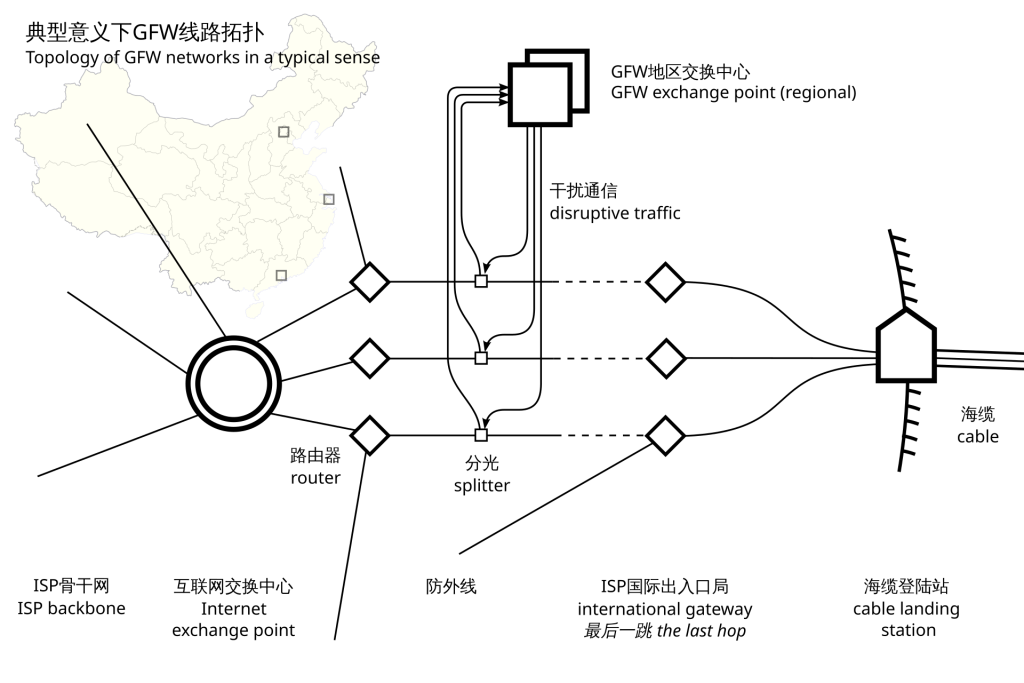
In this period the firewall’s technical toolkit took shape, deployed mainly at the international exchange points in Beijing, Shanghai and Guangzhou: blocking target websites’ IP addresses; “DNS poisoning,” returning false results for domain lookups; keyword filtering of URLs and content; forged packets that forcibly reset connections; and deep packet inspection. On the domestic side, internet cafés were required to register users’ identities, and websites were made to self-censor user content.
The net widened. In June 2004, on the eve of the 15th anniversary of the June 4 crackdown, Wikipedia was blocked in its entirety for the first time; blocked again in October 2005, it remained largely unreachable for nearly three years. During the 2008 Beijing Olympics, under pressure from the International Olympic Committee and foreign media, the authorities briefly loosened some blocks; most quietly returned after the Games.
Phase Three: Total Blocking in the Social Media Era (2009–2013)
The year 2009 was a watershed. In May, the Ministry of Industry and Information Technology (MIIT) ordered that all PCs sold in China from 1 July carry pre-installed filtering software called “Green Dam Youth Escort,” officially to block pornography; researchers, however, found large numbers of political keywords in its filter lists. Amid strong opposition at home and abroad, MIIT postponed the mandate on 30 June and in August limited it to public venues such as internet cafés and schools — a rebuffed attempt to extend censorship to the user’s own machine.
On 2 June 2009, just before the 20th anniversary of June 4, Twitter, Flickr, Bing and other foreign services were blocked; YouTube had been blocked months earlier. On 5 July, deadly violence in Ürümqi, Xinjiang, left nearly 200 people dead. The next day, internet access across Xinjiang was cut, along with text messaging and international calls, a step officials said was taken to “quench the riot quickly.” The blackout lasted some ten months: texting resumed in limited form in January 2010, and full internet service was restored only on 14 May 2010 — China’s largest and longest regional shutdown. On 7 July, Facebook was blocked nationwide and has never returned.
On 12 January 2010, Google disclosed the “Operation Aurora” cyberattacks originating in China and announced it would no longer censor its search results; on 23 March it redirected google.cn search to its Hong Kong servers, leaving the mainland market. In December 2012, the Standing Committee of the National People’s Congress adopted a decision requiring network service providers to register users under their real names, giving the real-name system a legal basis.
Phase Four: The Cyberspace Administration Era and Legalization (2013–2019)
After 2013, the center of gravity shifted from the police to the internet regulator. The Cyberspace Administration of China (CAC) became the lead agency for content control; according to Wikipedia’s “Great Firewall” article, technical operation of the firewall passed to the CAC in 2013 (a claim the Chinese government has never confirmed). In February 2014, a central leading group for cybersecurity and informatization was created, chaired by Xi Jinping personally.
Blocking escalated again. From 27 May 2014, Google’s search, mail and maps were comprehensively disrupted in mainland China; on 26 December, Gmail’s mail protocols were blocked outright and its mainland traffic fell to near zero. In September 2014, during Hong Kong’s Umbrella Movement, Instagram was blocked. In March 2015, an attack system co-located with the firewall — dubbed the “Great Cannon” by the University of Toronto’s Citizen Lab — hijacked foreign traffic bound for Chinese websites and used it to mount days-long distributed denial-of-service attacks on GitHub and the anti-censorship group GreatFire: the first publicly documented use of the censorship infrastructure for cross-border attacks.
The arms race intensified. On 19 May 2015, the Chinese Wikipedia was blocked: after Wikipedia moved entirely to encrypted HTTPS connections, censors could no longer filter page by page, so the whole site was blocked instead. Between April and May 2019, all language editions of Wikipedia were blocked (the Chinese Wikipedia records a full-site block on 23 April; the English Wikipedia notes that all editions were blocked as of May 2019).
In 2017, censorship entered a phase of deep legalization. In January, MIIT announced a cleanup of cross-border networking services, barring anyone from setting up or leasing channels — VPNs included — for cross-border operations without approval. On 1 June, the Cybersecurity Law took effect, writing real-name registration and data localization into law. At the end of July, Apple, at the Chinese government’s request, removed hundreds of VPN apps from its China App Store; in a November letter to two US senators, Apple confirmed it had removed 674 such apps that year.
Phase Five: The Encryption Arms Race (2020–Present)
As encryption became universal, the firewall — no longer able to read content — shifted to new methods: blocking based on domain names (SNI), behavioral analysis of proxy and VPN traffic, and active probing of suspected servers. Measurements by censorship researchers in 2021–2022 showed it could identify and block even “fully encrypted” proxy traffic: censorship and circumvention had entered an algorithmic contest.
In October 2020, a man in Zhoushan, Zhejiang, was detained and given an on-the-spot police reprimand for using the Lantern circumvention app to browse Wikipedia; a Zhejiang government notice described it as the first known case of punishment specifically for browsing Wikipedia. In March 2021, the encrypted messaging app Signal was blocked.
Key People and Institutions
Fang Bingxing — “Father of the Great Firewall.” Born in Harbin in 1960, Fang earned a doctorate in computer science at the Harbin Institute of Technology. From 1999 he worked at the National Computer Network Emergency Response Technical Team/Coordination Center, becoming its chief engineer in 2000 and supervising the development of China’s filtering and blocking systems; he later served as president of the Beijing University of Posts and Telecommunications. In early 2010, official media publicly identified him as the “father of China’s national firewall.” On 19 May 2011, while attending an event at Wuhan University, Fang was pelted with a shoe and eggs by a student from Huazhong University of Science and Technology, who told CNN that Fang had made him “spend unnecessary money to access websites that should be free”; the incident drew overwhelming support online and became an emblem of public resentment of censorship. Fang stepped down as BUPT president in 2013, citing health reasons. On 3 April 2016, lecturing at his alma mater in Harbin, he found the South Korean web pages he wanted to cite — as evidence that other countries also build firewalls — blocked by his own system, and had to connect through a VPN in front of his audience; the connection dropped twice within a minute, and he finished the talk using Baidu-search screenshots of Google pages, an episode widely reported as the system’s self-inflicted irony.
Lu Wei — the cyberspace czar. Lu became the first director of the Cyberspace Administration of China in 2013 and was the most energetic promoter of “internet sovereignty,” named one of Time magazine’s 100 most influential people in 2015 and dubbed China’s “internet czar” by foreign media. He was abruptly removed in 2016; in March 2019, a court in Ningbo sentenced him to 14 years in prison for accepting more than RMB 32 million in bribes.
The Ministry of Public Security and the Golden Shield. The firewall’s builder and original operator. Its Bureau of Public Information and Network Security Supervision is widely believed by outsiders to run the system, but this has never been officially confirmed — the firewall’s existence itself long appeared in no official document.
The Cyberspace Administration of China. Established in 2011, it became the secretariat of the central cybersecurity leadership body after 2014 and directs content governance and censorship policy.
The Ministry of Industry and Information Technology. Regulator of telecommunications and cross-border networking services; both the Green Dam mandate and the 2017 VPN cleanup originated there.
The role of foreign companies. The Golden Shield and backbone networks were built with extensive purchases of Western technology. According to Wikipedia, Cisco Systems supplied large amounts of hardware for the project, drawing criticism from members of the US Congress; an internal Cisco document showed the company viewed China’s firewall and censorship as a business opportunity. In 2011, Falun Gong practitioners sued Cisco in US court, alleging its technology was used to persecute them; Cisco denied having customized products for persecution.
Impact and Aftermath
An internet apart from the world. Google, Facebook, X (formerly Twitter), YouTube, Instagram, WhatsApp and Wikipedia — none of the world’s major information platforms can be used normally in mainland China. According to Wikipedia’s “Great Firewall” article, China has one of the lowest rates of cross-border internet traffic in the world. For most Chinese users, the internet simply is the walled internet: Baidu, WeChat, Weibo and Douyin form a complete, closed ecosystem. In Freedom House’s annual Freedom on the Net reports, China has ranked at or near the bottom for years.
An industry reshaped. Censorship removed the strongest foreign competitors from the field: Baidu for Google, Weibo for Twitter, WeChat for WhatsApp — domestic substitutes grew into giants in a protected market, operating under domestic censorship rules. Researchers note that blocking was never the only purpose: a 2007 study by Jedidiah Crandall and colleagues argued the system was designed to “flag and warn,” using difficulty and unpredictability to induce self-censorship by users and platforms alike.
The long tug-of-war over circumvention. Some users rely on VPNs and other tools to “climb the wall” for information, study and business, but at rising cost and risk: using unapproved cross-border channels can draw fines or police reprimands, as documented in police notices across the country. Per an estimate carried by Wikipedia, only about 3 percent of Chinese internet users regularly used VPNs in 2022 (surveys differ in definitions and method; the figure is indicative only).
From defense to export. Under the banner of “internet sovereignty,” China has promoted its model abroad — selling surveillance and filtering technology and pushing sovereignty-based rules of internet governance — a pattern human-rights groups and researchers describe as the export of “digital authoritarianism.” And the 2015 Great Cannon attacks showed the infrastructure’s capabilities already extended beyond blocking at home. Over two decades, the Great Firewall has grown from a filter at the border into a system of governance spanning law, platforms, technology and manpower — and understanding China’s speech environment and technology industry today is impossible without the project approved in 2001.
Sources
- Wikipedia, “Great Firewall” and “Golden Shield Project”; Chinese Wikipedia, “National Public Security Work Informational Project” (全国公安工作信息化工程), “Internet censorship in China,” “Fang Bingxing” (方滨兴), “Censorship of Wikipedia,” “Google’s withdrawal from China,” “Removal of VPN apps from the China App Store”
- Citizen Lab, University of Toronto: research brief on China’s “Great Cannon,” April 2015
- Associated Press, report on the full restoration of internet service in Xinjiang, 14 May 2010; Congressional-Executive Commission on China (CECC), analysis of the Xinjiang shutdown
- TechCrunch, reports on the blocking of Twitter, Facebook and other services, June–July 2009
- Reporters Without Borders, statement on the blocking of Google, September 2002
- China Media Project, report on the 2011 shoe-throwing incident at Wuhan University
- TechNode, report on Lu Wei’s 14-year sentence, March 2019
- China Internet Network Information Center (CNNIC), Statistical Reports on Internet Development in China
- Cover image: Wikimedia Commons (see file page for license)