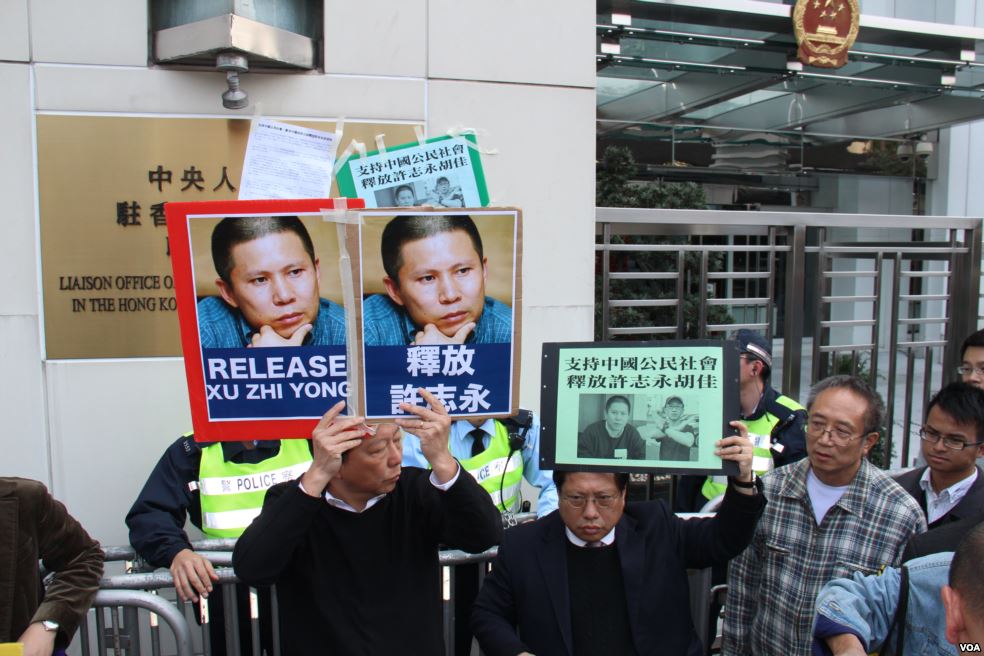
Introduction
In May 2012, the legal scholar Xu Zhiyong published an essay, “China Needs a New Citizens’ Movement,” urging Chinese people to stand up and be citizens in earnest: officials should publicly disclose their assets; the children of migrant workers should attend school and sit the university entrance exam on equal terms in the cities where their parents work; and citizens should gather over dinner on the last Saturday of each month to discuss public affairs. Most of these demands were framed within existing law — asset disclosure even appeared to echo the anti-corruption campaign loudly proclaimed by the new leadership. Yet within a year, the movement’s participants were being arrested in batches. Between March 2013 and June 2014, courts in Beijing and Jiangxi sentenced Xu Zhiyong to four years in prison and Ding Jiaxi, Zhao Changqing, Li Wei, Zhang Baocheng and Yuan Dong to between eighteen months and three and a half years, mostly for “gathering crowds to disrupt order in public places”; in Xinyu, Liu Ping and Wei Zhongping received six and a half years each. The fate of the New Citizens’ Movement is widely regarded as a landmark in the drastic shrinking of civil-society space in the Xi Jinping era.
Background and Rise of the Movement
Xu Zhiyong, born in 1973, holds a doctorate in law and was a lecturer at the Beijing University of Posts and Telecommunications. In 2003, after Sun Zhigang, a young migrant worker, was beaten to death in a custody-and-repatriation station in Guangzhou, Xu and fellow legal scholars Teng Biao and Yu Jiang petitioned the National People’s Congress Standing Committee to review the custody-and-repatriation regulations; the system was abolished that year, making Xu nationally prominent. The same year he co-founded the Sunshine Constitutionalism Research Center, renamed Gongmeng (the Open Constitution Initiative) in 2005, which provided legal aid to disadvantaged groups, represented families harmed by melamine-tainted milk powder, and promoted independent candidacies in local people’s congress elections. In 2009 the authorities fined Gongmeng 1.46 million yuan for alleged tax evasion and shut it down; Xu was briefly detained and then released on bail. With the organization dismantled, its members continued their work simply under the name “Citizens.”
In June 2010, Xu Zhiyong, Teng Biao, Wang Gongquan, Li Xiongbing, Li Fangping, Xu Youyu and Zhang Shihe launched the “Citizen Pledge” initiative, generally regarded as the starting point of the New Citizens’ Movement. In March 2012, Gongmeng lost its office once again and completed its transformation from a physical institution into a formless civic network. That May, Xu published his programmatic essay “China Needs a New Citizens’ Movement,” formally launching the initiative: its emblem was the word “Citizen” in Sun Yat-sen’s calligraphy, white characters on a blue ground; its core values were “freedom, justice, love”; and it called on people to take their identity, rights and responsibilities as citizens seriously, and to press, constructively and within the law, for China’s transition to constitutional government. As Xu later recounted, police interrogators returned again and again to one question — whether the “New Citizens’ Movement” was an “organization.” In his view it was precisely an organization-less community of citizens, and that, he argued, was the authorities’ central anxiety in handling the cases.
Principal Demands and Activities
Equal education rights. The movement’s most broadly grounded demand was to abolish household-registration (hukou) restrictions on secondary-school and university entrance examinations, so that migrant workers’ children could study and sit the gaokao in the cities where they lived. The campaign, first proposed by the businessman Wang Gongquan, began in 2010 with just four parent volunteers and grew within two years into petitions backed by more than 100,000 people; Beijing parents repeatedly petitioned the Ministry of Education, with Xu Zhiyong and Ding Jiaxi deeply involved in organizing and legal argumentation. Under pressure, the Ministry of Education issued a policy in August 2012 allowing migrant children to take the gaokao locally, and every province except Beijing and Shanghai subsequently opened, or promised to open, local exams. In Beijing, however, parents’ petitions continued into 2013 — and later became part of the “criminal facts” in the indictments of Xu and others.
Disclosure of officials’ assets. From late 2012, Ding Jiaxi and others in Beijing promoted signature drives and publicity campaigns demanding that officials take the lead in disclosing their assets. Human Rights Watch recorded a series of small, peaceful actions in Beijing and elsewhere between December 2012 and March 2013 calling for asset disclosure and education equality. On 31 March 2013, Yuan Dong, Zhang Baocheng, Ma Xinli and Hou Xin unfurled a banner at Xidan Culture Square in Beijing demanding that officials make their assets public, gave speeches and took photographs; they were taken away by police on the spot — the starting point of the entire wave of arrests.
Citizens’ same-city dinners. From late 2011, the movement encouraged citizens in different cities to dine together on the last Saturday of each month and discuss public affairs over the table, with no set topic or format. By 2013, people in more than thirty cities were taking part, with responses among overseas Chinese as well. The dinners were low-key and not illegal, but participants in Beijing, Shanghai, Zhengzhou, Nanning and Changsha were routinely summoned for “chats” and warned by police, while prominent figures thought likely to attend were often placed under house arrest in advance or threatened not to go.
The movement also promoted low-threshold forms of participation — “citizen” T-shirts, umbrellas, badges and social-media avatars — seeking to make “citizen” a public identity that ordinary people could openly claim.
Arrests and Trials
The first wave (March–April 2013). Between 31 March and 17 April 2013, ten Beijing activists — Yuan Dong, Zhang Baocheng, Ma Xinli, Hou Xin, Ding Jiaxi, Zhao Changqing, Sun Hanhui, Wang Yonghong, Li Wei and Qi Yueying — were detained one after another and became known as the “Ten Gentlemen of Asset Disclosure.” Song Ze, a Gongmeng volunteer, also disappeared into custody from April 2013 (according to Xu Zhiyong’s own account and Radio Free Asia reporting). Xu himself was intercepted at the airport on 12 April and held under house arrest for more than three months, with state-security police watching his home around the clock.
The crackdown widens (July–September 2013). On 16 July 2013, Xu Zhiyong was criminally detained on suspicion of “gathering crowds to disrupt order in public places”; he was formally arrested on 22 August and indicted in December. His detention prompted Mao Yushi, Wang Gongquan, Xiao Shu, He Sanwei and Yang Zili to launch an open letter, the “Citizen Society Appeal on the Xu Zhiyong Case,” demanding the release of the detained citizens; five batches of signatories eventually numbered 2,003. The writer Xiao Shu was forcibly removed from Beijing on 2 August and held under soft detention in Guangzhou. On 8 August, the southern activist Guo Feixiong was detained in Guangzhou — his lawyer maintained that Guo had nothing to do with the New Citizens’ Movement; on 11 August, the eastern-China organizer Li Huaping was detained in Shanghai. On 13 September, the businessman Wang Gongquan, one of the movement’s principal initiators, was criminally detained in Beijing and formally arrested on 20 October; in January 2014 he was released on bail after writing a statement in the nature of a confession and admission of guilt (as reported by Global Voices and other outlets). Zhang Xiangzhong, a Shandong activist detained in Beijing in July 2013, found the charge against him changed to “credit card fraud” when he was tried by Beijing’s Haidian District Court on 11 June 2014; he was sentenced to three years and released in July 2016 (per Chinese Wikipedia, drawing on BBC and Radio Free Asia reports).
Xu Zhiyong’s trial (January 2014). On 22 January 2014, Xu’s case opened at the Beijing No. 1 Intermediate People’s Court. Holding the proceedings to be gravely unlawful, Xu and his lawyer Zhang Qingfang protested by remaining silent throughout, except for Xu’s closing statement; the statement was cut short by the presiding judge before he could finish, but the full text circulated widely online. On 26 January, the court sentenced Xu to four years in prison for “gathering crowds to disrupt order in public places,” finding that he had “organized and planned” the education-equality petitions and the asset-disclosure actions. The Beijing Higher People’s Court rejected his appeal on 11 April. On 29 January, the Haidian court sentenced Yuan Dong to eighteen months; Hou Xin was convicted but exempted from criminal punishment.
The trial of Ding Jiaxi and three others (April 2014). The cases of Ding Jiaxi (formerly a practising Beijing lawyer), Zhao Changqing (a participant in the 1989 student movement who, according to AFP, had previously spent a cumulative eight years in prison), Li Wei and Zhang Baocheng were first heard in January 2014 but adjourned after the four men dismissed their lawyers in protest at procedural violations. According to Human Rights Watch and the later opinion of the UN Working Group on Arbitrary Detention, the cases resumed at the Haidian District Court on 8–10 April: Zhang Baocheng was tried on 8 April, Ding Jiaxi and Li Wei on 8–9 April, and Zhao Changqing on 10 April. Police sealed off the courthouse; foreign diplomats were refused entry, and supporters were taken away. Ding’s lawyer, Sui Muqing, was beaten by police after giving a media interview during a recess, walked out on 9 April in protest at being given only photocopies of the evidence, and on 17 April — the day before sentencing — was stripped of his right to represent Ding and barred from the sentencing hearing. On 18 April the court handed down its verdicts: Ding Jiaxi three and a half years, Zhao Changqing two and a half years, and Li Wei and Zhang Baocheng two years each, all for “gathering crowds to disrupt order in public places.”
Related cases. On 23 April 2013, more than a dozen people including Liu Ping and Wei Zhongping held placards in Xinyu, Jiangxi, in support of the Beijing asset-disclosure actions; Liu Ping, Wei Zhongping and Li Sihua were arrested between 27 and 30 April. On 19 June 2014, the Yushui District Court in Xinyu sentenced Liu Ping and Wei Zhongping to six and a half years each on charges of “picking quarrels and provoking trouble,” “using a cult to undermine implementation of the law” and “gathering crowds to disrupt order in public places,” and Li Sihua to three years for “picking quarrels” — the heaviest sentences of the entire wave. Liu Ping’s defence lawyer maintained that the three had nothing to do with the New Citizens’ Movement, and Chinese Wikipedia likewise notes that the case’s link to the movement was never confirmed; Amnesty International, for its part, condemned the verdicts as “absurd” and treated the case as part of the political suppression of the movement. Five activists in Chibi, Hubei — Yuan Fengchu, Yuan Xiaohua, Huang Wenxun, Chen Jianxiong and Li Yinli — were arrested in the same period (25 May 2013); the link between their activities and the movement is likewise unconfirmed.
The charges used. Notably, most defendants in this wave were charged not with political offences such as “subversion of state power,” but with “gathering crowds to disrupt order in public places,” a public-order offence under Article 290 of the Criminal Law. Chinese Wikipedia observes that by handling the cases as public-order matters, the authorities avoided the political substance of suppressing the New Citizens’ Movement. In a 2015 opinion, the UN Human Rights Council’s Working Group on Arbitrary Detention found that Ding Jiaxi’s detention was arbitrary and that he had been convicted solely for peacefully exercising his freedoms of expression and association.
Reactions
Inside China, Xu’s detention drew sustained support from intellectuals and rights advocates: the open letter gathered 2,003 signatures, and his court statement was widely shared online. Foreign Policy magazine named Xu among its Top 100 Global Thinkers for 2013; he received the National Endowment for Democracy’s Democracy Award in 2014 and PEN America’s PEN/Barbey Freedom to Write Award in 2020.
International human rights organizations reacted strongly. In a statement on 30 January 2014, Amnesty International called Xu’s sentence “shameful,” said his calls were “entirely legitimate,” and designated him a prisoner of conscience who should be released immediately and unconditionally; it added that prosecuting a man whose call to expose corruption coincided on the surface with Xi Jinping’s own much-heralded anti-corruption drive was “hypocrisy of the highest order.” Human Rights Watch, calling in April 2014 for the charges against Ding Jiaxi and the others to be dropped, said through its China director Sophie Richardson that the selective persecution of people “trying to improve governance through legal means has to stop now.” The United States and the European Union also publicly expressed concern, and diplomats from several countries attempted to observe the April trials but were turned away. Chinese officials consistently described the cases as ordinary criminal matters, maintaining that the defendants had disrupted order in public places and were punished according to law.
Impact and Aftermath
After this wave of repression, the New Citizens’ Movement ceased to exist as a loose nationwide network, and citizens’ dinners and street banner actions essentially vanished from China. Together with the “709” crackdown on lawyers that followed in 2015, the cases are widely seen as the beginning of a systematic tightening of civil-society space in the Xi era: the signal sent was that even moderate, lawful, self-consciously “constructive” citizen self-organization would not be tolerated.
Xu Zhiyong was released on 15 July 2017; Ding Jiaxi had completed his sentence on 16 October 2016. Neither man ceased his activism after release. On 13 December 2019, a group of rights lawyers and activists met in Xiamen to discuss current affairs; from 26 December, arrests followed in several places. Ding Jiaxi was taken away by police from Yantai, Shandong, and held under “residential surveillance at a designated location” for six months; according to testimony his wife Luo Shengchun gave to the UN Human Rights Council, he was tortured and held completely incommunicado. While on the run, Xu Zhiyong published an open letter in February 2020 calling on Xi Jinping to resign over, among other things, his handling of the COVID-19 outbreak; on 15 February Xu was captured in Guangzhou. In June 2022 the two men were tried behind closed doors in Linshu County, Shandong; on 10 April 2023 the Linshu County People’s Court sentenced Xu to fourteen years and Ding to twelve years for “subversion of state power” (according to human rights organizations and the families; the judgments were not made public). PEN America and Amnesty International condemned the sentences as retaliation for the exercise of free expression and association. Amnesty International reported that from October 2024 Xu Zhiyong was on hunger strike in prison in protest at his treatment.
From the 2003 petition that helped abolish custody and repatriation, to the launch of the “New Citizens” in 2012, to imprisonment for “gathering crowds to disrupt order” and then a fourteen-year sentence for “subversion,” the trajectory of Xu Zhiyong and the New Citizens’ Movement traces, almost in full, the boundary of the space available to Chinese civil society over two decades.
Sources
- Wikipedia: “New Citizens’ Movement,” “Xu Zhiyong,” “Zhang Xiangzhong” and “Song Ze” entries
- Amnesty International: statement of 30 January 2014 (Xu Zhiyong’s sentence “shameful”); June 2014 statement on the Xinyu case; 2023–2024 updates on Xu Zhiyong
- Human Rights Watch: “Drop Charges Against Civic Activists,” April 2014
- UN Human Rights Council, Working Group on Arbitrary Detention: Opinion No. 3/2015 (the case of Ding Jiaxi, A/HRC/WGAD/2015/3)
- U.S. Congressional-Executive Commission on China (CECC): January 2014 analyses of the Xu Zhiyong case and the trials of transparency advocates
- Chinese Human Rights Defenders (CHRD): May 2014 submission to the UN on the trial proceedings in Ding Jiaxi’s case
- Beijing No. 1 Intermediate People’s Court: criminal judgment in the case of Xu Zhiyong, 26 January 2014
- BBC, The New York Times, AFP, Global Voices and other media reports, 2013–2014 and 2023
- Luo Shengchun, statement to the 45th session of the UN Human Rights Council, 21 September 2020
- Cover image: Wikimedia Commons (see file page for license)