Introduction
On 10 March 2008, monks from Drepung Monastery marched through Lhasa demanding the release of detained monks and protesting restrictions on religious life. Four days later, Lhasa erupted in rioting: Tibetan crowds burned shops and attacked Han and Hui civilians, and security forces moved in to crush the unrest. Within a week, protests had spread across the Tibetan plateau — into the Tibetan areas of Sichuan, Gansu and Qinghai — in the largest upheaval in Tibet since 1989. Coming five months before the Beijing Olympics, it shook the world. The death toll has never been agreed: the Chinese government says 22 people died in Lhasa; the Tibetan government-in-exile says about 203 Tibetans were killed by January 2009; the Dalai Lama put the figure at at least 400. With foreign journalists expelled and the region sealed off, none of these numbers could be independently verified — and that disagreement is itself part of the history.
Background and Causes
On 10 March 1959, Lhasa rose in revolt and the 14th Dalai Lama fled to India. Every 10 March since has been a sensitive anniversary: a day of heavy precautions for the authorities and of commemoration for exiled Tibetans.
Grievances had accumulated for years. In religion, monasteries were subjected to “patriotic education” campaigns, public display of the Dalai Lama’s image was banned, and the size, movement and study of monastic communities were tightly controlled; loyalty to the Dalai Lama was treated in official discourse as “splittism.” In economic life, the opening of the Qinghai–Tibet railway in 2006 accelerated migration from inland China, and many Tibetans felt marginalised in jobs, education and the local economy, while rising prices squeezed the poor (according to Human Rights Watch and the U.S. State Department). Politically, talks between the Dalai Lama’s envoys and Beijing, resumed in 2002, had produced nothing, leaving Tibetans little hope of improvement through negotiation.
The Olympic year raised the stakes on both sides. Beijing treated the Games as a national coming-out party and was acutely sensitive to any sign of instability; Tibetan activists saw the Olympics as a rare window to be heard. In that double sensitivity, a routine anniversary protest became the gravest crisis in two decades.
What Happened
10 March, Lhasa. According to a Human Rights Watch report, 300 to 400 monks from Drepung Monastery marched toward the city centre at midday demanding religious freedom; police blocked their route, monks were kicked and beaten with batons, and about 60 were arrested. The official Xinhua account said that more than 300 Drepung monks had come downtown to “make trouble,” and that ten monks at Sera Monastery raised the flag of the exile government and shouted “Tibetan independence.”
11 March, Lhasa. Some 300 to 400 monks from Sera Monastery marched in a line to demand the release of the arrested monks. The BBC, citing an eyewitness, reported that ten to fifteen plainclothes officers kicked and beat the monks; the monks sat down in protest, surrounded by riot police and soldiers, and Radio Free Asia reported tear gas being fired. Monks and nuns from Ganden Monastery and other institutions tried to march the same day, were turned back, and their monasteries were sealed off.
14 March: the Lhasa riot. Monks at Ramoche Temple, preparing to march, were barred from leaving by police and threw stones; as police withdrew, the enraged crowd turned on people from outside Tibet. Shops with Chinese signage were smashed, looted and burned, Han and Hui passersby were beaten, and a crowd tried to storm the Lhasa Great Mosque. By the official count, 908 shops were burned or ransacked, 120 homes destroyed, 84 vehicles wrecked, seven schools and five hospitals damaged, with direct economic losses of nearly 250 million yuan. The International Herald Tribune reported that five young women shop assistants were burned alive in a clothing store — one of them Tibetan. Police and soldiers re-entered the city that afternoon; tear gas was used and there were reports of gunfire, with Amnesty International citing evidence that machine guns were fired. Qiangba Puncog, chairman of the Tibet Autonomous Region government, insisted that police in Lhasa had not fired their guns or used lethal weapons.
14–15 March: Gannan, Gansu. Two hundred monks of Labrang Monastery led a crowd of about 300 in protest; on 15 March some 4,000 Tibetans gathered around Labrang and clashed with security forces, government buildings in Xiahe were damaged, and there were reports of tear gas and shooting. Unrest spread to Machu, Luqu and Hezuo; Xinhua put the damage in Gansu at about 230 million yuan.
15–16 March: lockdown and sweeps. Large numbers of paramilitary police and soldiers poured into Lhasa; house-to-house searches and arrests went on for days, and monasteries were cut off from water and food. The BBC reported that around 600 Lhasa monks were flown to Chengdu in custody. All foreign and Hong Kong journalists were ordered out of Lhasa; James Miles of The Economist, the only foreign correspondent in the city, was told he had to leave when his permit expired on 19 March. Chinese state media, initially low-key, soon filled their coverage with the suffering of Han victims.
16 March: Aba (Ngaba), Sichuan. After monks of Kirti Monastery and local Tibetans protested, clashes with police turned deadly. The BBC cited a witness who said about 17 Tibetans were killed, including a schoolgirl; the India-based Tibetan Centre for Human Rights and Democracy said at least seven people were shot, and photographs of the dead circulated abroad. Beijing at first denied any shooting, then on 20 March said police in Aba had fired “in self-defence,” wounding four protesters. On 21 March, in Sertar, police shot and killed another protester, according to the Free Tibet Campaign.
Mid-to-late March: Qinghai and beyond. Demonstrations took place at Rongwo Monastery in Tongren, Qinghai, on 14–16 March; on 19 March troops sealed off Taktser, the village where the Dalai Lama was born; in Hezuo, Gansu, protesters tore down a Chinese flag and raised a Tibetan one. Sporadic protests in Kardze and elsewhere continued into April and May. Xinhua counted roughly 150 protests between 10 and 25 March; the International Campaign for Tibet counted 235 protests from March 2008 to October 2009.
Reactions
The Chinese government defined the Lhasa violence as a “serious violent crime of beating, smashing, looting and burning,” and accused the “Dalai clique” of organising, premeditating and inciting it. At a press conference on 18 March, Premier Wen Jiabao dismissed the Dalai Lama’s charge of “cultural genocide” in Tibet as “sheer lies,” and said security forces had exercised “extreme restraint.” Tibet party secretary Zhang Qingli called for a “people’s war” against separatism; according to Human Rights Watch, on 17 March Zhang also demanded “quick arrests, quick hearings and quick sentencing” for those involved. Beijing launched a counter-campaign against Western media, accusing CNN and others of cropping photographs and distorting the story. On 1 April the Ministry of Public Security claimed to have found caches of guns and explosives in monasteries and alleged plans for suicide attacks — an allegation the exile side denounced as fabrication.
The Dalai Lama and the government-in-exile denied orchestrating the protests, saying they sprang from Tibetans’ “deep-seated disillusionment and despair,” and invited Chinese officials to come to India and present their supposed evidence. The Dalai Lama accused Beijing of “cultural genocide” in Tibet and called for an international investigation. He also urged Tibetans to shun violence, opposed any boycott of the Beijing Olympics, and said on 18 March that he would resign as head of the exile administration if Tibetan violence spun out of control. James Miles, the journalist on the scene, told CNN he “didn’t see any evidence of any organized activity,” and saw the riot primarily as an eruption of long-festering grievances in the Olympic year.
The international response centred on restraint and human rights. UN Secretary-General Ban Ki-moon expressed concern and urged all sides to avoid violence; Louise Arbour, the UN High Commissioner for Human Rights, urged China to exercise restraint and to respect freedom of assembly and expression. The European Union called for restraint and respect for human rights. U.S. House Speaker Nancy Pelosi led a congressional delegation to Dharamsala on 21 March to meet the Dalai Lama. The Olympic torch relay became a rolling protest stage: activists, including from Reporters Without Borders, disrupted the lighting ceremony in Greece on 24 March, and in early April the relay drew mass demonstrations in London, Paris and San Francisco — in Paris the flame was repeatedly extinguished and the route altered. IOC president Jacques Rogge voiced “deep concern” over Tibet for the first time on 7 April and called for a swift, peaceful resolution. In the end, calls to boycott the opening ceremony went largely unheeded: leaders of more than 80 countries attended the Beijing Games.
Casualties and Judicial Consequences
The death toll is the most contested fact of the entire event, with figures differing by more than an order of magnitude:
| Source | Claim |
|---|---|
| Chinese government (Xinhua / Tibet regional government) | 22 dead in Lhasa: 18 innocent civilians and 1 police officer killed by rioters, plus 3 “rioters” dead (breakdown as cited in the U.S. State Department report); 382 civilians injured (58 critically), 241 police and paramilitary injured (23 critically, 1 killed); Beijing also said its security forces killed only one “insurgent” |
| Tibetan government-in-exile (Central Tibetan Administration) | At least 80 Tibetan deaths confirmed by 16 March; more than 140 by 5 April; ultimately about 203 Tibetans killed, 5,600 arrested and 1,294 injured between March 2008 and January 2009 |
| The Dalai Lama | At least 400 Tibetans killed and thousands arrested (April 2008) |
| Third-party estimates | The U.S. State Department’s 2008 Human Rights Report cited outside observers’ estimates of 100 to 218 deaths; the Tibetan Centre for Human Rights and Democracy estimated 79 killed |
Because foreign journalists were expelled, the region sealed, and hospital records withheld (according to Human Rights Watch), none of these figures has ever been independently verified.
The scale of arrests is known only from incomplete official numbers. As compiled by the U.S. Congressional-Executive Commission on China from official Chinese reports, 953 people were detained by police in Lhasa, of whom 403 were formally arrested, and another 362 “surrendered”; in Gannan, Gansu, more than 2,600 people surrendered or were detained. TAR vice-chairman Baima Caiwang said in November 2008 that public security organs had initially detained 1,317 people in total. In June 2008, Amnesty International reported that more than 1,000 detained Tibetans remained “unaccounted for.”
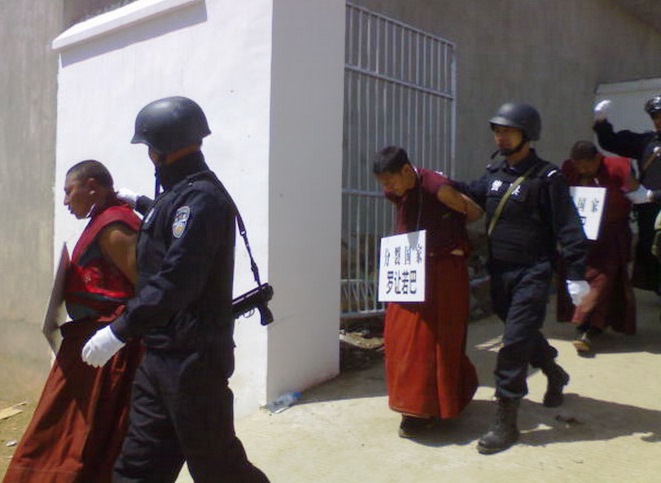
Justice was swift. On 29 April 2008, the Lhasa Intermediate People’s Court staged a sentencing session at which 30 Tibetans received prison terms of three years to life for arson, looting, assembling to storm state organs and similar offences. Human Rights Watch pointed out that the actual trials had been held earlier, in secret — 29 April was a “sentencing rally,” and the defendants had no meaningful defence. By February 2009, Xinhua reported 76 people sentenced over the unrest. On 8 April 2009, the Lhasa court sentenced Lobsang Gyaltsen and Loyak to death for arson causing deaths, with two more men given death sentences with reprieve and one life imprisonment; on 21 April three more Tibetans were sentenced (a suspended death sentence, life, and ten years). On 20 October 2009 the two death sentences were carried out: China’s Foreign Ministry spokesman confirmed two executions and defended the proceedings as lawful, while the Tibetan Centre for Human Rights and Democracy reported that four Tibetans had in fact been executed that day. They were the first reported executions of Tibetans since 2003.
Impact and Aftermath
Dialogue briefly resumed: representatives met in Shenzhen on 4 May 2008 and again on 1 July. At the eighth round of talks that autumn, the Dalai Lama’s envoys presented the Memorandum on Genuine Autonomy for the Tibetan People; Beijing rejected it as disguised independence. In November 2008, exiled Tibetans met in special session in Dharamsala and voted to keep the “Middle Way” policy, but the Dalai Lama’s trust in Beijing had visibly worn thin.
Control over Tibetan areas tightened across the board. “Patriotic education” in monasteries was massively expanded, and stationed officials and police became a permanent presence. The U.S. State Department’s 2008 International Religious Freedom Report concluded that religious freedom in the Tibet Autonomous Region and other Tibetan areas had “deteriorated further” after the unrest. On 19 January 2009, the TAR legislature created an official counter-commemoration: “Serfs’ Emancipation Day,” to be marked every 28 March.
The deepest echo came in Aba. On 27 February 2009, after authorities cancelled a Kirti Monastery prayer ceremony meant to commemorate the victims of 2008, a young monk named Tapey walked into the town of Ngaba and set himself on fire — the first self-immolation protest in Tibet. The tactic spread: according to tallies by the International Campaign for Tibet and others, there were 12 self-immolations in 2011 and 83 in 2012. In July 2010, Human Rights Watch published a 73-page report, “I Saw It with My Own Eyes,” documenting excessive force, torture and arbitrary detention by security forces in Tibet between 2008 and 2010, based on interviews with Tibetans who had fled abroad. In May 2009, the Open Constitution Initiative, a group of Beijing legal scholars, issued its own study attributing the protests to economic inequity, migration and religious feeling, and urged the authorities to respect Tibetans’ rights — a rare dissenting voice from within China, soon silenced in the crackdowns that followed.
March 2008 set the pattern for the years that followed: every March, the Tibetan plateau goes on high alert, and for Tibetans, 10 and 14 March remain anniversaries that cannot be publicly marked at home.
Sources
- Wikipedia, “2008 Tibetan unrest”; Chinese Wikipedia, 《2008年西藏骚乱》
- Xinhua News Agency, Q&A on the Lhasa riots, 26 March 2008, and related reports (via CCTV International and other state media)
- U.S. Department of State, 2008 Human Rights Report: China (includes Tibet, extracts)
- U.S. Department of State, 2008 International Religious Freedom Report
- Human Rights Watch, “I Saw It with My Own Eyes”: Abuses by Chinese Security Forces in Tibet, 2008–2010 (July 2010); “China: Hundreds of Tibetan Detainees and Prisoners Unaccounted for” (March 2009); “China: Tibetan Protesters Denied Fair Trial” (30 April 2008); statement of 14 March 2008
- Amnesty International, The Olympics Countdown — Crackdown on Tibetan Protesters (April 2008) and June 2008 statements on detainees unaccounted for
- U.S. Congressional-Executive Commission on China, Special Topic Paper: Tibet 2008–2009 and its compilation of official detention figures
- Kyodo News, October 2009 reports on the confirmed executions
- International Campaign for Tibet, 2008–2009 protest logs
- Cover image: Wikimedia Commons (see file page for license)