Introduction
At 11 p.m. on 30 June 2020, the Law of the People’s Republic of China on Safeguarding National Security in the Hong Kong Special Administrative Region took effect in Hong Kong. Passed by the Standing Committee of the National People’s Congress in Beijing and inserted into Annex III of Hong Kong’s Basic Law, it was promulgated directly by the Hong Kong government, bypassing the city’s own Legislative Council entirely — and its full text was published only on the night it came into force. The law created four offences — secession, subversion, terrorist activities, and collusion with a foreign country or external elements to endanger national security — punishable by up to life imprisonment, and it reaches conduct by non-residents committed anywhere in the world. The next day, police arrested about 370 people, ten of them for suspected offences under the new law. Over the following six years the law became the axis of Hong Kong’s transformation: opposition parties and civil-society groups disbanded one after another, two major independent news outlets were forced to close, hundreds were arrested on national security charges, and hundreds of thousands emigrated. Beijing and the Hong Kong government say the law took the city “from chaos to governance.” Critics say it ended the freedoms that “one country, two systems” was supposed to protect.
Background and Causes
National security legislation was meant to be Hong Kong’s own work. Article 23 of the Basic Law provides that Hong Kong “shall enact laws on its own” to prohibit treason, secession, sedition and subversion. In 2003 the Hong Kong government’s attempt to legislate under Article 23 drew some 500,000 people onto the streets and was shelved; no administration revived it. In 2019, a proposed extradition law triggered the anti-extradition movement, more than half a year of mass protests and escalating clashes that Beijing and the Hong Kong government characterised as a “Hong Kong version of a colour revolution.” Beijing concluded that Hong Kong’s decades-long failure to pass Article 23 legislation had left a “legal vacuum” in national security that the central government had to fill itself. Critics countered that for the central government to legislate directly, on a matter the Basic Law assigns to Hong Kong, itself changed the constitutional arrangement.
In May 2020, as the COVID-19 pandemic eased, the National People’s Congress convened in Beijing with a Hong Kong national security law on its agenda.
The Legislative Process
On 28 May 2020, the National People’s Congress adopted, by 2,878 votes to one with six abstentions, a Decision authorising its Standing Committee to draft a national security law for Hong Kong directly. The draft was never published or put out for consultation; throughout the process, no one outside the drafting circle knew its contents.
On the morning of 30 June, the NPC Standing Committee passed the Hong Kong National Security Law and added it to Annex III of the Basic Law the same day. The Hong Kong government gazetted it that evening, and it took effect at 11 p.m.; Xinhua published the full text shortly before it commenced — the public saw the complete law for the first time at the moment it became binding. That same day, the United States announced the revocation of Hong Kong’s special trading status (see “Reactions”).
That a law for Hong Kong was made in Beijing, bypassing the Legislative Council, was its deepest controversy from birth: supporters cite the Annex III mechanism as a lawful channel for applying national laws; critics reply that Article 23’s instruction that Hong Kong legislate “on its own” meant direct legislation from Beijing redrew the boundary of the city’s autonomy.
What the Law Contains
The law has 66 articles. Its main elements:
Four offences and their penalties. Secession (Articles 20–21), subversion (Articles 22–23), terrorist activities (Articles 24–28), and collusion with a foreign country or external elements (Articles 29–30). Sentencing follows three tiers: principal offenders and grave cases draw life imprisonment or ten years and above; active participants, three to ten years; other participants, up to three years, criminal detention or restriction. “Collusion” includes requesting foreign sanctions, blockades or other hostile action.
Extraterritorial reach (Article 38). “This Law shall apply to offences under this Law, which are committed against the Hong Kong Special Administrative Region from outside the Region by a person who is not a permanent resident of the Region.” In other words, the conduct of non-residents anywhere in the world can fall within the law — a provision later used as the basis for bounties on overseas activists (see below).
New institutions. A Committee for Safeguarding National Security, chaired by the Chief Executive and attended by a central-government adviser, whose decisions “shall not be amenable to judicial review” (Article 14); a central-government Office for Safeguarding National Security in Hong Kong, whose personnel acting in their duties are “not subject to the jurisdiction” of Hong Kong (Article 60); a National Security Department within the police; and a dedicated national security prosecutions division in the Department of Justice.
Designated judges and trial arrangements. National security cases are heard by judges designated by the Chief Executive from among the city’s judges (Article 44). The Secretary for Justice may direct that a case be tried without a jury — by a panel of three judges instead — on grounds such as protecting state secrets, the involvement of foreign factors, or jurors’ safety (Article 46), a departure from the common-law tradition of jury trial in Hong Kong’s High Court. A certificate from the Chief Executive on whether an act involves national security is binding on the courts (Article 47).
The bail threshold (Article 42). No bail shall be granted unless the judge has sufficient grounds for believing the defendant “will not continue to commit acts endangering national security.” This reverses the common-law presumption in favour of bail, and national security defendants are routinely held for long periods before trial.
Mainland jurisdiction in special cases (Article 55). In three situations — cases complicated by foreign involvement, cases the Hong Kong government cannot effectively handle, and cases of imminent major threat — the central authorities may approve the Office for Safeguarding National Security exercising jurisdiction, in which case the case proceeds under mainland China’s Criminal Procedure Law. As of the sources used here, this provision has not been publicly invoked.
No retroactivity (Article 39). The law applies only to acts committed after it took effect. Prosecutors in several cases have nevertheless relied on pre-enactment words and deeds as part of an alleged conspiracy or as evidence; defendants and critics argue this hollows out the non-retroactivity guarantee, while the court in the Lai case held that the conspiracy continued after enactment and so was not retroactive (according to the judgment).
Enforcement and Landmark Cases
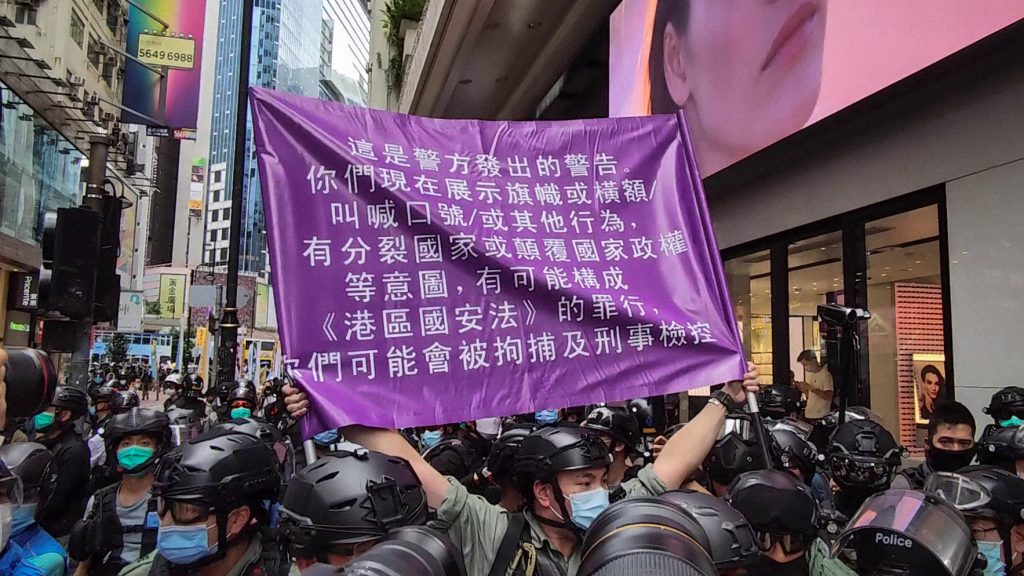
Day one (1 July 2020). Police banned the traditional July 1 march, but large crowds took to the streets anyway. According to a U.S. Congressional Research Service report, about 370 people were arrested that day, ten of them under the new law, among them a 15-year-old girl; police raised for the first time a purple warning flag citing the law. Tong Ying-kit, 23, riding a motorcycle flying a “Liberate Hong Kong, revolution of our times” flag, rammed into police officers and was arrested the same day.
The Tong Ying-kit case (the first NSL trial). Tong was charged with inciting secession and terrorist activities. His case was tried without a jury by three designated judges, and turned in part on whether the slogan “Liberate Hong Kong, revolution of our times” carried a secessionist meaning. On 27 July 2021 the court convicted him on both counts; on 30 July he was sentenced to six and a half years for incitement to secession and eight years for terrorist activities, part of them consecutive — nine years in total. He later withdrew his appeal (according to Wikipedia, citing reports).
Jimmy Lai and the closure of Apple Daily. On 10 August 2020, national security police arrested Next Digital founder Jimmy Lai on suspicion of colluding with foreign forces and raided the Apple Daily newsroom. On 17 June 2021 police raided the paper again, arrested five executives, and the Security Bureau froze about HK$18 million in related company assets; Apple Daily printed its final edition on 24 June 2021 and closed. Lai had been held on remand since December 2020. His national security trial opened on 18 December 2023 before three designated judges without a jury and ran for 156 days. On 15 December 2025 the High Court convicted him of two counts of conspiracy to collude with foreign forces and one count of conspiracy to publish seditious publications, in a judgment of more than 850 pages. On 9 February 2026 Lai was sentenced to 20 years in prison — the heaviest sentence yet under the law — while six former Apple Daily executives and associates received terms of six years and three months to ten years. Lai subsequently decided not to appeal his conviction or sentence (according to his lawyer, speaking to Reuters). In a separate case, his 2022 fraud conviction was quashed by the Court of Appeal on 26 February 2026 (reported by Reuters and others).
The 47 democrats case. In July 2020 the pro-democracy camp held unofficial primary elections in which more than 610,000 people voted. On 6 January 2021 police arrested 53 organisers and participants; on 28 February, 47 of them were charged with conspiracy to commit subversion, accused of plotting to win a Legislative Council majority and indiscriminately veto budgets to force the Chief Executive’s resignation. It was the largest prosecution under the law: 31 pleaded guilty and 16 stood trial. On 30 May 2024 the court convicted 14 and acquitted two; on 19 November 2024 sentences ranged from four years and two months to ten years, with primary organiser Benny Tai receiving ten years and Joshua Wong four years and eight months. On 23 February 2026 the Court of Appeal dismissed the appeals of 12 defendants and upheld the convictions and sentences (reported by Reuters). Wong was additionally charged with a collusion offence in June 2025 while already in prison; that case was adjourned (according to the UK government’s six-monthly report on Hong Kong).
The Hong Kong Alliance case. The Hong Kong Alliance, organiser of the Victoria Park June 4 candlelight vigil for thirty years, was ordered by national security police to hand over materials in September 2021 and voted to disband on 25 September; its vice-chair Chow Hang-tung and leaders Lee Cheuk-yan and Albert Ho were charged with incitement to subversion and have been detained since September 2021. That subversion trial finally opened in the High Court on 22 January 2026 (according to the UK government’s six-monthly report); no verdict had been reported in the sources used here. In a separate case over the Alliance’s refusal to comply with the police notice, the three were initially convicted, but the Court of Final Appeal overturned the convictions on 6 March 2025.
The Stand News case. On 29 December 2021 national security police arrested current and former senior figures at Stand News and froze about HK$61 million of its assets; the outlet announced its closure the same day. The case was brought not under the National Security Law but under the colonial-era sedition provisions of the Crimes Ordinance. On 29 August 2024 the District Court convicted former chief editor Chung Pui-kuen and former acting chief editor Patrick Lam of conspiracy to publish seditious publications — the first sedition convictions of journalists since 1997. On 26 September 2024 Chung was sentenced to 21 months; Lam received 11 months and was released at once, having already spent a comparable period on remand and on health grounds.
Arrest totals, in several calibres. Figures vary by source and by what they count. The Security Bureau and police reported more than 300 arrests in national security cases by August 2024, about 60 percent of those arrested charged (as reported by media). Chief Executive John Lee said in June 2025 that 332 people had been arrested in total (as quoted by the Global Times). Police reported in early 2026 that the National Security Department had arrested 385 people by the end of 2025, more than half of them charged — a figure that also covers cases under the local Safeguarding National Security Ordinance. Rights groups use a wider frame: according to tallies cited by the U.S. State Department and Hong Kong Watch, more than 10,000 people were arrested and over 2,900 prosecuted in connection with the 2019 protests overall — but those figures cover ordinary criminal prosecutions, not only national security cases, and the two should not be conflated. Police have also repeatedly issued arrest warrants with HK$1 million bounties for overseas activists, beginning with eight people in July 2023; according to the UK government, 34 such warrants had been issued by June 2026.
Reactions
Beijing and the Hong Kong government. The central and Hong Kong governments say the law closed a national security loophole, ended the violence and unrest “with immediate effect,” and took Hong Kong “from chaos to governance,” stressing that it targets only “a very small number” of people while the rights of the great majority are unaffected. In February 2026 the State Council issued a white paper on Hong Kong safeguarding national security under “one country, two systems,” presenting the law as a guarantee of long-term prosperity and stability.
Hong Kong’s democrats and civil society. Opposition parties, members of the legal profession and human-rights groups argue that the offences are defined so broadly that “collusion” and “incitement” can cover ordinary lobbying, journalism and parliamentary politics; that designated judges, non-jury trials and the strict bail threshold depart from common-law traditions; and that the chilling effect has entrenched media self-censorship and shrunk civil society. Amnesty International’s Hong Kong overseas office called the dismissal of the “Hong Kong 47” appeals evidence of the prosecutions’ political motivation. Establishment figures and some legal scholars defend the law, noting that every country has national security legislation.
The United States. On 27 May 2020 Secretary of State Mike Pompeo reported to Congress that Hong Kong no longer retained a high degree of autonomy. On 14 July, President Donald Trump signed the Hong Kong Autonomy Act and an executive order ending Hong Kong’s special treatment; the U.S. later suspended or terminated several bilateral agreements with Hong Kong. On 7 August 2020 the Treasury Department sanctioned 11 Chinese and Hong Kong officials, including then–Chief Executive Carrie Lam, then–Secretary for Justice Teresa Cheng and then–Police Commissioner Chris Tang. Further rounds followed over the years, most recently on 31 March 2025, when six officials, including Secretary for Justice Paul Lam, were sanctioned for repressing Hong Kong’s autonomy and freedoms (according to U.S. State Department statements).
The United Kingdom. The UK government said Beijing’s imposition of the law was a “clear and serious breach” of the Sino-British Joint Declaration, and opened a migration route for holders of British National (Overseas) status: the BN(O) visa launched on 31 January 2021, allowing holders to live, work and study in the UK, apply for settlement after five years and for citizenship a year later. London has continued to publish six-monthly reports on Hong Kong documenting what it describes as the erosion of freedoms. Beijing and Hong Kong retaliated by ceasing, from 31 January 2021, to recognise the BN(O) passport as a valid travel document.
Other states and international bodies. The European Union, Canada and Australia condemned the law and took limited measures: Canada and Australia created special migration arrangements for Hong Kongers, Australia suspended its extradition treaty with Hong Kong, and the Five Eyes issued repeated joint statements. In 2022 the UN Human Rights Committee, reviewing Hong Kong, recommended repealing the National Security Law and the sedition offences. China rejects the criticism as interference in its internal affairs and accuses Western states of double standards.
Impact and Aftermath
A reshaped political landscape. In March 2021 the National People’s Congress overhauled Hong Kong’s electoral system, sharply reducing directly elected Legislative Council seats and subjecting candidates to vetting; at the December 2021 election no democrat stood, and turnout hit a record low. The main opposition parties disbanded one by one: the Civic Party in 2023, the League of Social Democrats in June 2025, and the Democratic Party announced its dissolution in 2025. Major unions and civic groups, including the teachers’ union and the Civil Human Rights Front, also disbanded in 2020–2021.
A shrinking press. After the closures of Apple Daily and Stand News, Hong Kong fell in Reporters Without Borders’ World Press Freedom Index from 80th in 2021 to 148th in 2022, hovering around 140th in recent years. The Hong Kong Journalists Association has repeatedly reported entrenched self-censorship.
The emigration wave. The law was followed by Hong Kong’s largest emigration wave since 1997. According to the Census and Statistics Department, Hong Kong’s population fell from about 7.509 million in mid-2020 to about 7.292 million in mid-2022 — a drop of more than 210,000 in two years (the government attributes part of the decline to the pandemic; the population later recovered somewhat under talent-admission schemes). Movement to Britain was the largest single stream, but the numbers come in distinct calibres: before the route opened, the UK government estimated the BN(O) scheme might attract 258,000 to 322,400 people over five years; the Home Office later reported 181,609 BN(O) visas granted by June 2025, with more than 166,300 people having arrived (Home Office figures, as reported by media); the Foreign Office’s six-monthly report put BN(O) applications approved between January 2021 and March 2026 at about 238,000 — approvals of applications, a different measure from visas granted; and the Office for National Statistics estimated about 160,000 arrivals via the route in 2021–2025. Canada, Australia, Taiwan and other places also received substantial numbers of Hong Kong emigrants, but methodologies differ and no single agreed total exists.
Local security legislation completed. On 19 March 2024 the Legislative Council unanimously passed the Safeguarding National Security Ordinance, which took effect on 23 March — finally enacting Article 23 legislation locally. It added offences including treason, insurrection, espionage, external interference and sabotage of public infrastructure, raised sedition penalties, and tightened early-release arrangements for national security prisoners. Hong Kong is now governed by two national security laws in parallel: the centrally enacted National Security Law and the local Ordinance.
Bounties and cross-border disputes. Hong Kong’s bounties on overseas activists have made the law’s cross-border enforcement a continuing point of friction with Western governments, which have repeatedly condemned it; the Hong Kong government maintains the warrants are lawful and brook no interference.
Six years on, the text of the National Security Law has not changed, but its marks are everywhere in Hong Kong — in courtroom procedure, in newspaper front pages, in the departure halls of the airport. Whether it is a “stabilising anchor” or the end of the city’s freedoms, Beijing and the Hong Kong government give an answer diametrically opposed to their critics’. The cases and the numbers, accumulating year by year, are the central story of Hong Kong in the 2020s.
Sources
- Full text of the Law of the People’s Republic of China on Safeguarding National Security in the Hong Kong Special Administrative Region (Xinhua, 30 June 2020)
- Decision of the National People’s Congress on establishing and improving the legal system and enforcement mechanisms for safeguarding national security in Hong Kong (28 May 2020)
- U.S. Congressional Research Service, “China’s National Security Law for Hong Kong: Issues for Congress”: about 370 arrests on 1 July 2020, ten under the new law
- Reuters: sentencing of Tong Ying-kit (30 July 2021); dismissal of the “Hong Kong 47” appeals (23 February 2026); Jimmy Lai sentenced to 20 years (9 February 2026); Lai’s fraud conviction overturned (26 February 2026)
- UK government six-monthly reports on Hong Kong (second half of 2025; first half of 2026): national security arrest figures, the further charge against Joshua Wong, the opening date of the Hong Kong Alliance trial, BN(O) applications approved, 34 overseas arrest warrants
- Georgetown Center for Asian Law, submission to the Congressional-Executive Commission on China on the Jimmy Lai verdict (September 2026): conviction on 15 December 2025 and the 20-year sentence, the heaviest under the law
- Associated Press, Committee to Protect Journalists, Hong Kong Free Press: the Stand News verdict and sentencing (August–September 2024)
- Hong Kong Police Force, “Law and order situation in Hong Kong in 2025”: 385 arrests by the National Security Department as at end-2025
- Hong Kong Census and Statistics Department population figures (about 7.509 million in mid-2020; about 7.292 million in mid-2022); UK Home Office BN(O) visa statistics (181,609 granted by June 2025); UK Office for National Statistics migration estimates
- U.S. State Department sanctions statements (7 August 2020; 31 March 2025); UK Foreign Office statements on the Sino-British Joint Declaration
- Wikipedia: “Hong Kong national security law,” “Tong Ying-kit,” “Hong Kong 47,” “HKSAR v Lai Chee Ying & Others”
- Cover image: Wikimedia Commons (see file page for license)