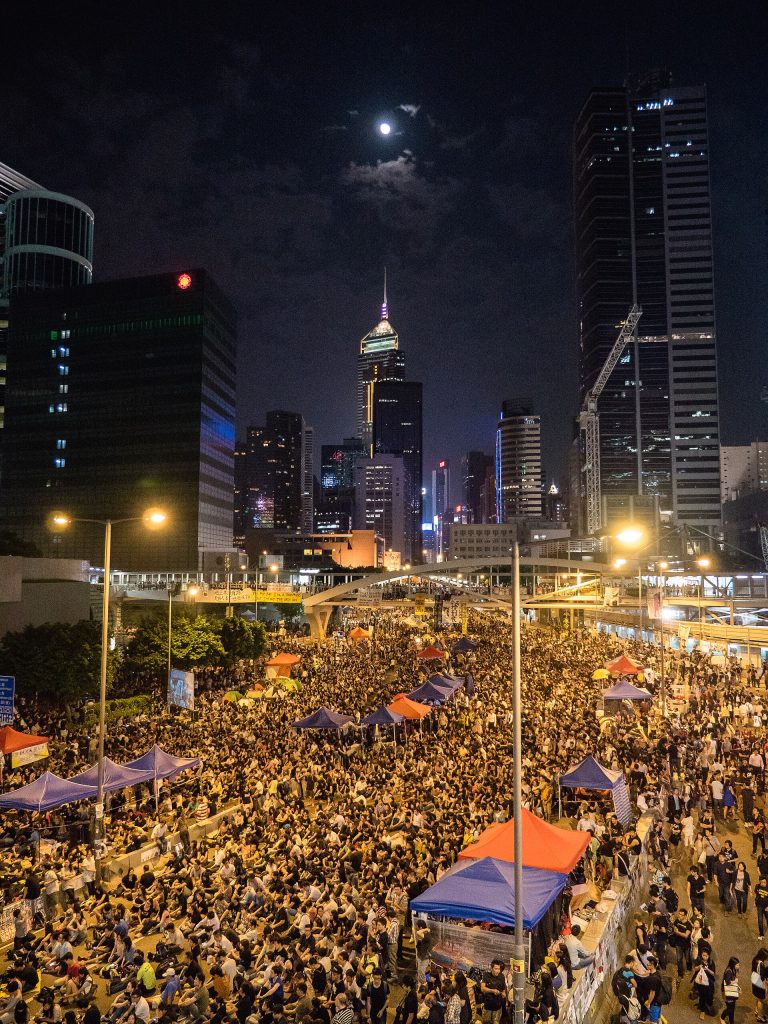
On the evening of 28 September 2014, riot police fired volley after volley of tear gas — 87 canisters in all — at the peaceful crowds packed onto the roads outside Hong Kong’s government headquarters in Admiralty. The crowds did not disperse. They opened umbrellas against the pepper spray and tear gas, and they stayed. That night, tens of thousands more citizens poured into the streets in support. For the next 79 days, tents, barricades and banners occupied major thoroughfares in Admiralty, Causeway Bay and Mong Kok, in the largest act of civil disobedience since Hong Kong’s return to Chinese rule — the Umbrella Movement, also called the Umbrella Revolution.
The demand was simple. Hong Kong’s Basic Law promises that the Chief Executive and the Legislative Council will ultimately be elected by universal suffrage. The protesters wanted the genuine article — elections in which Beijing did not pre-screen the candidates. The movement won no concessions, and the occupied zones were cleared one by one in December. But it transformed Hong Kong politics: a generation of young people entered public life, localist movements rose, and the seeds of the far larger 2019 anti-extradition movement were sown. Many of its organisers were prosecuted and jailed years afterwards, in cases that became markers of the city’s shrinking freedoms of speech and assembly.
Background and Causes
When Hong Kong was handed back to China in 1997, Articles 45 and 68 of the Basic Law stated that the methods for selecting the Chief Executive and forming the Legislative Council would ultimately reach the goal of universal suffrage. In 2007, Beijing’s Standing Committee of the National People’s Congress (NPCSC) ruled that the Chief Executive could be elected by universal suffrage in 2017. Everything turned on the definition: Beijing insisted that candidates must first be screened by a nominating committee; democrats replied that if candidates needed the blessing of a Beijing-approved body, voters would merely be rubber-stamping a pre-approved list — not genuine universal suffrage.
In January 2013, University of Hong Kong legal scholar Benny Tai Yiu-ting proposed “Occupy Central with Love and Peace”: if the government’s electoral proposal fell short of international standards, thousands would stage non-violent civil disobedience in the Central financial district. Tai, together with sociologist Chan Kin-man and Baptist pastor Chu Yiu-ming — the “Occupy trio” — organised deliberation days and, from 20 to 29 June 2014, a civil referendum in which some 790,000 people voted, most backing proposals that included public nomination of candidates. Beijing condemned the vote as “illegal and invalid.”
On 31 August 2014, the NPCSC issued its decision on Hong Kong’s electoral reform — the “831 Decision.” Candidates for Chief Executive in 2017 would need the support of more than half of a 1,200-member nominating committee, and only two or three candidates would be allowed; the Legislative Council’s method would stay unchanged. Protesters called it “the shutter coming down”: Beijing retained an effective veto over who could run. Joshua Wong, convenor of the student group Scholarism, responded that night: “Our generation is about to begin an era of civil disobedience.” In September, the Hong Kong Federation of Students (HKFS) and Scholarism called a class boycott. On the other side, the pro-Beijing Alliance for Peace and Democracy had staged an anti-Occupy march on 17 August, claiming 193,000 participants against a police estimate of 111,000 — the battle over numbers would run through the entire movement.
Course of Events
22–26 September 2014: class boycott and the storming of Civic Square. On 22 September the HKFS launched a five-day university class boycott; some 13,000 students rallied at the Chinese University of Hong Kong. On 26 September the rally moved outside government headquarters in Admiralty. That evening, hundreds of students answered Scholarism’s call to “reclaim” the fenced-off forecourt of the headquarters — Civic Square. Joshua Wong, HKFS secretary-general Alex Chow and his deputy Lester Shum were arrested; Wong was held for about 46 hours. The next day, tens of thousands gathered in support.
28 September: the occupation erupts; 87 tear-gas canisters. At about 1:30 a.m. on 28 September, Benny Tai announced from the rally stage that Occupy Central was starting ahead of schedule. By evening, crowds trying to reinforce the protesters besieged by police were met with pepper spray; police raised the black “Warning: Tear Smoke” flag and, from about 6 p.m., fired tear gas — 87 canisters in total — and at one point levelled long guns at the crowd. It was the first time since the 2005 anti-WTO protests that Hong Kong police had used tear gas, and the first time against a local movement. The gas backfired: that night, crowds estimated from tens of thousands to over one hundred thousand occupied major roads in Admiralty, Wan Chai, Causeway Bay and Mong Kok. Images of protesters shielding themselves with umbrellas circled the globe, and the movement had its name.
October: dialogue and stalemate. On 3 October, anti-Occupy groups attacked the Mong Kok camp, tearing down tents; at least 19 people were arrested, and media reported that some attackers had triad backgrounds. The occupiers returned that night. On 21 October, the government held its only formal dialogue with the HKFS, led by Chief Secretary Carrie Lam and broadcast live. The government offered to submit a “public sentiment report” to Beijing and to set up a platform to discuss reform after 2017; the students dismissed both as empty, and the talks went nowhere. The occupation sites settled into self-sustaining “villages” — tent camps, supply stations, study rooms, carpentry workshops and a sprawling “Lennon Wall” of messages.
November–December: injunctions, clearances, and the end. In November, taxi and minibus operators and building owners obtained court injunctions against parts of the occupied zones. Bailiffs, backed by police, cleared the area outside CITIC Tower in Admiralty on 18–19 November. Mong Kok was cleared on 25–26 November; more than a hundred people were arrested over the two days, including Joshua Wong and Lester Shum. On the night of 30 November, the HKFS and Scholarism called supporters to surround the government headquarters in an “escalation”; fierce clashes followed, with many injured and arrested — a turning point widely seen as the movement losing control. On 1 December, Joshua Wong and two fellow students began a hunger strike, later abandoned on medical advice. On 3 December, the Occupy trio and 62 others surrendered at a police station; they were allowed to leave, with prosecution reserved. On 11 December, police cleared the main Admiralty site, arresting 209 people who refused to leave, among them pro-democracy legislators and public figures; the last occupiers left behind a banner reading “We will be back.” On 15 December, the final site, in Causeway Bay, was cleared, ending 79 days of occupation.
The toll, in official figures. Police Commissioner Andy Tsang announced that 955 people had been arrested during the 79 days, with 48 more arrested afterwards; 221 protesters and 130 police officers were injured, according to police figures.
Key Figures and Reactions
The Occupy trio — Benny Tai, Chan Kin-man and Chu Yiu-ming — founded the campaign on strict non-violence, though events (the storming of Civic Square, the early launch) quickly outran their script, and they became largely symbolic figures. Student leaders Joshua Wong (then 17), Alex Chow, Lester Shum and Nathan Law became the movement’s public faces. On the government side, Chief Executive Leung Chun-ying took a hard line, repeatedly calling the occupation “illegal” and alleging “foreign forces” were involved — a claim for which no evidence was ever produced. Chief Secretary Carrie Lam led the televised dialogue; Police Commissioner Andy Tsang defended the use of tear gas as appropriate.
The movement’s darkest episode came in the early hours of 15 October, when Civic Party member and social worker Ken Tsang was filmed being beaten by seven police officers in a dark corner of Tamar Park. The seven were later charged with assault occasioning actual bodily harm and, in February 2017, convicted and each jailed for two years — among the very few cases in which officers were held accountable.
Internationally, Britain, the United States and the European Union urged restraint and respect for Hong Kong people’s right to universal suffrage. Beijing characterised the movement as “illegal” and Hong Kong affairs as China’s internal matter. Participants in Taiwan’s Sunflower Movement voiced solidarity, and the slogan “Today Hong Kong, tomorrow Taiwan” circulated widely there.
Disputed Figures and Accounts
The numbers game. Almost every rally produced two sets of figures, often differing by a factor of several. For the 1 July 2014 march, organisers claimed 510,000 marchers; police put the peak at 98,600. For the 17 August anti-Occupy march, organisers claimed 193,000; police said 111,000; the University of Hong Kong’s polling programme estimated about 88,000. Which figures were closest to the truth remains contested — and the chasm itself became a symbol of a divided city.
“Foreign forces.” Leung Chun-ying and Beijing officials repeatedly alleged foreign involvement and a “colour revolution.” Protesters and scholars replied that no evidence was ever made public; Western governments denied orchestrating the movement. The accusation nonetheless became a fixture of the official narrative.
Economic impact. The government and pro-establishment camp argued the occupation devastated retail and tourism. Official statistics complicate that claim: visitor arrivals to Hong Kong rose about 12 per cent year-on-year in 2014, and the decline in retail sales cannot be attributed to the occupied districts alone (Hong Kong Tourism Board and Census and Statistics Department data). Most economists and journalists judged the “economic devastation” claim exaggerated; the stock market and the Hong Kong dollar stayed broadly stable throughout.
The scale of police force. Police supporters argue the force was restrained over 79 days of occupation and that no one was killed. Critics point to tear gas, batons and pepper spray used against peaceful protesters, and to the beating of Ken Tsang as proof of abuse. The two sides never agreed even on the definitions of “peaceful” and “violent.”
Impact and Aftermath
Reform vetoed; localism rises. On 18 June 2015, the government’s reform package, built on the 831 framework, was voted down in the Legislative Council 28 to 8 — the lopsided tally the accidental result of a botched pro-Beijing walkout. In the 2016 LegCo elections, democrats, localists and self-determination advocates together took 30 seats, and former Scholarism member Nathan Law, aged 23, became the youngest legislator in Hong Kong’s history. But in November 2016 the NPCSC issued an interpretation of the Basic Law on oath-taking, and six pro-democracy lawmakers were subsequently disqualified by the courts. In 2018 the government banned the pro-independence Hong Kong National Party under the Societies Ordinance — the first political party outlawed since the handover.
Delayed prosecutions: the “Umbrella Nine.” In March 2017, the day after Carrie Lam was chosen as Chief Executive, police charged the Occupy trio and six others with common-law public nuisance offences. On 9 April 2019 all nine were convicted of at least one charge. Sentencing followed on 24 April: Benny Tai and Chan Kin-man each received 16 months in prison; Chu Yiu-ming received 16 months, suspended for two years; Shiu Ka-chun and Raphael Wong received eight months; others received suspended sentences or, in Tommy Cheung’s case, 200 hours of community service; lawmaker Tanya Chan, who needed brain surgery, was sentenced in June to eight months, suspended. Amnesty International condemned the prosecutions for using vague public-nuisance charges against peaceful protest. Earlier, in August 2017, Joshua Wong, Alex Chow and Nathan Law had been jailed for six to eight months over the Civic Square storming after the Department of Justice sought stiffer sentences; in February 2018 the Court of Final Appeal upheld their convictions but restored the original non-custodial sentences, freeing them.
The long shadow. The Umbrella Movement is widely seen as the dress rehearsal for 2019: the frustration of winning nothing, doubts about the “peaceful, rational, non-violent” playbook, and a deepened distrust of the police all returned five years later on a far larger scale. After the National Security Law was imposed in 2020, the movement’s leaders faced far harsher fates — Benny Tai was sentenced in November 2024 to ten years in prison for “conspiracy to commit subversion” over the 2020 pro-democracy primary election, and Joshua Wong received four years and eight months in the same case. The tents on Harcourt Road vanished long ago, but the question they posed — whether Hong Kong people may genuinely choose their own government — remains unanswered.
Sources
Figures announced by the Hong Kong Police Force and the Chief Executive (955 arrests, injury tolls, 87 tear-gas canisters), as reported by the BBC, Reuters and the South China Morning Post
Amnesty International, “Hong Kong: Nine Umbrella Movement Leaders Convicted” (April 2019) and “Peaceful Protesters Still Face ‘Chilling’ Prosecutions” (2017)
NPCSC Decision on universal suffrage for the Chief Executive and the 2016 Legislative Council method (31 August 2014)
English Wikipedia, “2014 Hong Kong Protests” and “Umbrella Movement,” and the primary reporting cited therein
Court of Final Appeal judgment in the Joshua Wong et al. case (6 February 2018); District Court sentencing in the “Umbrella Nine” case, as reported by Hong Kong Free Press and the Associated Press (24 April 2019)
Hong Kong Census and Statistics Department and Hong Kong Tourism Board data on 2014 visitor arrivals and retail sales
(Image source: Wikimedia Commons, licensed CC BY-SA 2.0, by Pasu Au Yeung)