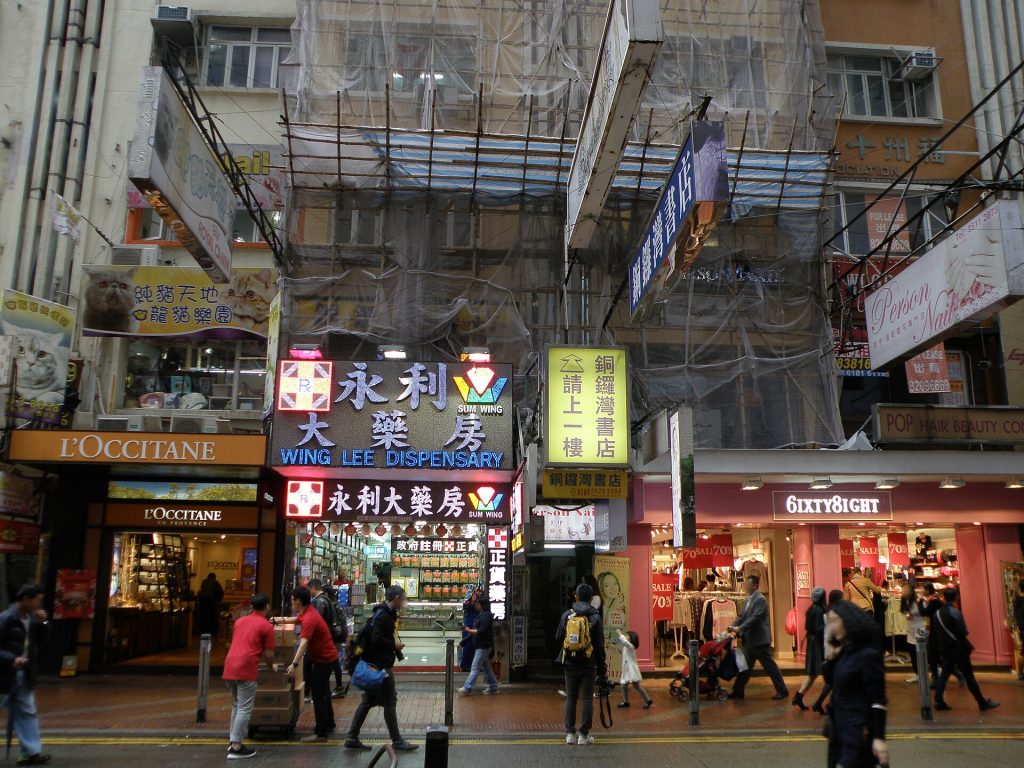
Between October and December 2015, in the space of just over two months, five men connected to Causeway Bay Books and its parent company, Mighty Current Media, disappeared one after another. General manager Lui Bo last logged on to the bookshop’s computer on 14 October. Co-owner Gui Minhai, a Swedish citizen, was taken from his condominium in Pattaya, Thailand, on 17 October; Thailand held no record of his leaving the country. Shop manager Lam Wing-kee crossed into Shenzhen on 24 October and was never heard from again. Business manager Cheung Chi-ping was seized by more than a dozen plainclothes men from his wife’s home in Dongguan. And finally, on 30 December, shareholder Lee Bo vanished outside a warehouse in Chai Wan, Hong Kong — his travel documents still in a drawer at home, even as calls to his wife came from a Shenzhen number.
Their business was selling books that cannot be published on the mainland — above all, insider accounts and gossip about the Chinese Communist Party’s top leaders — to mainland tourists visiting Hong Kong, where publishing and selling such books was entirely legal under “one country, two systems.” Only months after the disappearances did mainland authorities acknowledge, piece by piece, that all five were “under investigation” on the mainland. One of them later risked everything to describe what had happened: seized at the border by a “Central Task Force,” blindfolded, held in solitary confinement, and forced to “confess” on television. The case shook Hong Kong: the boundary that supposedly separated the two systems could be crossed, it turned out, by an invisible hand, at will.
Background and Causes
Causeway Bay Books was founded by Lam Wing-kee in 1994, on the second floor of 531 Lockhart Road in Causeway Bay — less than 300 square feet of space. Alongside ordinary literary and history titles, it specialised in political books unavailable on the mainland, and became a fixture for mainland tourists who made special trips to Hong Kong’s “upstairs bookshops.” In 2014 Lam sold the store to Mighty Current Media Ltd. and stayed on as manager. Mighty Current’s shareholders were Gui Minhai (34 per cent), Sophie Choi (34 per cent) and Lui Bo (32 per cent). Industry sources estimated that Mighty Current and its imprints produced between 30 and 60 per cent of the political-insider books sold in Hong Kong; Gui himself had written or published some 200 books in a decade.
In Beijing’s narrative, such books are “illegal publications endangering state security,” and in the tightening climate after 2013, titles about leaders’ private lives and power struggles were especially sensitive. According to the poet Bei Ling, a friend of Gui’s, the likely trigger for the disappearances was a forthcoming book about Xi Jinping’s private life that the company was preparing. When the five men vanished, none had any public criminal record, and no complaint against any of them had ever been filed in Hong Kong.
Course of Events
October 2015: four men vanish. Lui Bo logged on to the bookshop computer for the last time on 14 October; unconfirmed reports said he was taken from his wife’s home in Shenzhen. On 17 October, Gui Minhai was led away from his Pattaya home by an unknown man; his family alerted the Swedish authorities, Swedish police filed a report through Interpol, and Thai authorities confirmed there was no record of Gui departing Thailand. In late October, Cheung Chi-ping was taken in Dongguan. On 24 October, Lam Wing-kee made his routine crossing to Shenzhen and disappeared; on 5 November his wife filed a missing-person report in Hong Kong — hours later she received a call from Lam “reporting his safety,” refusing to say where he was.
30 December 2015: Lee Bo disappears in Hong Kong. Lee Bo, a British citizen, was married to shareholder Sophie Choi. After his four colleagues vanished, Lee had given a series of anonymous interviews to foreign media about their disappearance. On the evening of 30 December he vanished after delivering books to a warehouse in Chai Wan. His wife received two calls from him that night, displayed as coming from a Shenzhen number, saying he would be “assisting an investigation” for some time. All his travel documents were at home. A Hong Kong resident had crossed the border without passing any checkpoint and without any exit record — appearing, somehow, on the other side.
January–February 2016: televised confessions. On 17 January 2016, state broadcaster CCTV aired Gui Minhai’s “confession”: he claimed he had “voluntarily returned to surrender,” to answer for a 2003 drink-driving death in Ningbo after which he had fled. State media then added that he was suspected of further, unspecified “criminal activities.” In late February, Phoenix TV broadcast interviews in which Lam Wing-kee, Lui Bo and Cheung Chi-ping “admitted” to illegally selling some 4,000 books into the mainland through intermediaries. Guangdong police confirmed in February that all five were in custody in connection with Gui’s case.
March 2016: four come “back” — and go back again. In early March, Lui Bo and Cheung Chi-ping returned to Hong Kong one after another, asked police to cancel their missing-person cases, and promptly returned to the mainland. On 24 March, Lee Bo returned, insisting he had crossed “by his own methods” to assist the investigation voluntarily, and refused all detail. Lam Wing-kee remained in custody: held first in Ningbo under round-the-clock guard, then transferred to Shaoguan, where he worked in a library but was not allowed to leave the mainland. Meanwhile, on Sophie Choi’s instructions, shop staff destroyed some 45,000 books from the company’s warehouse, in the hope it would speed her husband’s release.
16 June 2016: Lam Wing-kee tells the truth. Lam was allowed back to Hong Kong on 14 June — his assignment: to retrieve a hard drive containing the bookshop’s customer records and carry it back across the border. On 16 June, on the eve of his scheduled return, he held a press conference alongside legislator Albert Ho and repudiated everything. On 24 October 2015, he said, he had been stopped at the Shenzhen crossing by officers of a “Central Task Force”; never told of any charge, denied a lawyer and denied contact with his family, he had been blindfolded, taken to Ningbo, kept in a cell under 24-hour guard and interrogated for months. His televised confession had been a script, rehearsed and read on cue. Lee Bo, he added, had told him privately that he had been taken away from Hong Kong. He spoke out, he said, because “if I don’t stand up, no one will dare to stand up again.” On 18 June, some 6,000 people marched in his support (police put the peak figure at about 1,900).
Gui Minhai: released, seized again, sentenced to ten years. In October 2017, Sweden’s foreign ministry said China had informed it that Gui had been released after serving his sentence for the traffic offence — but in reality he remained in Ningbo under tight surveillance, his movements restricted. On 20 January 2018, travelling by train to Beijing with two Swedish diplomats for a medical examination at the Swedish embassy — he was suffering neurological symptoms — Gui was seized again by about ten plainclothes officers, in front of the diplomats. Late on 24 February 2020, the Ningbo Intermediate People’s Court announced that Gui had been sentenced to ten years’ imprisonment and five years’ deprivation of political rights for “illegally providing intelligence overseas”; the notice said he had pleaded guilty, would not appeal, and had “restored his Chinese citizenship” in 2018. Swedish Foreign Minister Ann Linde responded that Sweden had never approved any renunciation of his citizenship, and demanded his immediate release and consular access. To this day, Gui’s place of detention has never been confirmed, and neither his family nor Swedish consular officials have ever been allowed to visit him.
Lam Wing-kee reopens the bookshop in Taiwan. In April 2019, as Hong Kong’s government pushed its extradition bill, Lam — fearing he could be surrendered to the mainland — moved to Taiwan. On 21 April 2020 he was splashed with red paint on a Taipei street; three men were later arrested and convicted. On 25 April 2020, Causeway Bay Books reopened near Taipei’s Zhongshan station, with a congratulatory floral tribute from President Tsai Ing-wen. In September 2024 the shop relocated to Taipei’s Zhongzheng District, where it continues to trade.
Key Figures and Reactions
The five men’s fates diverged: Lui Bo and Cheung Chi-ping returned to the mainland and vanished from public view; Lee Bo returned to Hong Kong and kept silence; Lam Wing-kee became the only one to tell the full story in public; Gui Minhai remains in prison. Gui’s daughter, Angela Gui, has campaigned for her father in Britain, Sweden and beyond, and has said publicly that Chinese officials sought meetings with her to pressure her into silence.
The British government responded most bluntly. In February 2016, Foreign Secretary Philip Hammond wrote in his six-monthly report to Parliament on Hong Kong that available information indicated Lee Bo had been “involuntarily removed to the mainland without any due process under Hong Kong SAR law,” constituting “a serious breach of the Sino-British Joint Declaration” and undermining “one country, two systems.” Earlier, on 5 January 2016, Hammond had raised the case with Chinese Foreign Minister Wang Yi, who replied that Lee was “first and foremost a Chinese citizen.”
The Hong Kong government was markedly more cautious: Chief Executive Leung Chun-ying said there was “no evidence” mainland officers had enforced the law in Hong Kong; police said they would follow up the missing-person cases. In the end, nothing came of it. Sweden has demanded Gui’s release and consular access for years, without result. PEN America devoted a 2016 report, “Writing on the Wall,” to the case, characterising it as a systematic assault on Hong Kong’s publishing freedom; Amnesty International and Human Rights Watch have continued to demand Gui’s release.
Disputed Figures and Accounts
“Voluntary cooperation” or cross-border abduction? The official version, echoed by the men on camera, was that Gui had voluntarily returned to surrender, the others were voluntarily assisting an investigation, and Lee Bo had sneaked across the border “by his own methods.” Lam Wing-kee’s press conference demolished that version: seizure by a Central Task Force at the border, blindfolded transfer, eight months of solitary detention, coerced confession. Lee Bo, back in Hong Kong, neither confirmed nor denied Lam’s account, saying only that he wished to say no more. The two accounts flatly contradict each other — but one detail cannot be explained away: Lee’s travel documents were in his home in Hong Kong, and no account of a “normal crossing” can survive that fact. It was on precisely this basis that the British government concluded he had been “involuntarily removed.”
Gui Minhai’s “Chinese citizenship.” The Ningbo court said Gui had “restored his Chinese citizenship” in 2018 — the ground on which China refused Sweden consular access. Sweden replied that under Swedish law, citizenship can be renounced only with the Swedish Migration Agency’s approval, that Gui had never applied, and that he remains a Swedish citizen. China has never produced any documentation. That a man’s nationality could be unilaterally “restored” during two years of incommunicado detention is among the aspects of the case most criticised by international lawyers.
What book was it really about? The true trigger remains a matter of inference. Friends such as Bei Ling point to a planned book about Xi Jinping’s love life. Gui’s televised emphasis on an old traffic case, state media’s vague “other crimes,” and the eventual conviction for “providing intelligence overseas” do not add up to a single story; the authorities have never disclosed any content of the alleged “intelligence.” What actually happened cannot be verified from outside — which is, of course, the common feature of secret arrests and secret trials.
Impact and Aftermath
The chilling effect on Hong Kong publishing was immediate: political titles vanished from airport and chain bookstores, publishers, printers and booksellers dropped sensitive projects, and authors took their manuscripts to Taiwan. The once-thriving “upstairs bookshop” trade in banned books withered. The deeper damage was psychological: for the first time, Hong Kong people had concrete proof that the Basic Law’s guarantees — freedom of movement, and the promise that mainland authorities may not enforce the law in Hong Kong — could be worth no more than the paper they were written on.
Four years later, in the 2019 anti-extradition movement, “Causeway Bay Books” was a name protesters invoked again and again: the fear of being sent across the border for trial had its roots here. Lam Wing-kee himself fled to Taiwan because of that very bill.
Gui Minhai’s fate, meanwhile, turned the case into an international emblem of “transnational repression”: a European Union citizen taken while on holiday in a third country, seized a second time in front of diplomats, stripped and reassigned nationality by fiat, and sentenced to a decade in secret. October 2025 marked ten years since his abduction, and Amnesty International again demanded his immediate and unconditional release. A decade on, four of the five booksellers’ lives have been irreversibly altered — and no one has ever had to answer for the hand that reached across the border.
Sources
PEN America, “Writing on the Wall: Chinese Government Influence in Hong Kong” (2016), including its timeline of the disappearances
UK Foreign Secretary’s Six-Monthly Report on Hong Kong, July–December 2015 (published February 2016), on Lee Bo’s “involuntary removal”
Lam Wing-kee’s press conference of 16 June 2016, as reported by the South China Morning Post, HK01 and Initium Media
English Wikipedia, “Causeway Bay Books disappearances,” “Causeway Bay Books” and “Gui Minhai,” and the reporting cited therein
Human Rights Watch and Amnesty International appeals for Gui Minhai’s release (January 2018, February 2020, October 2025)
Ningbo Intermediate People’s Court notice on Gui Minhai’s sentencing (24 February 2020) and the Swedish Foreign Ministry’s response (via AFP and Hong Kong Free Press)
Central News Agency (Taiwan) and Reuters on the reopening of Causeway Bay Books in Taipei (25 April 2020)
(Image source: Wikimedia Commons, by Exploringlife, CC BY-SA 4.0 — the original Causeway Bay Books storefront, 531 Lockhart Road, Causeway Bay, Hong Kong)