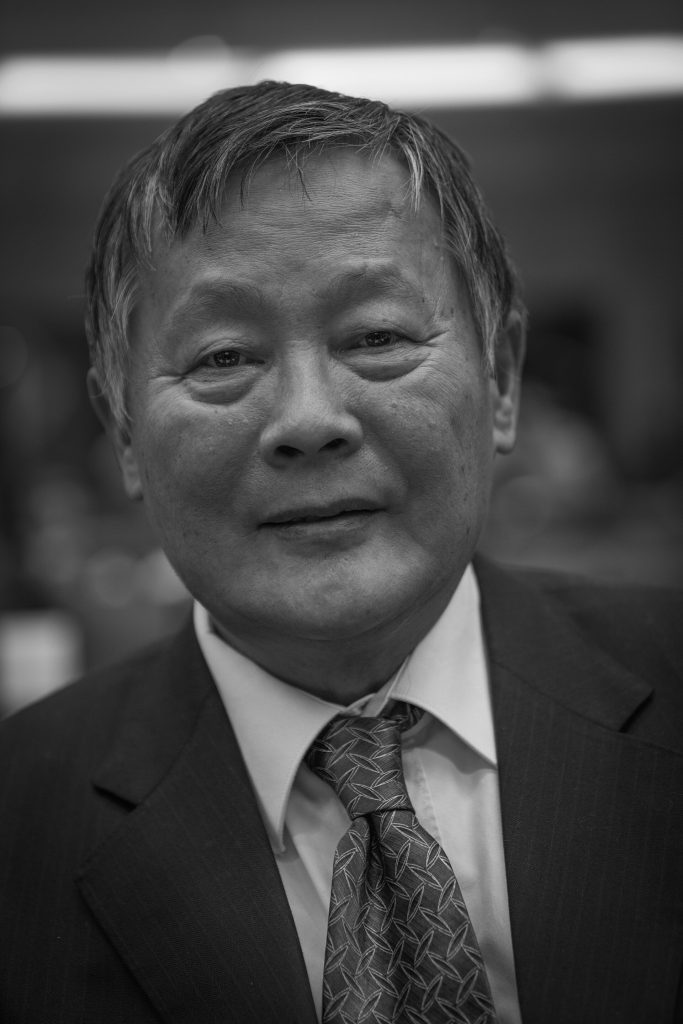
In November 1978, crowds began gathering beside a grey brick wall, some 200 metres long, on Xidan North Street in central Beijing. The wall was filling with handwritten big-character posters: accounts of Cultural Revolution injustices, demands for rehabilitation, attacks on bureaucracy and privilege, arguments about Mao’s legacy — texts that months earlier could have cost their authors their lives, now posted openly beside a busy shopping street while thousands copied them down. It soon had a name known around the world: the Xidan Democracy Wall. The brief thaw became known as the “Beijing Spring.”
What carried the Democracy Wall into history was a signed poster pasted up on 5 December 1978. Its author, Wei Jingsheng, was a 28-year-old electrician at the Beijing Zoo. In “The Fifth Modernization — Democracy and Others,” he argued that the officially proclaimed Four Modernizations — industry, agriculture, science and technology, and national defence — were not enough: a fifth, democracy, had to be added. He signed his real name and address. Less than four months later, on the night of 29 March 1979, Wei was arrested; on 16 October 1979 he was sentenced to 15 years for “counterrevolutionary propaganda and incitement” and for supplying military intelligence to a foreigner. He would be imprisoned twice, serving over 18 years in total, until in November 1997 he was released on medical parole and put on a plane to the United States. The Democracy Wall was the reform era’s first open democratic wave; Wei’s case drew its boundary: the economy could be reformed, but the political system and one-party rule were not open to challenge.
Background and Causes
The wall’s roots lay in a decade of accumulated grievance from the Cultural Revolution. Around the Qingming festival on 5 April 1976, tens of thousands of Beijing residents poured into Tiananmen Square with wreaths, posters and poems to mourn Premier Zhou Enlai, who had died that January — aiming their anger at the Gang of Four and the Cultural Revolution itself. The gathering was cleared by militia and police and labelled a “counterrevolutionary incident”; Deng Xiaoping was blamed as its organizer and stripped of his posts. This was the April Fifth Movement. Many of its participants — Xu Wenli, later editor of April Fifth Forum, and Chen Ziming and Wang Juntao — became the backbone of the Democracy Wall movement.
Mao died in September 1976 and the Gang of Four was arrested in October, formally ending the Cultural Revolution. But Hua Guofeng’s attempt to rule by Mao’s unalterable instructions — the “Two Whatevers” — set up a contest against the rehabilitated Deng. In May 1978, the article “Practice Is the Sole Criterion for Testing Truth” opened a nationwide debate that built momentum for Deng’s line; victims of past campaigns were rehabilitated in large numbers — per Wikipedia’s “Democracy Wall” article, some 130,000 victims of the 1957 Anti-Rightist Movement alone had their status restored in spring 1978. In November 1978 the verdict on the April Fifth Movement was reversed and the movement declared “completely revolutionary.” That cleared Deng’s record — and persuaded ordinary people that a space for public expression was opening.
Deng, meanwhile, was advancing his Four Modernizations, about to be ratified at the Third Plenum in December 1978. Most early posters attacked the Gang of Four and Cultural Revolution abuses, which suited Deng’s struggle against conservative rivals, so they were tolerated and even encouraged. But the crowds quickly moved beyond the approved script: petitioners posted their grievances; workers and young people debated wages, housing, privilege and corruption; and the more radical began asking whether, without democracy, the first four modernizations would come to nothing.
Course of Events
Late November 1978: the wall comes alive. According to Wikipedia’s “Democracy Wall” article: on 23 November 1978, Lü Pu posted an essay criticizing Mao and tracing the April Fifth Movement to backwardness, rigid thought control and poor living conditions — a poster remembered as the wall’s “fire lighter.” On 24 November, the Guizhou poet Huang Xiang and his comrades announced the Enlightenment Society and posted posters near Tiananmen; Huang is credited in several studies as among the first to question Mao in posters in Beijing. On 25 November, Ren Wanding and eight others formed a democracy discussion group; on 27 November they marched from the wall to Tiananmen Square with, by Wikipedia’s account, more than 10,000 participants demanding democracy and human rights — a date often taken as the movement’s formal beginning. On 26 November, Deng told a Japanese delegation that the wall’s activities were legal under the Constitution; days later he told American and Canadian journalists that big-character posters were “nothing to be afraid of” (per the Vienna project).
5 December 1978: “The Fifth Modernization.” Wei Jingsheng posted his long essay “The Fifth Modernization — Democracy and Others,” signed with his name and address. True democracy, he wrote, means the people’s right to choose their own representatives — and to replace them at any time. In a passage widely quoted from the English translation in his prison writings, he declared: “We want to be the masters of our own destiny. We need no gods or emperors and we don’t believe in saviors of any kind… Democracy, freedom, and happiness for all are our sole objectives.” The poster was exceptional because it named Deng Xiaoping and aimed not at the Gang of Four but at the one-party system itself. Wei went on to edit the journal Explorations (《探索》).
December 1978 – January 1979: the unofficial journals multiply. Wall and journal fed each other: posters were reprinted in journals, and journal pages were pasted back onto the wall. Guiyang’s Enlightenment (《启蒙》), first issued on 26 November 1978, was among the earliest; on 16 December, Xu Wenli, Liu Qing and Zhao Nan launched April Fifth Forum (《四五论坛》); in December, Bei Dao, Mang Ke and others founded the literary journal Today (《今天》), the cradle of Misty Poetry; Chen Ziming and Wang Juntao ran Beijing Spring (《北京之春》); Hu Ping and Jiang Hong ran Fertile Soil (《沃土》). On 1 January 1979, Ren Wanding founded the Chinese Human Rights Alliance and issued the “Chinese Declaration of Human Rights” — the Nineteen Articles — demanding freedom of expression, the release of political prisoners and a constitutional right to criticize Party and state leaders. On 15 January, six leading journals jointly declared they would fight for freedom of speech and of the press “without retaliation.”
January 1979: the arrest of Fu Yuehua. Petitioners, many of them peasants in Beijing to seek redress, marched in late 1978 and early 1979 behind banners reading “Down with hunger, down with repression — we want human rights, we want democracy.” One of their organizers, the worker Fu Yuehua, was arrested in mid-January 1979. Posters preserved in the Vienna archive show the wall erupting in protest, demanding her release in accordance with the Constitution; six activist groups issued a joint statement in her support — the movement’s first collective fight for an arrested member.
February–March 1979: war and tightening. From 17 February to 16 March 1979, China fought its border war against Vietnam. During the war, Wei published in Explorations an exposé of inhuman conditions in Beijing’s Qincheng Prison. On 25 March, hearing a crackdown was imminent, Wei and his colleagues rushed out a special issue carrying his signed article “Do We Want Democracy or a New Dictatorship?” (《要民主还是要新的独裁?》), warning by name against Deng Xiaoping’s transformation into a new dictator. On the night of 29 March, police took Wei from his home; some thirty activists were rounded up in the same period (per Orville Schell, as cited in Wikipedia’s “Wei Jingsheng” article).
30 March 1979: the Four Cardinal Principles. The day after Wei’s arrest, Deng delivered the closing speech of the Party’s theory work forum, “Uphold the Four Cardinal Principles”: uphold the socialist road, uphold the dictatorship of the proletariat, uphold the leadership of the Communist Party, and uphold Marxism-Leninism and Mao Zedong Thought. These, Deng said, were “the fundamental premise for realizing the Four Modernizations,” and tendencies doubting them must be resolutely fought (text as quoted in scholarly studies and the Vienna project). The speech drew a red line around all later political discussion — one still at the core of Party discourse today.
April–December 1979: aftershocks and closure. On 4 April, Ren Wanding was seized by plainclothes police at the wall as he posted a protest against the new restrictions and Wei’s arrest. Poster activity persisted under pressure until December 1979, when the authorities abolished the Xidan wall and moved poster-posting to a designated site in distant Yuetan Park, where posters had to be registered under real names and identity checked — which activists regarded as closure by another name. (Some English summaries give Ritan Park; Opletal’s research and participants’ accounts give Yuetan Park.) Xu Wenli was arrested in April 1981 and convicted in 1982 on charges including organizing a counterrevolutionary group; he served 12 years.
September 1980: the “Four Bigs” leave the Constitution. In September 1980, the National People’s Congress deleted from Article 45 of the Constitution the right to “speak out freely, air views fully, hold great debates and write big-character posters” — the “Four Big Freedoms” Deng had called constitutional two years earlier.
16 October 1979: the trial of Wei Jingsheng. After nearly seven months in detention, Wei was tried by the Beijing Intermediate People’s Court on two counts: supplying a foreigner with military intelligence about the war with Vietnam, and “counterrevolutionary propaganda and incitement” through posters and journals (per Schell’s account and overseas translations of the trial record). Wei defended himself at length and refused to plead guilty. Sentence was passed the same day: 15 years. A recording and transcript later circulated abroad and became the central primary source on the case (see below).
Key Figures and Reactions
Wei Jingsheng (born 1950). Born in Beijing to a cadre family, Wei joined the Red Guards at 16 in 1966, later served in the army from 1969, and in the northern countryside heard peasants describe the Great Leap famine at first hand — the experience that began his questioning of a system he had fervently believed in. “I felt as if I had suddenly awakened from a long dream,” he later wrote, “but everyone around me was still plunged in darkness.” From 1973 he worked as an electrician at the Beijing Zoo. Within the movement he was distinctive: most participants blamed a “bureaucratic class” and argued inside a socialist-democratic frame, whereas Wei identified the totalitarian system itself as the source of suffering and openly rejected rule by a Marxist party (per Lauri Paltemaa, Journal of Contemporary China, 2007). That made him both the movement’s emblem and the crackdown’s first target.
Deng Xiaoping and the Party leadership. Deng’s attitude ran from use, to tolerance, to suppression. In November 1978 his reform line needed public momentum against Party conservatives, and posters attacking Mao’s legacy and the Gang of Four served that purpose; he publicly called big-character posters legal and nothing to fear. Once criticism reached the system itself and Deng personally — and once his power was secured at the Third Plenum and war demanded unity — the attitude reversed in March 1979: first Wei’s arrest, then the Four Cardinal Principles. Scholars still dispute the interpretation (see below). Reform-minded leaders such as Hu Yaobang were comparatively sympathetic; accounts from Hu’s circle say he argued for a supervised “democracy park” rather than a ban, but could not change a decision already taken at the top.
Ren Wanding, Xu Wenli, Huang Xiang and the journal generation. Ren Wanding, a worker-activist, founded the Chinese Human Rights Alliance on New Year’s Day 1979 and issued its Declaration — the first open human-rights organization and manifesto in the People’s Republic; he was arrested at the wall on 4 April 1979. Xu Wenli, an April Fifth veteran who edited the north’s most influential unofficial journal, was imprisoned from 1981 to 1993, then sentenced to 13 more years in 1998 for helping found the China Democracy Party, before medical parole to the United States in 2002. Huang Xiang and Guizhou’s Enlightenment Society carried underground literature onto the wall, while Bei Dao and Mang Ke’s Today launched Misty Poetry. The generation scattered into later history: Chen Ziming and Wang Juntao became strategists of the 1989 movement and received heavy sentences; many others passed through prison, exile or silence.
The international reaction. For foreign journalists, the wall was the first chance since 1949 to hear ordinary Chinese speak politics freely; “The Fifth Modernization” was reported worldwide within days, and Wei’s arrest and sentencing drew sustained condemnation from Western media and human-rights groups. Amnesty International adopted Wei as a prisoner of conscience. Andrew Chubb’s study notes an irony: Western coverage of the “Beijing Spring” improved American perceptions of China in late 1978 and smoothed the path to normalization of US–China relations on 1 January 1979 — after which Washington’s reaction to the crackdown was muted.
Disputed Figures and Accounts
The “military intelligence” charge: espionage, or speech punished? This is the case’s central dispute. The official account holds that, during the war with Vietnam, Wei passed military intelligence to a foreigner. Wei and his supporters reply that what he discussed with foreigners was not secret, and that the sentence’s real object was his political writing; Amnesty International and Human Rights Watch have consistently treated him as a prisoner of conscience. The trial record that circulated overseas — disclosed on posters in October 1979 and later translated by Amnesty and others — shows Wei rebutting the charges point by point. But it is not an official document: while scholars generally accept its authenticity, it cannot be checked against the case file, which China has never released.
Why did Deng turn? One explanation stresses fear of losing control: as posters moved from the Gang of Four to the one-party system and to Deng himself, Deng concluded the movement threatened order and his reform agenda. A second stresses instrumentality: Deng had viewed the wall all along as a weapon against Hua Guofeng and the conservatives; with power won at the Third Plenum and war requiring unity, the weapon could be put away. Both readings draw on public texts — Deng’s remarks of November 1978 and his speech of 30 March 1979 — and differ in inferring motive.
The movement’s numbers. Sources diverge. Wikipedia counts more than 50 unofficial journals in Beijing alone between the winter of 1978 and the spring of 1981; Chubb’s study cites a Party-history figure of more than 80 groups, other listings of 67 journal titles outside Beijing, and totals as high as 127; the Chinese Human Rights Reader speaks of more than one hundred journals nationwide. Print runs were usually only 200 to 500 copies per issue, spread further by hand-copying, so circulation and influence cannot be equated.
The official narrative and the information blockade. In the official Chinese narrative, this history has long been played down: Party histories tend to describe the Democracy Wall as a brief “erroneous trend” exploited by a few, and Wei as a convicted “counterrevolutionary.” Inside China today, Wei’s name and writings and any positive account of the wall cannot be openly published or circulated online; his prison letters could only be published abroad.
Impact and Aftermath
Wei’s later life: 18 years in prison and exile. In prison Wei spent long periods in solitary confinement and his health broke down, yet he kept writing — including letters addressed directly to Deng. Smuggled out, the letters were published abroad in 1997 as The Courage to Stand Alone. On 14 September 1993, a week before the IOC voted on Beijing’s bid for the 2000 Games and about six months before his 15 years expired, he was paroled. He refused to keep quiet. After meeting US Assistant Secretary of State John Shattuck on 27 February 1994, he was detained in early March and arrested again on 1 April 1994 while trying to return to Beijing, then held for well over a year in an undisclosed location. In December 1995 he was sentenced to 14 years for “conspiring to subvert the government,” after a trial Amnesty International condemned as unfair. Honours reached him in his cell: the Olof Palme Prize in 1994, the Robert F. Kennedy Award and the European Parliament’s Sakharov Prize in 1996, and the National Endowment for Democracy Award in 1997. On 16 November 1997, following high-level US–China exchanges and intense international pressure, he was released on “medical parole” and put directly on a flight to the United States. He founded the Wei Jingsheng Foundation in 1998 and remains active in the democracy movement — two sentences totalling 29 years, of which he served more than 18.
The long tail of the Four Cardinal Principles. The principles Deng announced on 30 March 1979 were written into the preamble of the 1982 Constitution and have bounded Chinese political discussion ever since: successive campaigns, the official verdict on the 1989 movement, and today’s prohibitions on “improper discussion” all trace their logic to that speech. Together, the movement’s defeat and the speech established the reform era’s basic bargain: the Party could repudiate Mao’s excesses and build a market economy, but the Party’s own rule was not a subject for discussion.
From the Democracy Wall to 1989 and Charter 08. The Democracy Wall generation seeded every later Chinese democracy movement: Chen Ziming and Wang Juntao of Beijing Spring became central figures of 1989; the Today poets shaped a generation’s inner life; and Liu Xiaobo, a drafter of Charter 08 in 2008, traced his political awakening to the Democracy Wall era. The poster-and-journal combination was modern China’s first attempt to create a public sphere without press freedom; its descendants run to Charter 08’s online signature campaign and later protests. And Wei’s question of 1978 — whether economic growth can substitute for political rights — remains unanswered over China today.
Sources
Wikipedia, “Democracy Wall” and “Wei Jingsheng”; Chinese Wikipedia, “The Fifth Modernization” (第五个现代化) and “Xidan Democracy Wall” (西单民主墙)
University of Vienna, “Beijing Spring” (Pekinger Frühling) digital archive: poster photographs and translations; Helmut Opletal, “The 1978–1981 Democracy Wall Movement,” Journal of the European Association for Chinese Studies, 2021
Andrew Chubb, study of the Democracy Wall movement (Lancaster University repository)
Wei Jingsheng, The Courage to Stand Alone: Letters from Prison and Other Writings (Penguin, 1997), including “The Fifth Modernization” in English and his 1979 trial defence
Amnesty International: document on Wei Jingsheng (AI Index: ASA 17/34/97, 1997) and materials on the 1979 trial record
European Parliament, Sakharov Prize: laureate page for Wei Jingsheng, 1996
“Chinese Declaration of Human Rights” (the Nineteen Articles), Chinese Human Rights Alliance, January 1979, English translation at constitution.org
Lauri Paltemaa, “The Democracy Wall Movement, Marxist Revisionism, and the Variations on Socialist Democracy,” Journal of Contemporary China, 2007
Orville Schell, Discos and Democracy (1989); Schell and David Shambaugh, eds., The China Reader: The Reform Era (1999)
(Image source: Wikimedia Commons, licensed CC BY-SA 3.0, by Claude Truong-Ngoc)