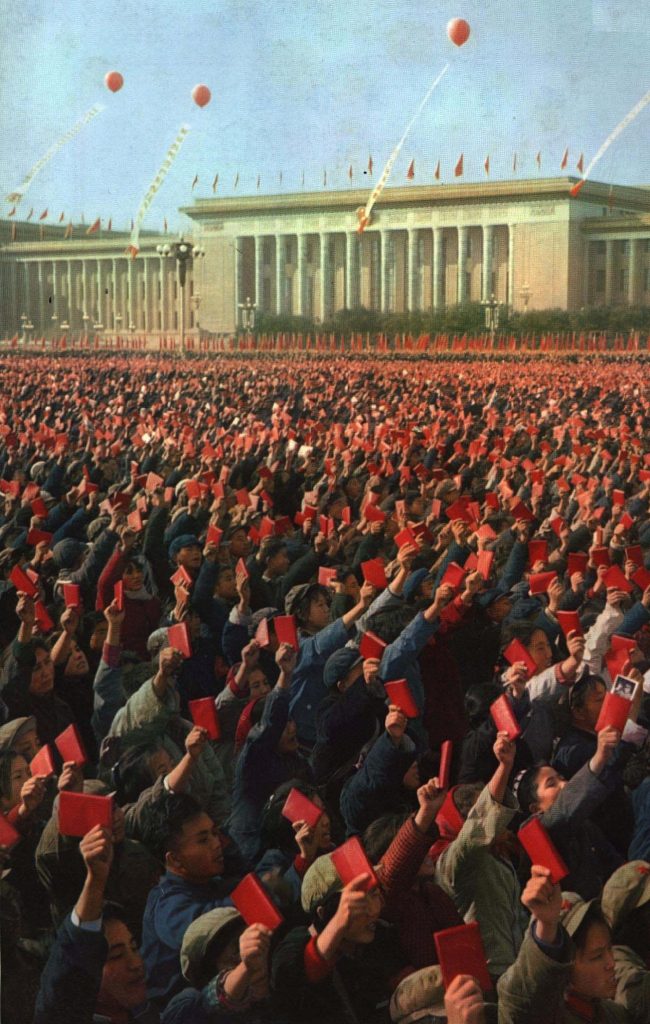
From May 1966 to October 1976, China endured a political movement launched personally by its supreme leader: the Great Proletarian Cultural Revolution. Begun in the name of “preventing a capitalist restoration,” it became an assault on the party-state, schools, factories and virtually every family. A head of state was struggled against and left to die. Millions were killed in armed clashes, massacres and purges, tens of millions were persecuted, university entrance examinations were suspended for a decade, and cultural heritage suffered unprecedented destruction.
In 1981, the CCP’s Resolution on Certain Questions in the History of Our Party judged the Cultural Revolution “civil turmoil, wrongly launched by the leader and exploited by counter-revolutionary groups, which brought grave disaster to the Party, the country and the people” — the most severe setback since 1949. It gave no death toll. The subject remains tightly restricted in mainland China: no national memorial museum, no public list of victims, no permitted definitive count of the dead. This article draws on published records and scholarship to document those ten years as fully as possible.
Background and Causes
The roots of the Cultural Revolution lay in the catastrophe of the Great Leap Forward. After the famine of 1959–1961, which killed tens of millions, Mao Zedong retreated to the “second line” while President Liu Shaoqi and Party General Secretary Deng Xiaoping ran day-to-day affairs and pursued economic adjustment. Mao resented this. He believed “revisionism” was growing inside the Party, that China risked following the Soviet Union into “changing colour,” and that his own authority was under challenge.
The Sino-Soviet split made “opposing imperialism and revisionism” the ideological watchword, and in the Socialist Education (Four Cleanups) Movement from 1963, Mao’s disagreements with Liu became open. In November 1965, in a move orchestrated by Jiang Qing and others, Yao Wenyuan attacked Wu Han’s play Hai Rui Dismissed from Office in Shanghai’s Wenhui Daily as an anti-Party “poisonous weed” — widely regarded as the opening shot. Mao then bypassed the Beijing apparatus and prepared, from Shanghai and Hangzhou, a “revolution” mobilizing the masses directly against the bureaucracy. The army under Defence Minister Lin Biao and the army-wide promotion of Quotations from Chairman Mao — the “Little Red Book” — fed a personality cult that by 1966 had reached its peak.
Course of Events
Launch and the Red Guards (May–December 1966)
On May 16, 1966, an enlarged Politburo meeting adopted the “May 16 Notification.” It dissolved Peng Zhen’s Group of Five, created a Central Cultural Revolution Group under figures including Chen Boda, Jiang Qing and Kang Sheng, and declared that “bourgeois representatives” had infiltrated the Party. On May 25, Nie Yuanzi and others at Peking University posted a big-character poster attacking the university leadership; Mao praised it as “the first Marxist-Leninist big-character poster in the country” and ordered it broadcast nationwide. From June, schools suspended classes to “make revolution,” and students — first at Tsinghua University High School — organized as “Red Guards.”
On August 1, Mao wrote in support of the Tsinghua Red Guards; on August 5 he published his own poster, “Bombard the Headquarters,” aimed at Liu Shaoqi. On August 8, the Eleventh Plenum adopted the “Sixteen Points” on the Cultural Revolution. On August 18, Mao received the Red Guards in Tiananmen Square for the first time, accepting a Red Guard armband from student Song Binbin; by November he had held eight such receptions for a total of 11 to 12 million Red Guards, who travelled free on trains in nationwide “link-up” journeys. The movement exploded across the country.
What followed in Beijing is known as “Red August.” Destroying the “Four Olds” — old ideas, old culture, old customs and old habits — Red Guards ransacked homes, smashed temples and destroyed antiquities, then turned on people: teachers, principals, members of the “Five Black Categories” (landlords, rich peasants, counter-revolutionaries, bad elements and rightists) and their families were beaten, humiliated and expelled. According to figures disclosed in the 1980s, in Beijing alone 1,772 people were beaten to death in August–September 1966, 33,695 homes were ransacked and 85,196 families driven out; the writer Lao She died in August after being struggled against. From August 27 to September 1, in the wake of Public Security Minister Xie Fuzhi’s remarks that beating “bad people” was not wrong, militia and cadres in 13 communes of Daxing County killed “category” persons and their families from prepared lists: 325 died, the oldest 80, the youngest a baby of 38 days, and 22 families were wiped out — one of the earliest fully documented rural massacres of the period.
Seizures of power, armed fighting and massacres (January 1967–1968)
In January 1967, Shanghai rebels backed by Zhang Chunqiao and Yao Wenyuan seized municipal power in the “January Storm.” After Mao endorsed the “Shanghai model,” rebels seized power nationwide and new “revolutionary committees” were installed. But rebel organizations split into rival factions. In summer 1967, Jiang Qing promoted “attack with words, defend with arms,” and armed fighting (wudou) escalated, with factions using guns, artillery and even tanks seized from arsenals. Chongqing alone recorded at least 1,700 deaths. Researchers estimate 300,000 to 500,000 deaths in armed fighting nationwide; a CCP internal document instead gives 237,000 killed and 7,030,000 injured or disabled. Both figures are recorded here.
Still larger tolls came from organized massacres. From August to October 1967, Dao County and more than ten surrounding counties in Hunan killed “category” persons and their children: 9,093 died in total (in Dao County itself, 7,696 killed and 1,397 forced to suicide). In Guangxi in 1967–1968, official records put the toll at 100,000 to 150,000; the winning side, associated with provincial leader Wei Guoqing, systematically slaughtered defeated opponents and “class enemies,” and in Wuxuan and elsewhere victims’ hearts and livers were eaten at “human flesh banquets.” Drawing on the Party’s own internal inquiries, journalist Zheng Yi documented this in Scarlet Memorial (Chinese edition 1993; English edition 1996): official investigations confirmed 76 cases of cannibalism, while his informants said the real number was at least 100. Only 34 people were imprisoned in the 1980s reckoning, and the findings were ordered kept secret. The army entered Guangxi in July 1968 before the violence ended.
From 1967 to 1969, Inner Mongolia was convulsed by the “Inner Mongolian People’s Revolutionary Party” purge — the hunt, under commander Teng Haiqing, for a party that had in fact dissolved in the 1940s. According to the Supreme People’s Procuratorate’s official 1980 complaint figures, 346,000 people were arrested, 16,222 were persecuted to death (another official figure gives 16,632), and more than 81,000 were permanently disabled, the overwhelming majority of them ethnic Mongols. Other estimates put deaths between 20,000 and 100,000, with over a million people affected. The purge was later declared a miscarriage of justice, but Teng Haiqing was never tried.
The army restores order: Cleansing the Class Ranks and the sent-down youth (1968–1971)
In 1968 Mao decided the army would clean up the mess. Propaganda teams entered schools and workplaces, and the Red Guards were dissolved. From May 1968, the “Cleansing the Class Ranks” campaign spread nationwide: run by the new revolutionary committees, it used case teams, torture and forced confessions to hunt alleged traitors, spies and capitalist roaders. Scholarly estimates hold that some 30 million people were persecuted in this campaign, with deaths estimated at 500,000 to 1.5 million; the Party later admitted it produced large numbers of unjust cases. In October 1968, Liu Shaoqi was “expelled from the Party forever” as a “renegade, traitor and scab.” On November 12, 1969, he died, denied proper medical care, in secret detention in Kaifeng; his body was cremated under a false name, and his family learned of his death only years later.
In December 1968, Mao called on educated youth to go “up to the mountains and down to the countryside.” By the end of the 1970s, some 17 million urban young people had been sent to villages and frontier farms, their schooling cut short — China’s “lost generation.” In April 1969, the Ninth Party Congress declared the Cultural Revolution victorious and wrote Lin Biao into the Party constitution as Mao’s successor. From February to November 1970, the “One Strike–Three Antis” campaign targeted alleged counter-revolutionaries, graft and speculation: according to post-Cultural Revolution official statistics, 1.87 million people were persecuted as traitors, spies and counter-revolutionaries, and more than 284,800 were arrested or killed (scholar Ding Shu estimated deaths at around 200,000). On March 5, 1970, the young worker Yu Luoke was publicly sentenced and executed in Beijing for his essay “On Family Background,” which had attacked the doctrine that class status was inherited by blood.
The Lin Biao incident and the final years (1971–1976)
On September 13, 1971, came the decade’s most shocking turn: Lin Biao, the designated successor, fled by air with his wife Ye Qun and son Lin Liguo, and their Trident crashed near Öndörkhaan in Mongolia, killing all aboard. The official account holds that Lin Liguo had drafted the “Project 571” outline for assassinating Mao and that the family fled when it was exposed; whether Lin Biao himself directed any plot, and details of the crash — the Mongolian investigation disputed the claim that the plane ran out of fuel — remain contested. The incident shattered public faith, triggered a purge of Lin’s officer corps, and was followed by the “Criticize Lin Biao and Confucius” campaign.
Deng Xiaoping returned as vice-premier in 1973 and in 1975 led a broad rectification that briefly restored order, while the “Gang of Four” — Jiang Qing, Zhang Chunqiao, Yao Wenyuan and Wang Hongwen — controlled propaganda and fought Zhou Enlai and Deng for influence. Zhou Enlai died on January 8, 1976. Around the Qingming festival, Beijing residents laid wreaths in Tiananmen Square to mourn Zhou and attack the Gang of Four; the gathering culminated on April 5, 1976, and was forcibly cleared that night — the “April Fifth Tiananmen Incident.” Deng was blamed and on April 7 was stripped of all posts (though he kept Party membership). Mao Zedong died on September 9, 1976. On October 6, Hua Guofeng, Ye Jianying, Wang Dongxing and others arrested the Gang of Four. The Cultural Revolution was over.
Key Figures and Reactions
Mao Zedong — initiator and ultimate arbiter. Bypassing normal procedures, he used posters, mass receptions and personal instructions to ignite the movement, used the army to end its chaos, and held the final word over the fates of Liu Shaoqi, Lin Biao and Deng Xiaoping. The 1981 Resolution assigns him “chief responsibility,” while attributing the worst crimes to the Lin Biao and Jiang Qing groups and preserving “Mao Zedong Thought” — a division that still bounds the official narrative.
Liu Shaoqi — the highest-ranking victim. The president who had succeeded Mao as head of state was denounced as “the biggest capitalist roader in the Party,” publicly humiliated, held in solitary confinement without adequate medical care, and died wrongfully in Kaifeng in 1969. Rehabilitated in 1980, his case was officially called the Party’s greatest miscarriage of justice.
Lin Biao — from successor to “traitor.” Defence minister and chief promoter of the Mao cult in the army, named successor in 1969; after falling out with Mao at the 1970 Lushan plenum, he died in the 1971 crash and was posthumously branded a coup-plotter and traitor. The facts of his fall remain contested.
Jiang Qing and the Gang of Four. Jiang Qing, Zhang Chunqiao, Yao Wenyuan and Wang Hongwen dominated propaganda in the later years. At their televised trial in 1980–1981, Jiang and Zhang received suspended death sentences (later commuted to life), Yao 20 years and Wang life imprisonment. The indictment charged them with persecuting 729,000 people, of whom more than 34,800 were persecuted to death — a figure covering only that case, not the decade’s total toll.
Zhou Enlai — buffer inside the system. Premier throughout, he implemented many Cultural Revolution policies yet also protected cadres, specialists and cultural sites where he could; historians still debate his role. His death directly triggered the April Fifth Movement.
Deng Xiaoping — down, up, down, up. Purged twice in this decade: denounced in 1966 as the “number-two capitalist roader” and sent to labour in a Jiangxi tractor factory; recalled in 1973; purged again after April 1976. After his final return in 1977, he led the rehabilitation drive and the drafting of the 1981 Resolution, and launched reform and opening.
Ordinary people who resisted. Yu Luoke was executed in 1970 for challenging blood-line doctrine. Zhang Zhixin, a Liaoning cadre who criticized the personality cult, was imprisoned in 1969, tortured, and executed on April 4, 1975 — her vocal cords cut before the execution so she could not shout; in 1979 she was rehabilitated as a “revolutionary martyr.” Internationally, China was largely sealed off; the 1967 burning of the British chargé d’affaires’ office shocked the world, while some Western leftist youth romanticized the Revolution — a jarring contrast with the suffering inside.
Disputed Figures and Accounts
How many people died in the Cultural Revolution? There is no official total, and the different estimates must not be conflated:
1. Local-gazetteer scholarship (the most widely cited). Using 1,520 county gazetteers, Stanford sociologist Andrew G. Walder and Yang Su estimated for rural China alone 750,000 to 1.5 million deaths, a similar number permanently injured, and 36 million people subjected to political persecution — with the great majority of casualties occurring in 1968–1971, during repression by the newly established revolutionary committees rather than during the Red Guard phase. Roderick MacFarquhar and Michael Schoenhals cite the same conservative estimate in Mao’s Last Revolution (2006). Walder’s later work, based on 2,213 county and city gazetteers, revised the nationwide death estimate to 1.1–1.6 million, with 22–30 million persecuted.
2. Higher scholarly estimates. Frank Dikötter, in The Cultural Revolution: A People’s History, argues for at least 2 million deaths. R. J. Rummel’s estimate of 7.73 million is far higher and his methods are widely disputed. Song Yongyi’s edited volume Massacres during the Cultural Revolution (2002) and his “Chronology of Mass Killings during the Chinese Cultural Revolution (1966–1976)” document individual massacres — Daxing, Dao County, Guangxi and others — case by case; Song himself stresses that, with archives closed, no exact total can be established.
3. Figures attributed to Party insiders. The most repeated is the “Ye Jianying figure”: a 1997 book by Dong Baoxun and Ding Longjia quotes Ye as saying on December 13, 1978, that after investigation, “20 million people died in the Cultural Revolution, over 100 million suffered political persecution, and 800 billion yuan were wasted.” No transcript has ever been published and the Party has never confirmed it; scholars treat it as an unverified second-hand quotation — a claim, not a statistic. A different version attributes to Ye a figure of about 1.5 million deaths; the two versions themselves show the unreliability of such numbers. Deng Xiaoping told Oriana Fallaci in 1980 that the death toll was “an astronomical figure that can never be estimated.”
4. Official verdict without a total. The 1981 Resolution offers only a qualitative verdict — “grave disaster,” “ten years of turmoil” — and no death toll; the Gang of Four trial figures (729,000 persecuted, more than 34,800 persecuted to death) cover only that indictment. Estimates of the “persecuted” range from 36 million (rural persecution, Walder and Su) to claims of 100 million affected including family members, depending entirely on whether being struggled against, having one’s home ransacked, imprisonment, rustication or family implication are counted. Throughout this article, abnormal deaths, persecution and struggle sessions are therefore kept as separate categories, and readers citing any figure should state its definition and source.
Details of the Lin Biao incident, the scale of cannibalism in Guangxi (Zheng Yi’s second-hand material has been questioned, though the Party’s own investigations confirmed cannibalism occurred), and individual massacre tolls cannot be settled while the archives stay closed — information control is itself the greatest obstacle to this history.
Impact and Aftermath
Education was hit first and longest: the entrance examination was suspended from 1966 until 1977, blighting a generation’s schooling, while teachers were stigmatized as the “Stinking Ninth Category.” Cultural losses were immense: temples, tombs, paintings and private book collections were destroyed, and the Confucius temple and cemetery in Qufu were desecrated. Economically, seizures of power and armed fighting repeatedly drove production down. The deepest damage was to social trust: informing, children reporting parents and students beating teachers tore the ethics of family and community, leaving trauma across generations.
Politically, the decade destroyed what little rule of law existed: a head of state died without trial, and the security, procuratorial and court systems were “smashed.” After Mao’s death, the 1978 truth-criterion debate and the Boluan Fanzheng drive reversed large numbers of unjust cases; the 1981 Resolution “thoroughly negated” the Cultural Revolution, and reform and opening followed.
But the reckoning was incomplete. The official narrative concentrates blame on Mao’s “errors” and on Lin Biao and the Gang of Four, avoiding the disaster’s institutional roots; the archives remain essentially closed, and in mainland classrooms and publishing the period is compressed into a few formulaic sentences. The writer Ba Jin’s call for a Cultural Revolution museum was never realized, and the one local museum, in Shantou, was covered up in 2016. Remembering how these ten years slid into mutual persecution — and remembering the names and numbers — is the first step toward preventing a repetition.
Sources
Central Committee of the CCP, Resolution on Certain Questions in the History of Our Party Since the Founding of the People’s Republic of China, adopted June 27, 1981
Roderick MacFarquhar & Michael Schoenhals, Mao’s Last Revolution, Harvard University Press, 2006
Andrew G. Walder & Yang Su, “The Cultural Revolution in the Countryside: Scope, Timing, and Human Impact,” The China Quarterly, 2003; Andrew G. Walder, “Rebellion and Repression in China, 1966–1971,” Social Science History, 2014
Zheng Yi, Hongse jinianbei (Taipei, 1993); English edition: Scarlet Memorial: Tales of Cannibalism in Modern China, Westview Press, 1996
Song Yongyi (ed.), Wen’ge datusha [Massacres during the Cultural Revolution], Hong Kong, 2002; Song Yongyi, “Chronology of Mass Killings during the Chinese Cultural Revolution (1966–1976),” Online Encyclopedia of Mass Violence, Sciences Po
Frank Dikötter, The Cultural Revolution: A People’s History, 1962–1976, Bloomsbury, 2016
Wikipedia (English): Cultural Revolution, Red August, Daxing Massacre, Guangxi Massacre, Inner Mongolia Incident, Cleansing the Class Ranks, One Strike-Three Anti Campaign, Violent Struggle; Wikipedia (Chinese): 文化大革命, 清理阶级队伍, 内人党事件
Figures from the Supreme People’s Procuratorate’s 1980 complaint on the Inner Mongolia purge, as publicly reported
(Image source: Wikimedia Commons, public domain — Red Guards in 1967, originally published in a Chinese official pictorial, author unknown)