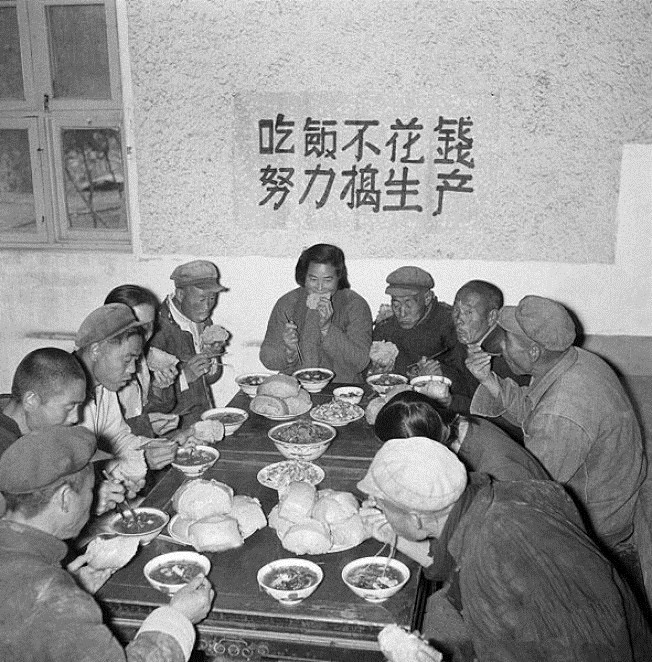
Between 1959 and 1961, China suffered a famine that reached almost every province. The government first called these years the “Three Years of Natural Disasters” and later the “Three Years of Difficulty”; historians and the public call them the Great Chinese Famine. Some scholars widen the period to 1958–1962. It is widely regarded as the deadliest famine in history and one of the greatest man-made disasters ever recorded. The overwhelming majority of the dead were peasants. The hardest-hit provinces, measured by the share of the population that died, were Anhui (about 18 percent), Chongqing (15 percent), Sichuan (13 percent), Guizhou (11 percent) and Hunan (8 percent), according to research data compiled by the English Wikipedia.
This was not simply a natural disaster. The famine was directly produced by the Great Leap Forward, launched in 1958, and by the people’s communes: falsified harvest reports, excessive state grain procurement, communal canteens, backyard steel furnaces and the political punishment of anyone who told the truth combined to turn a fall in agricultural output into a nationwide demographic catastrophe. In June 1981 the Chinese Communist Party (CCP) itself admitted, in its Resolution on Party History, that the disaster was “mainly due to the errors of the Great Leap Forward and of the struggle against ‘right opportunism’,” while also citing natural calamities and the Soviet Union’s withdrawal of contracts. How many people died remains unsettled — and presenting the rival estimates side by side is central to this article.
Background and Causes
The Great Leap Forward and communisation. In 1958 CCP Chairman Mao Zedong launched the Great Leap Forward, promising to multiply industrial and agricultural output through mass mobilisation and to “catch up with Britain and overtake America.” Within a few months the countryside was reorganised into more than 25,000 people’s communes; by the end of 1958 over 99 percent of peasant households had been absorbed. Land, tools and livestock became collective property, and peasants ate in public canteens — more than 2.6 million of them, by researchers’ counts — which at first advertised that “eating costs nothing.” The canteens’ early open consumption wasted stocks; once household pots and private grain were confiscated, a family whose canteen ran out of food had no means of self-rescue left.
Exaggeration and the “sputniks.” Under political pressure and in an atmosphere of competitive zeal, localities vied to report impossible harvests — “launching sputniks,” in the jargon of the day. On 13 August 1958 the front page of the People’s Daily reported that the Jianguo commune in Macheng, Hubei, had produced over 36,900 jin of early rice per mu. Such records were fabricated through transplanting tricks and outright falsification. Procurement quotas were then set on the basis of these fictitious figures. Official statistics show grain output falling from 200 million tons in 1958 to 170 million tons in 1959 and 143.5 million tons in 1960 — yet state grain procurement rose from about 46 million tons in 1957 to about 64 million tons in 1959 (figures compiled by Li and Yang from data published by the Ministry of Agriculture in 1989; totals vary slightly by source). In many places the state took the peasants’ food grain and seed grain alike.
Bad agronomy and diverted labour. The Leap promoted the pseudo-scientific methods of the Soviet agronomist Trofim Lysenko — extremely dense planting and deep ploughing — which damaged soil and reduced yields. The “Four Pests” campaign massacred sparrows on a huge scale, removing the natural predator of crop-eating insects and triggering infestations. At the same time, tens of millions of peasants were diverted to waterworks and steel-making: in 1958 the countryside was dotted with small “backyard furnaces,” peasants melted down their own pots and tools to meet quotas, and of the claimed 10.7 million tons of steel produced that year, more than 3 million tons were unusable (per Wikipedia’s “Great Leap Forward” article). With labour pulled from the fields, some harvested crops rotted where they lay.
A system that punished information. After the Anti-Rightist Campaign of 1957, telling the truth carried political risk. Cadres protected themselves by reporting only good news, so reliable information about the disaster could not travel upward. Starving peasants who tried to flee were intercepted as saboteurs of production; letters begging for help were confiscated. For a long time the centre governed on the basis of a fictitious picture of abundance, and every correction arrived late.
Course of Events
Second half of 1958: communisation and exaggeration at their peak. Communes and canteens spread nationwide and the steel campaign reached its climax. Grain shortages and oedema already appeared in some areas that autumn, but “sputnik” reports continued, and the state procured grain according to the inflated figures.
1959: nationwide famine — and the Lushan reversal. Grain output fell 15 percent below 1958, famine spread across the country, and whole villages began to starve. Yet China’s net grain exports in 1959 rose to about 4.16 million tons, the highest level of the entire 1950s and 1960s (according to research by Meng, Qian and Yared on the famine’s causes); even in 1960, the worst year, net exports were maintained at about 2.66 million tons. In July 1959 the Central Committee met at Lushan. Defence Minister Peng Dehuai, who had seen starvation in his home region, sent Mao a private letter mildly criticising the Leap’s exaggerations and imbalances. Mao reacted furiously, circulated the letter, and denounced it as a “right opportunist” attack. A campaign against “right deviation” followed: Peng was purged and replaced by Lin Biao, and many cadres who had spoken honestly were criticised or removed. The correction window slammed shut; localities raised procurement and exaggeration again, and the famine sharply worsened.
Winter 1959 – spring 1960: the Xinyang Incident. Xinyang prefecture in Henan became the emblem of the disaster. The prefecture had about 8.5 million people; between October 1959 and April 1960 at least one million of them died unnatural deaths — roughly one in eight residents (according to Yang Jisheng’s Tombstone and other studies). Local cadres, in the name of combating “hidden grain,” searched homes, confiscated food and ran some 12,000 struggle sessions against peasants accused of concealing grain; the postal service was so tightly policed that large numbers of appeal letters were seized. Lu Baoguo, a Xinhua reporter stationed there, later told Yang Jisheng that on a bus journey he had seen corpse after corpse in the ditches, yet dared not write about it: “I had seen people who had told the truth being destroyed. Did I dare to write it?” Only in October 1960 did a report on Xinyang reach Mao, who blamed the catastrophe on a “restoration by landlord elements.” A central investigation team was sent, leading local officials were removed and prosecuted, and the Xinyang Incident became the first major local case of the famine formally dealt with by the centre.
1960: the peak of mortality. Grain output bottomed out and death rates soared. National Bureau of Statistics figures published later show that in 1960 alone China’s total population fell by about 10 million compared with the previous year. Anhui, Sichuan, Henan and Gansu suffered most; archives and memoirs from many regions record people eating clay and bark, and cases of cannibalism. In July 1960 the Soviet Union withdrew all its experts, deepening the economic crisis. In November 1960 the Central Committee issued an emergency directive allowing commune members to keep private plots and pursue sideline occupations — the first loosening.
1961: adjustment begins. The government halted grain exports and began importing grain from Canada, Australia and other countries; canteens were dissolved, accounting units made smaller, and deaths fell markedly. In April–May 1961, President Liu Shaoqi spent 44 days investigating villages in his native Hunan and concluded that the famine’s causes were “three parts natural disaster, seven parts man-made disaster” (三分天灾,七分人祸).
January–February 1962: the Seven Thousand Cadres Conference. An enlarged central work conference in Beijing brought together more than 7,000 officials. Liu Shaoqi formally repeated his verdict — 30 percent natural disaster, 70 percent human error — Mao made a self-criticism and withdrew to the “second line,” leaving day-to-day economic management to Liu and Deng Xiaoping. The adjustment policies summed up as sanzi yibao — private plots, free markets, household responsibility for profit and loss, and output quotas contracted to households (三自一包) — were extended across the countryside, and agricultural output did not recover to its 1957 level until about 1965. The famine ended, but its political aftershocks had barely begun.
Key Figures and Reactions
Mao Zedong — author of the Leap and final arbiter. Mao launched the Great Leap Forward and the communes, turned policy criticism at Lushan into a question of political line, and thereby closed the correction window. After 1960 he accepted a retreat and stepped back from daily management, but never admitted that the line itself had been wrong. Frank Dikötter’s book quotes a remark attributed to Mao in Shanghai in 1959 — “When there is not enough to eat, people starve to death. It is better to let half the people die so that the other half can eat their fill.” Yang Jisheng has stated explicitly that he believes Mao never said this. The quotation’s authenticity remains disputed, and it is presented here as such, not as settled fact.
Peng Dehuai — the price of speaking out. The veteran marshal investigated his home area, found people starving, and wrote to Mao at Lushan. He was branded head of an “anti-party clique,” spent the rest of his life under house arrest, and was persecuted to death during the Cultural Revolution. His fate ensured that no senior figure dared speak so openly again — a turning point that researchers regard as key to the famine’s prolongation.
Liu Shaoqi and Deng Xiaoping — the adjusters. Liu’s “three parts natural disaster, seven parts man-made” was the most candid verdict delivered from within the leadership. The adjustment policies he and Deng directed revived the countryside — and were later denounced by Mao as “taking the capitalist road.” Liu died in custody in Kaifeng in 1969, denied proper medical care.
Local cadres and ordinary peasants. Within the chain of exaggeration, procurement and information blockade, some local cadres were both victims and perpetrators: in Xinyang and elsewhere, officials used violent grain searches and news blackouts that directly produced mass death. Ordinary peasants had no channel of appeal and no right to flee. The archival research of Yang Jisheng and Frank Dikötter documents many cases of peasants beaten to death for “stealing” a sweet potato or hiding a handful of grain; Dikötter estimates that at least 2.5 million people were beaten or tortured to death — a figure itself disputed, as discussed below.
The international response. Because of the information blockade, the outside world knew little while the famine raged: Beijing refused a food-aid offer from the International Red Cross and insisted reports of famine were exaggerations. Only when China began buying Western grain in 1961 did the scale of the disaster become clear abroad. Scholars abroad have since reconstructed the famine from demographic data and archives, while in mainland China discussion remains tightly restricted and works such as Tombstone can be published only in Hong Kong.
Disputed Figures and Accounts
The death toll is the central dispute of this event. Wartime-style statistical distortion at the time, decades of archival secrecy, differing definitions of “unnatural death,” and differing start and end years produce estimates ranging from just over ten million to forty-five million. The main figures are set out below, with their methods.
Official and Party-history figures. The Seventy Years of the Chinese Communist Party (CCP Party History Publishing House) and Bo Yibo’s memoir Recollections of Certain Major Decisions and Events both record that, according to official statistics, in 1960 alone China’s total population fell by more than 10 million compared with the previous year. That is a population decline — which includes births that never occurred — not a count of famine deaths. China’s Population: A General Survey (1991) put “unnatural deaths” in 1960–1962 at about 18.58 million. In attribution, the official line long stressed nature: before 1981 the official name was literally the “Three Years of Natural Disasters”; the 1981 Resolution shifted to “mainly the errors of the Great Leap Forward and the anti-right-deviation struggle,” while retaining natural disasters and the Soviet breach of contracts as contributing causes.
About 5 million (partial years only). According to a declassified CIA report, Mao told the British Field Marshal Montgomery in autumn 1961 that “unnatural deaths” in 1960–1961 exceeded 5 million. This covers only two years and survives at second hand; it is evidence that the leadership knew, not a total estimate.
Jiang Zhenghua, about 17 million. Demographer Jiang Zhenghua, working with the American scholar Ansley J. Coale and others on census-based demographic reconstruction, estimated unnatural deaths at about 17 million. Li Chengrui, former head of the National Bureau of Statistics, revised this approach to about 22 million. These represent the lower end of the scholarly range and rest purely on demographic reconstruction.
Banister and Ashton et al., about 30 million. The American demographer Judith Banister estimated about 30 million excess deaths in 1958–1961; Basil Ashton and colleagues (1984) likewise arrived at about 30 million premature deaths for 1958–1962. This is the most commonly cited mid-range estimate among Western demographers.
Wang Weizhi, about 33–35 million. Wang Weizhi, a researcher at the Chinese Academy of Social Sciences and a population specialist formerly with the Ministry of Public Security, had investigated the population losses since 1961–1962 and concluded that unnatural deaths in 1959–1961 numbered about 33 to 35 million. His work was one of the bases for Yang Jisheng’s calculation.
Cao Shuji, about 32.5 million. Cao Shuji, a historian at Shanghai Jiao Tong University, systematically worked through local gazetteers and population data for 1,050 counties (published 2005) and estimated about 32.5 million unnatural deaths in 1959–1961 — a demographic study built on local records rather than national aggregates.
Yang Jisheng, about 36 million. Yang, a senior Xinhua journalist who used his press credentials to consult archives in many provinces over more than a decade, concluded in Tombstone (Hong Kong, 2008) that about 36 million people died unnatural deaths, chiefly by starvation, and that another 40 million children were never born — a total population loss of 76 million. He insists the unborn and the dead are separate categories that must not be added together as “deaths.”
Chen Yizi, about 43–46 million. Chen Yizi, a former adviser to Zhao Ziyang, stated that an internal official survey in the 1980s (as relayed by him) produced an estimate of 43 to 46 million deaths. The underlying materials have never been published, and this figure’s reliability is widely questioned.
Frank Dikötter, at least 45 million. Dikötter, a historian then at the University of Hong Kong, drew on local and provincial Party archives for Mao’s Great Famine (2010) and argued that at least 45 million people died prematurely between 1958 and 1962, including at least 2.5 million beaten or tortured to death. Critics including the Irish economic historian Cormac Ó Gráda argue that he set the “normal” mortality baseline too low and blurred the line between excess deaths and lost births, substantially overstating the toll; Dikötter stands by his archival evidence. This is the highest estimate published by a mainstream press, and the most contested.
Method explains much of the spread: demographic reconstruction relies on the 1953, 1964 and 1982 censuses and later-published birth and death series, while archival studies rely on local archives and gazetteers; authors treat the “normal” mortality baseline, the inclusion of 1958 and 1962, and deaths by violence differently. But every serious estimate, from about 17 million to about 45 million, converges on the same fact: a catastrophe in tens of millions of deaths, caused mainly by policy — not ordinary bad weather.
Impact and Aftermath
Demographic and human scars. The famine damaged a generation’s health and shattered countless families. Births collapsed in 1960–1961, and by official statistics China’s population in 1961 stood about 14.58 million below 1959. Survivors’ memories were suppressed for decades. The “tombstone” Yang Jisheng erected in writing for his father, who starved in 1959, became an emblem of unofficial memory.
An economic turning point. The famine killed the Great Leap Forward outright and produced the early-1960s policy of “adjustment, consolidation, enrichment and improvement.” Private plots, free markets and household contracting restored a measure of peasant autonomy in practice — experience later seen as a precursor of the post-1978 reforms, but condemned at the time as a “capitalist tendency.”
A political aftershock that led to the Cultural Revolution. Adjustment raised the prestige of Liu Shaoqi and Deng Xiaoping; Mao saw it as a repudiation of his line, and Liu’s “three parts natural disaster, seven parts man-made” verdict was later listed among his crimes. In 1966 Mao launched the Cultural Revolution to reclaim power; Liu was overthrown and died in custody. The political bill for the famine was thus settled through another decade of upheaval.
An unresolved history. The 1981 Resolution’s admission of Great Leap errors remains the ceiling of the official verdict. Mainland textbooks pass over the period as the “Three Years of Difficulty,” without death tolls, and archive access opens and closes with the political climate. Tombstone, Mao’s Great Famine and similar works can be published only outside the mainland. Without public commemoration or an authoritative count, preserving the rival estimates and witnesses’ records side by side is itself a basic duty to this history.
Sources
Yang Jisheng, Tombstone: The Great Chinese Famine, 1958–1962 (Hong Kong, 2008; English edition, Farrar, Straus and Giroux, 2012)
Frank Dikötter, Mao’s Great Famine: The History of China’s Most Devastating Catastrophe, 1958–1962 (2010; winner of the 2011 Samuel Johnson Prize)
Cao Shuji, studies on population deaths in 1959–1961 and their causes (2005), based on gazetteers from 1,050 counties
CCP Central Committee, Resolution on Certain Questions in the History of Our Party since the Founding of the People’s Republic of China, June 1981
Bo Yibo, Recollections of Certain Major Decisions and Events (CCP Party History Publishing House); The Seventy Years of the Chinese Communist Party (1991)
Wikipedia, English edition: “Great Chinese Famine” and “Great Leap Forward”; Chinese edition: “三年困难时期” (Three Years of Difficulty) and “毛泽东的大饥荒” (Mao’s Great Famine)
Meng, Qian and Yared, research on the causes of the Great Leap famine (grain output, procurement and export data); Kasahara and Li, research on grain exports and mortality
Zhou Xun (ed.), The Great Famine in China, 1958–1962: A Documentary History (with a foreword by Frank Dikötter)
(Image source: Wikimedia Commons — a people’s commune canteen, 1958, unknown photographer; licence: public domain, PD-China)