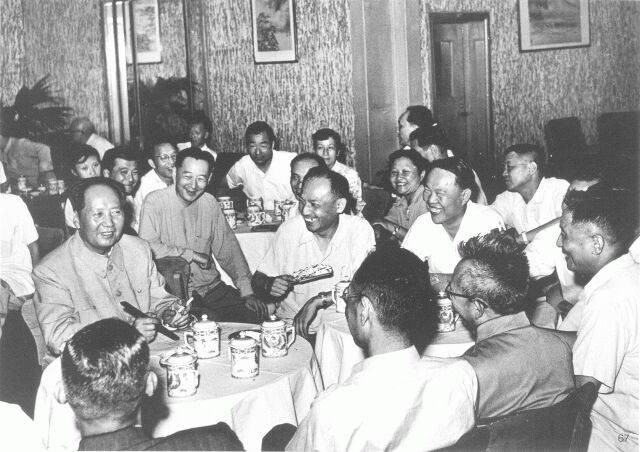
In the spring of 1957, China experienced a brief moment that looked like openness. The Chinese Communist Party (CCP) invited people outside the Party to criticise it and help it rectify its work, pledging that “those who speak are blameless.” Intellectuals, leaders of the small “democratic parties,” teachers and students spoke out against bureaucratism and demanded rule of law and press freedom. Within weeks, the wind reversed. On 8 June 1957 the People’s Daily published the editorial “Why Is This So?”, and Mao Zedong drafted an inner-Party directive ordering forces to repulse the “wild attacks of the rightists.” The Anti-Rightist Campaign had begun.
Over the following year and more, work units hunted for “rightists” to meet quotas and held struggle sessions. According to review statistics the CCP itself published after reform began, 552,973 people were designated “rightist elements” in 1957 and the 1958 “supplementary” round — a figure excluding the even larger category of “centre-rightists.” Those labelled faced demotion and supervised labour at the lighter end; at the heavier end they lost their jobs, were sent to labour camps or exiled, while their families lived under the stigma for decades. Only after 1978 were most hats removed and verdicts “corrected” — and the official verdict to this day is not that the campaign was a wrongful purge, but that it was “correct and necessary” and merely “far too broad.”
Background and Causes
The immediate prelude was the “Double Hundred” policy and the Rectification Movement. In April 1956 Mao proposed “let a hundred flowers bloom, let a hundred schools of thought contend,” encouraging independent thinking in the arts and sciences. That same year, Nikita Khrushchev’s “secret speech” denouncing Stalin’s cult of personality at the 20th Congress of the Soviet party, followed by unrest in Poland and the Hungarian uprising crushed by Soviet force, deeply shook the CCP leadership. Beijing feared similar instability at home, while also conceding that bureaucratism and other abuses inside the Party needed correction. In November 1956 the Party decided to launch a rectification campaign in 1957.
On 27 February 1957 Mao addressed an enlarged Supreme State Conference in a speech later titled “On the Correct Handling of Contradictions Among the People.” He distinguished “contradictions among the people” from “contradictions between ourselves and the enemy,” and said the former should be handled by discussion and criticism. On 27 April the Central Committee issued its directive on rectification — against bureaucratism, sectarianism and subjectivism — and invited non-Party people to take part. Published in the People’s Daily on 1 May, it opened the period remembered as the “great blooming and contending.”
At first, memories of earlier campaigns kept many silent. After repeated mobilisation and assurances that speakers would not be punished, criticism rose far beyond what the leadership expected: democratic-party leaders demanded real power for non-Party figures, journalists demanded press freedom, legal scholars attacked the substitution of Party for law, a “democratic wall” appeared at Peking University, and some voices raised rotation in office. Mao now treated the airing of views as an offensive by “bourgeois rightists.” Scholars still debate whether the invitation was a trap from the start or an improvised crackdown, but the turn had taken place inside the Party by mid-May, while ordinary speakers knew nothing of it.
Course of Events
April 1956 – February 1957: From the Double Hundred to the rectification decision. Mao proposes the Double Hundred policy; after the Hungarian events the Party decides on rectification. On 27 February 1957 Mao delivers the “Contradictions Among the People” speech.
27 April – May 1957: Rectification and the “great blooming.” After the rectification directive is published, democratic parties, universities, newspapers and cultural bodies hold forums. On 19 May the “May 19 Movement” erupts at Peking University, its democratic wall covered with posters, and the ferment spreads to other campuses. Lin Xiling, a law student at Renmin University, speaks at Renmin and Peking universities demanding institutional reform. In late May and early June, Democratic League leader Zhang Bojun proposes supervisory bodies resembling a parliament; Luo Longji proposes a committee to rehabilitate victims of earlier campaigns; and on 1 June Chu Anping, editor-in-chief of the Guangming Daily, denounces the “Party empire” — a world in which everything belonged to the Party and non-Party people were shut out. His speech was printed in full the next day and reverberated nationwide.
15 May 1957: The internal turn. Mao writes “Things Are Beginning to Change” for senior cadres, arguing that “poisonous weeds” must be allowed to grow so they can be uprooted. Publicly, the blooming continues, at organisations’ request.
8 June 1957: The campaign begins. Mao drafts the inner-Party directive “Muster Our Forces to Repulse the Rightists’ Wild Attacks.” The same day the People’s Daily editorial “Why Is This So?” declares that a handful of rightists have used rectification to attack the Party. The date is generally taken as the start of the Anti-Rightist Campaign. By the end of 1957 about 300,000 people had been labelled, among them the writer Ding Ling.
19 June 1957: The dividing line is published. Mao’s February speech is published in a heavily revised form, adding six political criteria for distinguishing “fragrant flowers” from “poisonous weeds” — above all, that words and deeds must strengthen, not weaken, the leadership of the Communist Party. Much of what had been said under the original speech could now be condemned as a poisonous weed.
1 July 1957: An “overt scheme.” In an editorial written for the People’s Daily, Mao attacks the Wen Hui Bao newspaper and figures including Zhang Bojun and Chu Anping, and explains the spring: the Party had let “demons and devils” air their views and poisonous weeds sprout, because only then could they be wiped out. “Some people say this was a covert scheme,” he wrote. “We say it was an overt one.” The Chinese term yangmou — an overt scheme — became the campaign’s best-known label and central evidence in the debate over its nature.
Summer 1957 – 1958: Quotas and harsh punishments. The campaign spreads from famous figures to ordinary cadres, teachers and students. Research cited by the Chinese Wikipedia article notes that some units had to fill a quota of roughly 5 per cent rightists, even where no one had spoken out. People were labelled for nodding at a meeting, for conflicts with leaders, or simply to fill a number; Zhu Rongji, later premier, was labelled in 1958 at the State Planning Commission and is often cited as a quota case. Punishments included struggle sessions, demotion, supervised labour, rustication, dismissal, and labour camps. In August 1957 the State Council promulgated its Decision on Re-education Through Labour: laojiao, detention without trial, was formally established at the campaign’s height and used extensively against rightists. The Jiabiangou farm in Gansu became one of its most lethal destinations.
1958–1959: “Making up missed lessons” and the wind-down. A supplementary round in 1958 labelled still more people, bringing the official total to 552,973. As the Great Leap Forward became the central task, the campaign faded. The “anti-right deviation” struggle after the 1959 Lushan Conference, aimed at Peng Dehuai and others inside the Party, was a different purge despite the similar name and should not be confused with 1957. From September 1959, the Party began removing rightist hats in batches from those deemed to have “truly reformed” — but removing a hat did not mean admitting the label had been wrong.
1960–1961: Famine at Jiabiangou. During the Great Famine, camp conditions were catastrophic. According to the English Wikipedia article on Jiabiangou and Yang Xianhui’s Jiabiangou Chronicles, the farm held about 3,000 political prisoners in 1957–1961, of whom about 2,500 died, mostly of starvation. After officials learned of this in December 1960, survivors were released and the camp closed in 1961; authorities falsified medical records to cover up the deaths.
1978–1981: Hats removed, cases “corrected.” After Mao’s death and the start of reform, the Central Committee decided in April 1978 to remove all rightist hats, and in September 1978 issued an implementation plan “correcting” those wrongly labelled. Officially, 552,877 cases were corrected and 96 were not. The Party’s 1981 Resolution on history held that the anti-rightist struggle had been “entirely correct and necessary” but “seriously broadened in scope.”
Key Figures and Reactions
Mao Zedong — the initiator. He was both the sponsor of the Double Hundred and rectification and the decision-maker behind the turn. The “overt scheme” formulation was his own. By reclassifying criticism voiced during the blooming as an antagonistic, enemy contradiction, he supplied the campaign’s theoretical and political basis.
Deng Xiaoping and Peng Zhen — the organisers. As general secretary, Deng ran the Central Secretariat, which one study calls the campaign’s “witch-hunting vanguard”: it set criteria, issued instructions and approved lists of major rightists. Beijing mayor Peng Zhen also played a leading role. The irony is well known: two decades later it was Deng who presided over the “corrections” — which helps explain why the Party used the word “correction” rather than “rehabilitation,” and kept a small number of cases uncorrected to preserve the claim that the campaign itself had been necessary.
Zhang Bojun and Luo Longji — “Rightists No. 1 and No. 2.” Zhang, a Democratic League leader and minister of transport, had proposed bodies such as a “political design institute” for consultation and oversight. Luo, a League leader and minister of forestry, had proposed a committee to redress the grievances of victims of earlier campaigns. The two were accused of forming a “Zhang–Luo alliance” to seize power. Luo died under persecution in 1965 and Zhang in 1969. Both were among the five central-level cases refused correction after 1978.
Chu Anping — the “Party empire.” Chu’s 1 June 1957 speech attacked the fusion of Party and state and the powerlessness of non-Party figures; it was summed up as the theory of the “Party empire” and printed in full by two newspapers the next day. Labelled a rightist in January 1958, he disappeared in 1966, at the start of the Cultural Revolution; whether he was beaten to death or took his own life has never been established. He too was among the five uncorrected central cases, together with Peng Wenying and Chen Renbing.
Lin Xiling — the student rightist. Born Cheng Haiguo, Lin was a law student at Renmin University who spoke repeatedly in May and June 1957, citing Khrushchev’s secret speech to attack Stalin and the cult of personality, calling the existing system a producer of a privileged stratum and demanding fundamental reform. Arrested in 1958, she was sentenced to 15 years for counterrevolutionary crimes. Her hat was removed in 1978 but her case was refused correction; according to Yanhuang Chunqiu and other accounts, she was the only student rightist among the uncorrected, and she appealed in vain for decades.
Other victims. The writers Ding Ling and Feng Xuefeng, the poet Ai Qing, the playwright Wu Zuguang, and the journalists Liu Binyan and Dai Huang were among the famous names; behind them stood countless ordinary teachers, engineers, cadres and students whose lives were changed by a sentence or a nod. Scholar Chen Ziming divides the active speakers into “right-wing intellectuals” seeking constitutional reform, “revisionists” who attacked the personality cult, and “rights defenders” who invoked the constitution — a reminder that the “rightists” included many of the most public-spirited people in China at the time.
Reactions. During the campaign, the domestic press was fully mobilised to denounce rightists, and work units rushed to “draw a clear line” from the accused. Later Western retrospectives, such as Gilbert King’s in Smithsonian Magazine, treat 1957 as the turn at which Mao invited criticism and then punished it. Around the 50th anniversary in 2007, human-rights organisations reported that propaganda authorities had instructed media not to cover the topic; in 2009 many outlets again omitted it. It remains highly sensitive in mainland China today: there has been no official apology, and demands for commemoration and compensation have never been accepted.
Disputed Figures and Accounts
How many “rightists” were there? This is the central numerical dispute, and the figures differ several-fold, so they must be read side by side. First, the official review figure: the Party announced during the post-Mao reassessment that 552,973 people were labelled in 1957 and 1958, of whom 552,877 were corrected and 96 were not (five at central level, 91 locally). Second, the English Wikipedia article on the campaign notes that the official 552,877 excludes people punished under other labels — “centre-rightists,” “anti-socialist elements,” “counterrevolutionaries” — and excludes victims’ families; it cites research putting the total persecuted at a consensus of about 1 million, with figures up to 3 million, or even 5 million if those suppressed in the later Socialist Education Movement are counted. Its introduction summarises scholarly estimates as between 1 and 2 million or higher. Third, the Chinese Wikipedia article states that, according to declassified central archives, more than 3.17 million people were in fact designated rightists nationwide, with a further 1.43 million or so classed as “centre-rightists” — a widely repeated claim whose archival basis and method remain disputed among scholars, and which should be cited as one account, not settled fact. Fourth, historian Frank Dikötter, in The Tragedy of Liberation, estimates at least 550,000 and possibly more than 650,000 persecuted — close to the official count. Much of the gap is definitional: whether one counts only those formally capped, or also those punished under variant labels and their families.
How many died? There is no reliable total, and any precise nationwide toll should be treated with suspicion. What is documented is that some rightists were executed, some died under struggle, in camps or in exile, and many starved in labour farms during the famine. Jiabiangou — about 2,500 deaths among some 3,000 inmates, corroborated by testimony, archival material and multiple studies — is a well-evidenced case, but cannot be extrapolated into a national figure. Ding Shu’s Yangmou, Qian Liqun’s studies and a large memoir literature record deaths case by case, but none provides a complete national count. This column therefore presents documented cases rather than an unverified total.
Covert trap or “overt scheme”? Mao denied setting a trap and called the strategy an overt scheme. Ding Shu and many participants argue that the 15 May internal document shows the crackdown was decided while the blooming was still at its height — in substance, luring the snakes out of their holes. Others, notably MacFarquhar in The Origins of the Cultural Revolution, argue Mao initially intended rectification to ease bureaucratism and turned only when criticism alarmed him — but then let the campaign expand to a terrifying scale. The readings dispute motive; about the consequence — the destruction of public speech — there is no dispute.
Why “correction,” not rehabilitation, and why leave 96 uncorrected? The official logic is that the campaign was necessary and only its scope was wrong, so mistaken cases were “corrected,” while 96 people were kept as proof that a “tiny number” of genuine rightists had existed. Christine Vidal’s study points to a further reason: full rehabilitation would have invalidated the repression’s legitimacy, and implicated Deng Xiaoping, a leading figure in 1957 now in charge. Victims who petitioned for apology and compensation have received no official redress.
Impact and Aftermath
The most immediate result was the destruction of China’s intellectual world and of the democratic parties as anything but decoration. Fields such as law, political science and sociology lost any chance of revival; early attempts at judicial independence were halted, and Party cadres and police exercised judicial power in place of judges. The label was effectively hereditary: children were discriminated against in schooling, military service and jobs, families broke apart, and many of the labelled spent over twenty years separated from home.
The deeper damage was political psychology. After 1957, no one dared offer substantive criticism. A year later the Great Leap Forward was launched without public dissent: inflated harvest claims went unchallenged, paving the way for the famine of 1959–1961. Many historians therefore treat the campaign as an institutional precondition of the Leap’s catastrophe — it first eliminated the people who might have told the truth. A 2018 study by Zeng and Eisenman of 144 counties found that the higher a county’s share of rightists, the worse its human-capital and economic outcomes remained for decades, with effects still visible in 2000.
As a repertoire, the campaign established techniques used again and again: quotas, struggle sessions, mutual denunciation, guilt by speech, and detention without trial. The Cultural Revolution re-enacted, on a far larger scale, methods rehearsed in 1957.
The corrections of 1978 onward restored citizenship to more than half a million people; some received back pay or their jobs back. But the lost twenty years could not be returned: there was no apology and no compensation, and the original verdicts still stand for the 96. In the 21st century textbooks pass over the episode with the word “broadened,” media coverage is restricted, and survivors’ efforts to commemorate and publish have been obstructed. As participants die, the campaign is becoming a memory preserved mainly by overseas publications, memoirs and scholarship — which is why recording it matters. Those who spoke out in 1957 were asking, in essence, for rule of law, oversight, and the right to tell the truth.
Sources
Wikipedia, Chinese edition: “Anti-Rightist Movement” (反右运动), “Rightists Who Were Not Corrected” (未获改正的右派), “Jiabiangou”; English edition: “Anti-Rightist Campaign,” “Hundred Flowers Campaign,” “Jiabiangou,” “Chu Anping”
CCP Central Committee, Resolution on Certain Questions in the History of Our Party since the Founding of the People’s Republic of China (1981), on the “broadening” of the campaign; Central Documents No. 11 (1978, removing rightist hats) and No. 55 (1978, implementation plan for corrections), as cited in Wikipedia and related studies
Ding Shu, Yangmou: A Documentary Record of the Anti-Rightist Movement (《阳谋——反右运动纪实》)
Roderick MacFarquhar, The Origins of the Cultural Revolution, Vol. 1
Frank Dikötter, The Tragedy of Liberation: A History of the Chinese Revolution, 1945–1957
Yang Xianhui, Jiabiangou Chronicles (《夹边沟记事》)
Chen Ziming (Chen Zeming), “The ‘Active Rightists’ of 1957 and Their Legacy,” China Perspectives, 2007/4
Christine Vidal, “The 1957–1958 Anti-Rightist Campaign in China: History and Memory (1978–2014),” CCJ Occasional Papers No. 4, 2016
Zhaojin Zeng and Joshua Eisenman, “The Price of Persecution: The Long-Term Effects of the Anti-Rightist Campaign on Economic Performance in Post-Mao China,” World Development, 2018
Gilbert King, “The Silence That Preceded China’s Great Leap into Famine,” Smithsonian Magazine, 2012
Hu Zhian, on why Lin Xiling was not corrected, Yanhuang Chunqiu, 2012, No. 3
(Photo credit: Wikimedia Commons, public domain, unknown author. Photo: Mao Zedong meeting prominent figures from all walks of life in Shanghai, 1957.)