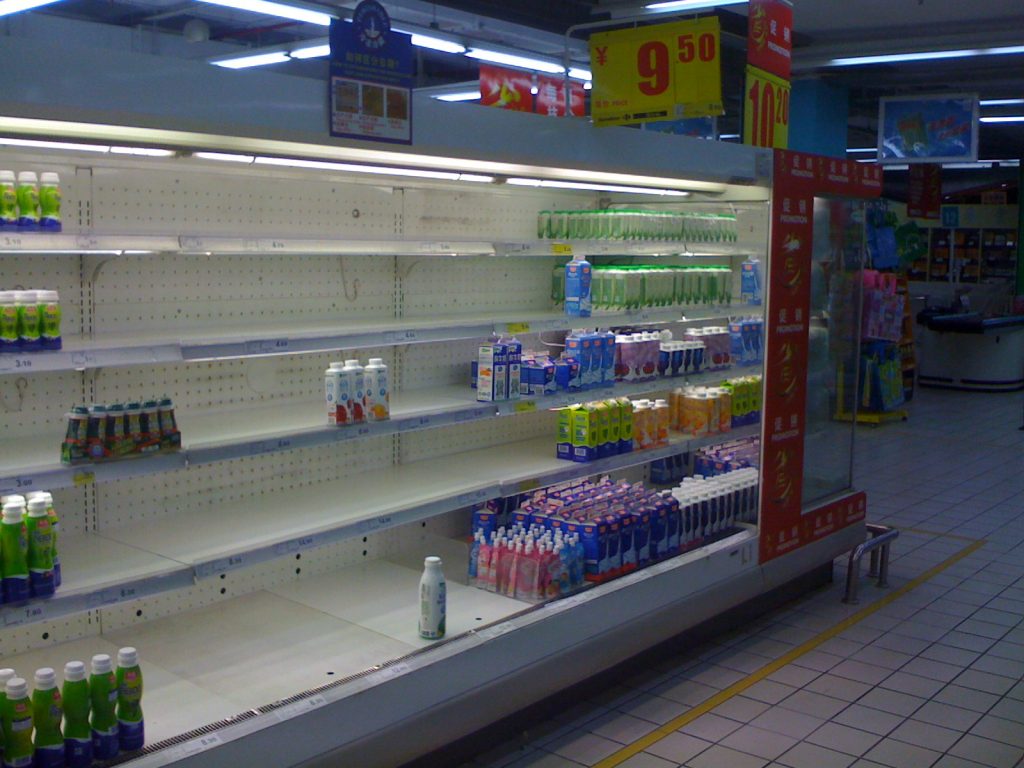
In September 2008, the Sanlu Group of Shijiazhuang, Hebei — one of China’s largest makers of infant formula — was confirmed to have sold baby milk powder contaminated with melamine, an industrial chemical used to make plastics and fertilisers. Milk dealers and collection stations had added the nitrogen-rich powder to watered-down raw milk so it would register a falsely high protein content in quality tests. Tens of thousands of babies, fed on the powder for months, developed kidney stones and kidney failure. China’s Ministry of Health ultimately reported that some 296,000 infants and young children had shown urinary-system abnormalities, roughly 52,000–54,000 had been hospitalised, and six babies’ deaths were officially linked to the tainted formula. The disaster was not unforeseeable: Sanlu had received consumer complaints as early as December 2007, and doctors, parents and journalists all raised alarms that were suppressed by the company, by local government, and by information controls surrounding the Beijing Olympics. The scandal became public only after Sanlu’s New Zealand shareholder, Fonterra, bypassed local authorities and had the New Zealand government alert Beijing directly. And the aftermath carried a second injustice: while Sanlu went bankrupt, its chairwoman received life imprisonment and two milk dealers were executed, a Beijing father named Zhao Lianhai — whose own son was among the kidney-stone babies — was sentenced in 2010 to two and a half years in prison for “picking quarrels and provoking trouble” after founding a support group, Kidney Stone Babies’ Home, to organise the victims’ parents.
Background and Causes
A runaway dairy industry and the “protein trick.” China’s dairy consumption grew rapidly after 2000, competition for raw milk was fierce, and price controls squeezed the margins of farmers and collection stations. Raw milk was priced by protein content, but the standard Kjeldahl test actually measures nitrogen — and melamine is about 66 per cent nitrogen by mass. Diluted milk spiked with melamine could therefore “pass” as protein-rich. According to a 2008 investigation by Caijing magazine, the practice of adulterating fresh milk with melamine and other additives had been circulating in Hebei’s dairy trade since at least 2006, collection stations operated with almost no oversight, and Sanlu’s own inspection regime had been compromised since around 2005. Melamine, combined with cyanuric acid in the body, forms insoluble crystals in the kidneys, causing stones and renal failure — most dangerous for infants whose only food is formula.
“Inspection-free” status and local protection. Sanlu was a major taxpayer in Shijiazhuang — about RMB 330 million in 2007 — its chairwoman Tian Wenhua held honorary political posts, and the company enjoyed close ties to local government. Sanlu and other leading dairies also held state-granted “inspection exemption” status, sparing their products from official sampling. The 2004 Fuyang “big-head baby” scandal, in which worthless formula killed babies in Anhui, should have been a warning to the whole industry; regulation was never genuinely tightened. After melamine in Chinese pet-food ingredients poisoned animals in the United States in 2007, China banned melamine in animal feed — yet a year later the same chemical entered baby bottles on a far larger scale.
Course of Events
From December 2007, according to Xinhua and the later State Council investigation, Sanlu began receiving consumer complaints about abnormal urine and kidney stones in babies, but did not test or act on them.
20 May 2008. A mother posted online that her baby had fallen ill on Sanlu formula — and that the very powder she had complained about had been donated by Sanlu to orphans of the Sichuan earthquake. The same day, Sanlu’s board discussed the problem for the first time and ordered third-party tests, which initially failed to detect melamine.
June–July 2008. Dr Zhang Wei, a urologist at a PLA hospital in Lanzhou, Gansu, treated an unusual cluster of infant kidney-stone cases, nearly all fed on Sanlu formula; he reported up the chain and sent samples for testing himself. On 16 July, Gansu health authorities reported the abnormal rise in infant kidney cases to the Ministry of Health — the hospital system’s first formal report to government. On 24 July, a paediatric urologist flagged the link to Sanlu on the national quality watchdog’s (AQSIQ) website bulletin board and received no substantive reply. A Southern Weekend journalist later disclosed that reporting on the story had been held back because it was “too close to the Olympics.”
1–2 August 2008. Sanlu’s tests finally identified melamine. On 2 August the board decided on a quiet “trade recall” from distributors without disclosing the contamination. According to the English Wikipedia’s account of investigation findings, a Shijiazhuang deputy mayor attending the meeting vetoed the recall and instructed the company to “shut the mouths of the victims with money” and wait until after the Beijing Olympics. The same day, Fonterra — Sanlu’s 43 per cent shareholder — learned of the contamination and pressed repeatedly for a full public recall, which local authorities stalled.
5–8 September 2008. Fonterra informed the New Zealand government on 5 September; on 8 September Prime Minister Helen Clark ordered officials to alert Beijing directly. A channel that bypassed the local level finally broke months of silence.
9–11 September 2008. Chinese media began reporting infant kidney-stone cases in Gansu and elsewhere, initially without naming any brand. On 11 September, Oriental Morning Post reporter Jian Guangzhou became the first to name Sanlu publicly. That evening the Ministry of Health confirmed melamine contamination in Sanlu formula, and Sanlu recalled some 700 tonnes of infant powder produced before 6 August.
13–16 September 2008. The State Council activated a national emergency response and ordered free treatment for affected children. On 16 September, AQSIQ announced that 69 batches of infant formula from 22 companies — including famous brands Yili, Mengniu and Yashili — had tested positive for melamine, with Sanlu’s levels the highest. A single company’s scandal had become an industry-wide crisis.
17–22 September 2008. Shijiazhuang mayor Ji Chuntang resigned. On 22 September, with the toll reported at about 53,000 sick children and four deaths, AQSIQ director Li Changjiang resigned after a State Council inquest found him responsible for negligent supervision; Shijiazhuang party secretary Wu Xianguo was dismissed, and investigators formally blamed the Shijiazhuang government for concealing the incident and failing to report it. Dozens of countries banned or recalled Chinese dairy products, and the World Health Organization called the incident “deplorable” and demanded to know why it had taken months to surface.
December 2008. The Ministry of Health revised its figures: more than 22 million children screened, about 290,000 cases reported, some 51,900 hospitalised, and 11 suspected deaths reported by localities, of which three were then officially confirmed. On 24 December, a Shijiazhuang court accepted Sanlu’s bankruptcy liquidation. The 22 implicated companies jointly funded a medical compensation fund of about RMB 1.1 billion, with one-off payments fixed at RMB 200,000 for each child who died, RMB 30,000 for serious cases and RMB 2,000 for ordinary cases.
22 January 2009. The Shijiazhuang Intermediate People’s Court handed down first-instance verdicts: chairwoman and general manager Tian Wenhua received life imprisonment for producing and selling fake or substandard products; Zhang Yujun, who had manufactured melamine “protein powder,” and Geng Jinping, a milk-station operator, were sentenced to death; Gao Junjie received a suspended death sentence; others received terms from five years to life. Zhang and Geng were executed on 24 November 2009. China’s Food Safety Law took effect on 1 June 2009, and the “inspection exemption” system was abolished.
The Zhao Lianhai thread. In 2008, Beijing resident Zhao Lianhai’s young son, Zhao Pengrui, was diagnosed with kidney stones after drinking Sanlu formula. Zhao founded the “Kidney Stone Babies’ Home” website, registering affected families’ medical records, sharing information and coordinating claims. Rejecting a one-off compensation scheme that had been set without consulting parents — and whose long-term health consequences were unknown — he circulated a petition signed by several hundred parents and organised parents’ gatherings and press conferences. On 13 November 2009, Beijing police took Zhao away; he was denied access to lawyers and family for nearly three months. His case was tried in Daxing District Court on 30 March 2010, and on 10 November 2010 the court sentenced him to two and a half years in prison for “picking quarrels and provoking trouble.” The conduct listed in the judgment included organising a gathering of parents, holding placards outside a factory and a court, and giving media interviews. Zhao tore off his prison uniform in court in protest and declared a hunger strike. On 28 December 2010, amid intense public pressure, he was released on medical parole — but lived thereafter under intensive surveillance.
Key Figures and Reactions
Tian Wenhua, Sanlu’s chairwoman and general manager, told the court she had learned of the problem from consumer complaints only in mid-May 2008 and reported to the Shijiazhuang government on 2 August. Her life sentence for a non-capital, product-quality offence struck many victims’ parents as lenient. According to Wikipedia and multiple media reports, her sentence was commuted three times for good behaviour, and she is scheduled for release on 3 August 2027.
Fonterra and the New Zealand government. Fonterra learned of the contamination on 2 August and pushed for a public recall, but spent over a month working “within the Chinese system” — a hesitation critics attributed to commercial sensitivities. Its eventual escalation, via Wellington to Beijing, proved decisive in breaking the story. Fonterra wrote off its entire investment in Sanlu.
Jian Guangzhou and Dr Zhang Wei. Jian’s 11 September report naming Sanlu is widely remembered as a landmark of journalistic conscience, after weeks in which Chinese outlets had referred only to “a certain brand.” Zhang Wei was the clinician who first systematically escalated the case cluster. Together with parents posting online, they formed the only alarm channels outside the system.
The central government. Premier Wen Jiabao visited sick children in hospital on 21 September and apologised to the public, saying he felt “extremely guilty.” The State Council then overhauled the dairy industry, abolished inspection exemptions and pushed through the Food Safety Law. At the same time, media were instructed to tone down coverage and use official copy; volunteer lawyers offering free help to victims came under pressure, and courts refused for months to accept victims’ lawsuits — the first individual compensation case was only accepted in March 2009.
Reaction to Zhao Lianhai’s sentence. The 10 November 2010 verdict caused an uproar. Amnesty International condemned it, designating Zhao a prisoner of conscience and saying the Chinese public rightly viewed him as “a protector of children, not a criminal”; the U.S. Congressional-Executive Commission on China listed him as a political prisoner. Hong Kong reacted especially strongly: Hong Kong deputies to the National People’s Congress, CPPCC members and legislators publicly appealed to Beijing to intervene and free him, and Hong Kong media covered the case for weeks. Commentators widely credited this pressure — from Hong Kong and overseas — with securing Zhao’s release on medical parole barely a month after sentencing, an outcome almost unheard of for a mainland convict. A statement then posted on his blog, “supporting and thanking the government” and expressing deep regret, was regarded by his lawyers and supporters as written under duress. He subsequently vanished from public view; according to Amnesty International’s 2011–2012 reporting, his home remained under watch by security personnel and cameras, and even family outings were obstructed.
Disputed Figures and Accounts
How many victims, how many deaths? The numbers were revised repeatedly and must be read separately. On 21 September 2008 the official tally stood at nearly 40,000 children treated, about 12,892 hospitalised and four dead (as summarised by Chinese Wikipedia from contemporary bulletins). On 1 December, Xinhua, citing the Ministry of Health, revised the toll to more than 290,000 affected and 51,900 hospitalised, with 11 suspected deaths reported by provinces but only three then officially confirmed. The final reporting, in January 2009, put the figures at about 296,000 children with urinary-system abnormalities (most English-language reports round this to some 300,000), about 54,000 hospitalised, and six deaths officially concluded to be related to the contaminated milk (Ministry of Health figures, as compiled by Wikipedia). Reuters’ own compilation from local media already approached 94,000 cases by late September 2008, far above the official figure of the time; because the scandal had been suppressed for months and early cases fell outside free-treatment and reporting schemes, journalists and scholars generally regard even the final official numbers as an undercount. Official recognition of a death mattered materially: families whose child’s death was not officially attributed to the milk could not claim the RMB 200,000 death payment.
Who knew, and when? Sanlu maintained it learned of the problem in mid-May and identified melamine only on 1 August; the State Council investigation concluded the company had received complaints from December 2007 and concealed them. Shijiazhuang’s government, told on 2 August, failed to report upward until 9 September — the investigation formally found local concealment. Fonterra said it pressed for a recall from the start and was constrained by local rules; critics asked why it did not warn consumers directly for five weeks. The Olympic factor remains contested: journalists have testified that stories were held for the Games, and the disclosed 2 August meeting remarks (“shut the mouths of the victims with money,” “wait until the Olympics end”) point the same way, but Beijing has never acknowledged any unified “Olympics gag order.”
The opaque compensation fund. The roughly RMB 1.1 billion medical compensation fund, administered under the China Dairy Industry Association, has never published its operations, payout records or remaining balance, leaving parents no way to audit it (per Chinese Wikipedia). The flat rates — RMB 200,000 per death, RMB 30,000 for serious illness, RMB 2,000 otherwise — were criticised as buying out families’ rights before the long-term renal consequences were known. A peer-reviewed ultrasound follow-up study by Peking University researchers, published in 2010, found that about 12 per cent of affected children in one rural area still showed kidney abnormalities six months later; no systematic public long-term tracking has followed.
Zhao Lianhai: criminal or citizen? The judgment held that Zhao had used rights-defence “as an excuse” to create disturbances and seriously disrupt public order. Yet the acts it enumerated — a parents’ gathering marking the scandal’s first anniversary, placards outside a court and a factory, interviews with foreign media, and speaking up in another petitioner’s case — are, to his critics’ chorus of lawyers and rights groups, ordinary exercises of expression and self-help. Amnesty International and Chinese Human Rights Defenders documented serious procedural abuses, including detention far beyond legal time limits and nearly three months without lawyer access. Whether his post-release statement of “regret” was voluntary remains disputed; supporters believe it was the price of his parole, and Zhao, silenced and surveilled, has never been able to clarify it publicly.
Impact and Aftermath
Institutional change. The scandal directly produced the 2009 Food Safety Law, a State Council Food Safety Commission, and progressively tighter licensing and formula-registration rules for infant formula (culminating in the 2016 registration regime). The “inspection-free” privilege was abolished. Yet accountability had a revolving door: by December 2009, Li Changjiang had resurfaced as a deputy head of the national anti-pornography task force, and Wu Xianguo and other punished officials later reappeared in new roles — prompting public questioning of what the punishments had meant (per the Economic Observer and others).
A long collapse of trust. Chinese consumers’ confidence in domestic formula remained depressed for years. Demand for imported formula surged; cross-border buying and daigou purchasing emptied shelves from Hong Kong to Australia, where supermarkets eventually imposed per-customer limits. Hong Kong, flooded by parallel traders, introduced its 2013 export restriction (the “two-can limit,” formally 1.8 kg per departing traveller). Sanlu’s assets were auctioned off, and its name became a byword for food-safety failure.
The victims, and the man who organised them. Most of the nearly 300,000 affected children were declared recovered, but their long-term kidney health disappeared from the public agenda; with the fund opaque and collective litigation blocked, families had no continuing remedy. Zhao’s case signalled to every community of victims in China that organising to demand an explanation could itself be a crime, and the kidney-stone parents gradually fell silent. Officially, the story is one of recovery — by 2018 domestic formula sampling pass rates exceeded 99 per cent and melamine monitoring had returned 100 per cent compliance for nine consecutive years, per China’s dairy quality reports. But whenever news of Tian Wenhua’s sentence reductions surfaces, Sanlu is invoked again — because for many families, neither the stones in a child’s kidneys nor a father’s two and a half years in prison ever truly ended.
Sources
Wikipedia (English): “2008 Chinese milk scandal,” “Timeline of the 2008 Chinese milk scandal,” “Zhao Lianhai”; Wikipedia (Chinese): “2008年中国奶制品污染事件,” “赵连海”
Ministry of Health bulletins and State Council investigation findings, as reported by Xinhua, September 2008 – January 2009 (c. 296,000 affected; 51,900–54,000 hospitalised; six officially recognised deaths)
Amnesty International: Urgent Action ASA 17/064/2009 (17 November 2009); statement condemning Zhao Lianhai’s sentencing (November 2010); follow-up reporting on Zhao’s status (2012)
U.S. Congressional-Executive Commission on China: “Authorities Release Prominent Tainted Milk Activist, Zhao Lianhai, on Medical Parole” (2010–2011)
Chinese Human Rights Defenders statement calling for Zhao Lianhai’s release (December 2010); Radio Free Asia report on the sentencing (10 November 2010)
Jian Guangzhou’s naming of Sanlu, Oriental Morning Post, 11 September 2008; Caijing magazine’s 2008 investigation of the Sanlu collapse; Southern Weekend journalists’ accounts of pre-Olympic suppression
World Health Organization statements and INFOSAN reporting on melamine, September 2008; case studies in The Lancet and The New England Journal of Medicine; Peking University ultrasound follow-up study of affected infants (2010)
BBC, Reuters and Associated Press reporting on the scandal, trials and executions, September 2008 – November 2009; Economic Observer reporting on the later re-emergence of punished officials
(Image source: Wikimedia Commons, photo by Marc van der Chijs, CC BY 2.0 — emptied dairy shelves in a Chinese Carrefour supermarket during the scandal, 19 September 2008)