On 20 March 2003, Sun Zhigang, a university graduate from Huanggang, Hubei, died inside a Guangzhou treatment station for custody detainees — three days after police picked him up. He had no criminal record and had never been tried. He did not even meet the conditions for custody: he had a job, a home, and an identity card; he had simply gone out to an internet café without his ID, and had not yet obtained a temporary residence permit. The station first said he died of a heart attack or a stroke. A month later, forensic examiners at Sun Yat-sen University concluded the opposite: in the 72 hours before his death he had been beaten repeatedly, and died of traumatic shock from extensive soft-tissue injuries. On 25 April, Southern Metropolis Daily put the story before the whole country as “The Death of Sun Zhigang in Custody.” Over the next two months, public anger, a constitutional-review petition by three doctors of law, and five scholars’ call for a special investigation converged on a system that had operated for 21 years. On 20 June 2003 the State Council promulgated new rules; on 1 August the 1982 measures were repealed. One young man’s death had ended a system under which millions of migrants could lose their liberty without trial — a rare outcome in China’s contemporary legal history.
Background and Causes
To understand Sun’s death, two institutions come first: household registration (hukou), and custody and repatriation (shourong qiansong).
From 1958, the hukou system divided citizens into urban and rural households, leaving rural residents only the narrowest legal channels to live and work in cities. After reform began, tens of millions of migrant workers poured into coastal cities — but their hukou did not move with them. On 12 May 1982, the State Council issued the Custody and Repatriation Measures, nominally welfare: homeless people would be taken in and repatriated home. They grew out of a 1961 Party directive against free movement; their essence was to fix people to their place of registration.
The decisive change came in 1991, when a State Council opinion greatly expanded who could be held. No longer limited to “three-withouts” persons — simultaneously lacking home, livelihood, and papers — the system now covered migrants lacking any of the “three certificates”: identity card, temporary residence permit, and work permit. A factory worker with a regular job could now be locked up for failing to produce a permit at a street check, held until relatives paid, or sent home. Guangdong’s rules contained a safeguard — provincial legal authorities had explained that lacking a permit alone was not grounds for custody — but in practice the line vanished, and before major events cities often swept and repatriated in batches.
The system’s scale was enormous, though figures were never consistent. Amnesty International’s October 2002 memorandum, citing Ministry of Civil Affairs figures in the Chinese press, counted about 700 centres detaining over one million people a year. Nicolas Becquelin of Human Rights in China counted some 800 facilities around 2000 (excluding Beijing), through which several million had passed. A first-hand account published by China Change gives 2002 alone: about 220,000 held in Beijing and 580,000 in Guangdong. Only a minority were the vagrants the system claimed to help — reports cited by Amnesty put the genuinely needy at roughly 15 percent; the rest were mostly migrant workers, petitioners, and other vulnerable people.
Worse, the system bred extortion and violence. Detainees paid for their own food, lodging, and transport home; those who could not pay worked off the debt and could be held for months. Beatings — even reports of detainees sold into forced labour — predated Sun’s case: Becquelin had warned for years, and rights advocate Tong Yi later told the U.S. Congressional-Executive Commission on China that in practice the system amounted to “kidnapping by police.” None of it moved the system before 2003 — until the dead man turned out to be a graduate who had argued back.
Sun Zhigang was exactly that man. Born on 29 July 1976 in Huanggang, Hubei, he graduated in 2001 from Wuhan University of Science and Technology’s art and design programme. After the 2003 Lunar New Year he travelled south, paused in Shenzhen, then moved to Guangzhou, where on 24 February he started as a clothing designer at the Daqi Garment Company. He had been in the city under a month and had not yet applied for a temporary permit.
Course of Events
17 March 2003, about 10–11 p.m.: stopped on the street. Sun went out to an internet café without his ID and without a temporary permit. Police took him to the Huangcun Street police station, from where he phoned a friend to bring his ID. The friend arrived with the card and money, hoping to pay and take him home — many stopped that night were released on payment — but officers refused outright: this one would not be released. Later reporting suggested Sun had argued with police, which may explain why he alone was held; his father later lamented that his educated son had probably stood on his rights. What is undisputed is that Sun had a lawful job, a home, and an ID, and did not qualify for custody even under Guangdong’s rules — yet his form recorded him as a “three-withouts” person.
18 March: transferred; his employer fails to free him. Sun was transferred to the Guangzhou custody station. The head of the Daqi Garment Company went in person to vouch for him and was also refused. Sun was then sent to the detainees’ medical facility, the Guangzhou Custody Detainees’ Treatment Station, in the Jiangcun ward of the Guangzhou Brain Hospital. Its records reportedly described him as “quiet” on admission and “sleeping” for most of the first twelve hours. Friends who phoned on 19 March learned he had been hospitalised; when they went to visit, they were turned away.
20 March, morning: notice of death. On 20 March, Sun was pronounced dead; the station attributed it to a heart attack, a stroke, or sudden death. A friend informed his family in Hubei. A healthy young man at work three days earlier had died inside an institution meant to “treat” him, for reasons no one would explain — and his family refused to accept it.
Late March to 18 April: the family presses on; an autopsy overturns the story. Sun’s father, Sun Liusong, spent over a month going from agency to agency in Guangzhou — public security, prosecutors, civil affairs, health — without a straight answer. The poor farming family borrowed money for a forensic examination. On 18 April, Sun Yat-sen University’s forensic centre concluded Sun had been severely beaten within 72 hours of death, with extensive injuries, notably to his back, and died of traumatic shock from blunt-force, massive soft-tissue damage — flatly contradicting the “natural death” claim. Contemporary accounts described round black marks on his shoulders and knees that the examiner believed were burns. Sun’s tomb inscription later gave the date its own line: “18 April: forensic examination found he had been beaten to death.”
25 April: Southern Metropolis Daily exposes the case. Having hit a wall with every agency, the family went to the press. Reporters Chen Feng and Wang Lei investigated and published “The Death of Sun Zhigang in Custody.” Appearing amid the SARS epidemic, when official opacity had already fuelled distrust, it ignited the country: hundreds of thousands of online comments followed, media nationwide took up the story, and further deaths, beatings, and fee abuses in custody stations were exposed. The question shifted from “who beat Sun to death?” to “is the system itself lawful?”
16 and 23 May: scholars petition the legislature. On 16 May, three doctors of law — Yu Jiang (Huazhong University of Science and Technology), Teng Biao (China University of Political Science and Law), and Xu Zhiyong (Beijing University of Posts and Telecommunications) — submitted, as citizens, a proposal to the NPC Standing Committee asking it to review the 1982 Measures. Their argument went to the heart of the matter: only laws enacted by the NPC may authorise restrictions on personal freedom; a State Council regulation could not, and the Measures conflicted with the Constitution, the 1996 Administrative Punishment Law, and the 2000 Legislation Law. On 23 May, five more scholars — He Weifang, Sheng Hong, Shen Kui, Xiao Han, and He Haibo — petitioned for a special investigation into Sun’s death and the system as a whole. The Standing Committee never publicly answered either petition — but the State Council moved first.
5 June to 27 June: trial, verdicts, execution. The criminal case moved with extraordinary speed. Hearings opened on 5 June. On 9 June, the Guangzhou Intermediate People’s Court sentenced Qiao Yanqin, a nursing worker convicted as the principal who organised and directed the beatings, to death; Li Haiying, a fellow detainee, received a suspended death sentence; Zhong Liaoguo, life imprisonment; and the other staff and detainees involved, prison terms. Custody and police personnel were separately tried for dereliction of duty (reports differ on numbers and terms; see below). On 27 June the Guangdong High People’s Court rejected the appeals, and Qiao, his sentence approved by the Supreme People’s Court, was executed the same day — under a hundred days after the killing.
20 June and 1 August: the system is abolished. On 20 June, Premier Wen Jiabao promulgated the new Measures for Assisting Vagrants and Beggars with No Means of Support in Cities: assistance would be voluntary, stations could not charge fees or impose forced labour, and custody stations became relief stations. The new measures took effect on 1 August 2003; the 1982 measures were repealed the same day. A 21-year-old system that had processed millions left the stage.
Key Figures and Reactions
Sun Zhigang and Sun Liusong. Little public record of Sun survives: a designer two years out of university, on an entirely ordinary course — precisely why the case stung. If an educated, employed man who knew to argue could be beaten to death in three days, the public could imagine the position of millions of silent migrant workers. His father, Sun Liusong, a Hubei farmer, borrowed money for the autopsy and pressed the family’s questions in public. The family later received a government settlement — English reporting put it at about US$53,000 — after which he said his son could now “sleep well in the nether world.” He designed his son’s grave himself and carved the timeline into the epitaph, ending: “A man worth remembering — Sun Zhigang, who at the cost of his life advanced the rule of law in China.”
Southern Metropolis Daily and its journalists. Chen, Wang, and the paper’s management were the case’s other hinge: without the 25 April report, Sun would likely have remained one more silent custody death. The outspoken paper’s SARS coverage had already angered local authorities; the Sun story ended a string of Guangzhou officials’ prospects. The paper paid for it the following year (see Impact and Aftermath).
The three doctors of law and the five scholars. Yu, Teng, and Xu’s petition was the first use of the Legislation Law’s citizen review-proposal right in a case commanding national attention, and is widely regarded as a landmark in China’s constitutional-review debate. The five scholars’ call widened the target to the system’s whole operation. None of the eight received a formal NPC reply — but the State Council’s repeal conceded their central claim more plainly than any reply could: the system had no legal leg to stand on.
Officials and the public. Wen Jiabao’s new government, in office only since March 2003, repealed the system at the height of the outcry — read by many commentators as a populist gesture. Guangzhou’s handling showed the other face: first “died of illness,” then the framing of the death as an individual crime by station staff and detainees, while the police who wrongly detained Sun were never criminally pursued. Online reaction was unprecedented: hundreds of thousands of posts demanded punishment and repeal, and many year-end reviews named the case the start of a “first year of citizens’ rights defence” (weiquan).
Disputed Figures and Accounts
The core facts — unlawful custody and a fatal beating — are not seriously disputed. The disputes concern details and the boundaries of responsibility.
Was he 26 or 27? Born on 29 July 1976 and dead on 20 March 2003, Sun was 26 by full years, as the Chinese Wikipedia’s infobox gives. Yet almost all contemporary reporting, his tomb inscription (“died aged twenty-seven”), and the English Wikipedia call him 27 — nominal-age or rounded usage that has become standard. Both versions of this article therefore give his birth date, generally follow the reported “27,” and flag the discrepancy here.
Who beat him to death? Official accounts and the verdicts agree: the hands-on attackers were fellow detainees, directed by nursing worker Qiao Yanqin. The doubts never went away. How could a nursing worker direct repeated group beatings over three days without management intervention? And why were the police who stopped Sun, refused his release, and wrongly detained him never indicted? The U.S. State Department’s 2003 report likewise noted police received mostly administrative punishments, and Tong Yi’s testimony argued the verdicts evaded police responsibility. The contest between the “individual case” and “institutional violence” theories remains unresolved.
Sentencing figures differ between reports. Reports agree on the principals (Qiao, death; Li, suspended death; Zhong, life). For the rest they diverge: the Chinese Wikipedia gives the other ten offenders three years to life and six officials one to three years; People’s Daily Online gives the remaining six accomplices three to twelve years and six civil servants two to three years; the English Wikipedia gives ten accessories six months to life, six civil servants two to three years, and a head nurse later sentenced to two years. This article’s body states only what all versions share — a reminder that even here, the public record is incomplete.
There is no authoritative total for the custody system. The annual intake is given as “more than one million” (Amnesty, citing Civil Affairs figures), facilities as both about 700 and about 800, and the 2002 figures for Beijing (220,000) and Guangdong (580,000) come from a participant’s account. These numbers have different sources and scopes and cannot be cross-verified; what is safe is the order of magnitude — over a million people a year, several million in total. How many died inside it was never officially counted — Becquelin’s judgement that documented deaths were “only the tip of the iceberg” is itself the sharpest commentary on that blackout.
Did constitutional review “succeed”? A popular version says the petition “abolished” the system. Strictly, it did not: the NPC Standing Committee never announced acceptance of the review and never declared the Measures unconstitutional; the State Council repealed its own regulation. Scholars remain divided — optimists cite a model of citizen proposals advancing the rule of law; cautious analysts note that bypassing formal review showed the mechanism itself was not functioning. No later citizen proposal has ever moved a nationwide system so quickly — itself the question this case leaves to legal history.
Impact and Aftermath
The most direct consequence was institutional: custody and repatriation was abolished, relief stations replaced custody stations, “voluntary and free assistance” entered the new rules, and police could no longer lock up migrants merely for lacking papers. For millions of migrant workers this was a real expansion of freedom. The year 2003 is also widely called the “first year” of the citizens’ rights-defence movement: online opinion, investigative reporting, and legal action combined — and actually changed a national system. In October, Xu, Teng, and others founded the Sunshine Constitutionalism centre, later the Open Constitution Initiative (Gongmeng).
The other side is equally real. First, hukou and the temporary-permit system were untouched: what was repealed was custody and repatriation, not the dual status order, and migrants’ unequal access to schooling and social security continues. Second, other systems restricting freedom without trial — re-education through labour (abolished only in 2013), “black jails” for petitioners — were exposed again and again later, suggesting Sun’s case changed one system rather than the logic producing such systems. Third, the participants’ fates turned: Xu Zhiyong was later imprisoned twice over the New Citizens Movement and in 2023 received a 14-year sentence for subversion; Teng Biao lives in exile. The space for the moderate petition path of 2003 has narrowed beyond recognition.
The newspaper’s fate best illustrates the reversal. In late 2003 and 2004, its management was prosecuted on economic charges: general manager Yu Huafeng was sentenced to prison (twelve years at first instance, reduced to eight; released early in February 2008), former editor Li Minying received eleven years (released in 2007), and editor-in-chief Cheng Yizhong was detained five months, then released without prosecution. The official line was financial corruption. But China’s press and legal communities and international press-freedom organisations widely regarded the case as revenge for the Sun and SARS reporting — the Committee to Protect Journalists and Reporters Without Borders both took that position, and UNESCO awarded Cheng its 2005 World Press Freedom Prize. The two cases are thus remembered together: one shows the power of media scrutiny, the other its price.
In public memory, Sun has not been forgotten. At his grave in Xingfu Village, Taodian Township, Huanggang — its bridge named “Relief Bridge” and pavilion “Reform Pavilion” by his father — the epitaph still tells the story in dated lines. Every 20 March, internet users still commemorate him, though discussion is tightly restricted on China’s domestic internet. An ordinary graduate’s name became a measuring rod: a test of how far a system stands from treating people as people.
Sources
Southern Metropolis Daily: Chen Feng and Wang Lei, “The Death of Sun Zhigang in Custody” (25 April 2003) and follow-ups
Wikipedia (Chinese): “Sun Zhigang incident,” “Southern Metropolis Daily case”; Wikipedia (English): “Sun Zhigang incident,” “Custody and repatriation”
State Council: Measures for Assisting Vagrants and Beggars with No Means of Support in Cities (20 June 2003, effective 1 August 2003); 1982 Custody and Repatriation Measures
People’s Daily Online and China Daily: first-instance verdicts (9–10 June 2003); Xinhua and China News Service on the final appeal and Qiao Yanqin’s execution (27 June 2003)
Amnesty International: Memorandum to the State Council and National People’s Congress on the rule of law and human rights (October 2002, ASA 17/052/2002), custody and repatriation section
Nicolas Becquelin, “Enforcing the Rural-Urban Divide,” China Rights Forum (2002); Tong Yi, “Kidnapping by Police,” China Rights Forum (2003), and testimony before the Congressional-Executive Commission on China (2 June 2003)
Human Rights Watch statements on Sun Zhigang; U.S. State Department, 2003 Country Report on Human Rights: China
Committee to Protect Journalists: “Two editors sentenced to lengthy prison terms” (2004) and “Falling Short” (2008); UNESCO, 2005 World Press Freedom Prize (Cheng Yizhong)
China Change: “For the Sake of the Citizens: Working to Abolish the Custody and Repatriation System in the Wake of Sun Zhigang’s Death” (2024)
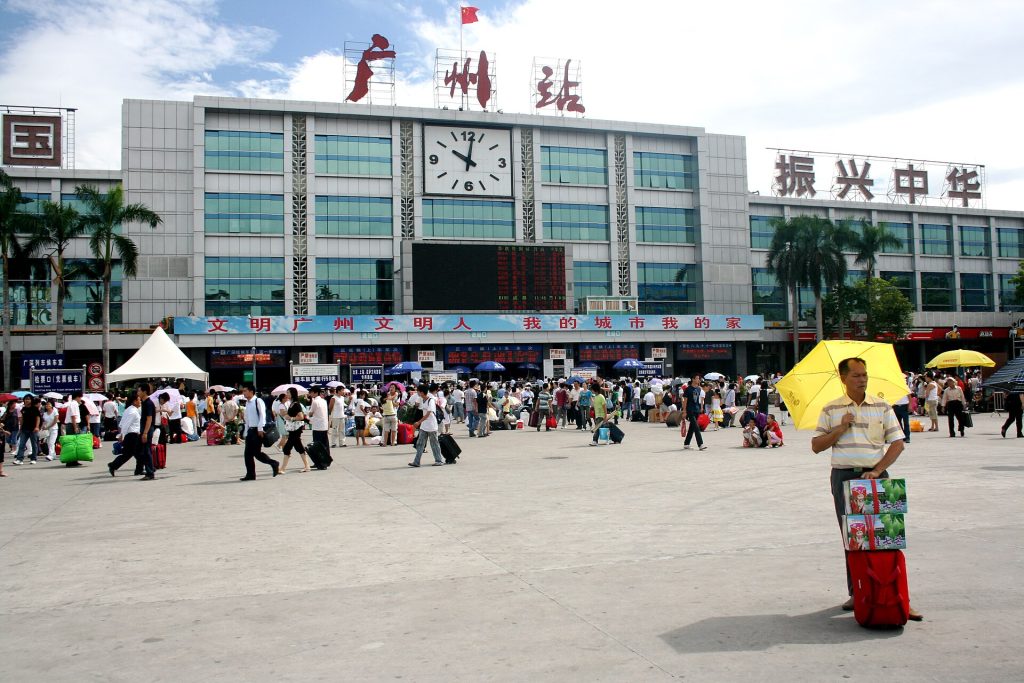
(Image source: Wikimedia Commons, Guangzhou Railway Station, by Rain Rannu, CC BY 2.0. Commons holds no freely licensed photo of Sun Zhigang or the scene; this is a substitute image, not a scene photo.)