In June 2012, Feng Jianmei, a farmer’s wife from Yuping Village in Zengjia Township, Zhenping County, under the city of Ankang in Shaanxi Province, was seven months pregnant with her second child; she and her husband Deng Jiyuan already had a five-year-old daughter. Local family-planning officials demanded 40,000 yuan from the family — a sum officials later admitted had “no legal basis,” calling it a “deposit.” The family could not pay. On June 2, Feng was taken from a relative’s home to Zhenping County Hospital, held down, forced to press her thumbprint onto a consent form, and at 3:40 p.m. injected with an abortifacient. On June 4 she delivered a dead baby girl, and the corpse was placed beside her on the hospital bed. On June 11, photographs taken by her sister-in-law, Deng Jicai, were posted on Sina Weibo: Feng lying with dull, staring eyes, the bloodied stillborn infant next to her. Officials first insisted the abortion had been “voluntary”; two weeks later they admitted it was an illegal forced abortion. The county family-planning chief was sacked, a deputy county magistrate and others were punished, and the city government publicly apologized. Not one person was criminally prosecuted.
Background and Causes
The one-child policy and the “one-and-a-half-child” rule. From 1979, China enforced strict birth planning: urban couples were generally allowed one child, while rural areas followed the so-called “one-and-a-half-child” policy — a farming household whose first child was a girl could, after an interval of several years, have a second. Births beyond the quota incurred a “social maintenance fee,” and birth permits and hukou registration depended on having the paperwork in order. The independent demographer He Yafu noted at the time that such fines had become a major source of revenue for family-planning authorities: he estimated they brought in about 20 billion yuan a year, and more than 2 trillion yuan since 1980 (as cited by Wikipedia).
Late-term abortion was already illegal. The Population and Family Planning Law, first enacted in 2001, provided for punishment of officials who infringe citizens’ personal and property rights in family-planning work, and Chinese law prohibited abortion after the sixth month of pregnancy. Feng was seven months pregnant when she was injected, so the abortion was illegal whether or not it was “voluntary.” Human rights groups had long pointed out that such laws were enforced inconsistently, with forced sterilizations and coerced abortions still carried out locally, sometimes in the third trimester. In 2005, the Shandong activist Chen Guangcheng exposed forced abortions and sterilizations in Linyi; he was jailed and held under house arrest, reaching the United States only in May 2012.
Quota pressure at the grassroots. Zengjia Township had failed its family-planning targets for two years running and had received a “yellow card” warning; determined to clear it in June 2012, township officials stepped up enforcement.
The family’s situation. Feng Jianmei was born on December 25, 1989, in Inner Mongolia, married Deng Jiyuan in 2006, moved to Yuping Village, and gave birth to a daughter in 2007. She became pregnant again in October 2011. The couple had been told by relatives that, living in the countryside and having waited five years, they should be allowed a second child. County officials later said they had informed Feng in March 2012 that, as a holder of a non-agricultural hukou from another province, she first had to transfer her household registration and obtain the birth documentation; the Deng family denied this, saying they were told only a few days before the abortion. That hukou hurdle, plus the 40,000 yuan, was the fuse of the whole case.
Course of Events
Around May 28, 2012, local officials telephoned Feng to persuade her to abort, without success. On May 30, more than a dozen officials came to the house while Deng Jiyuan was away at work. Feng said she was going out to buy food, and instead went to an aunt’s home; the officials followed and kept watch in shifts. Early on May 31, she escaped, flagged down a van, then hid in hillside brush for some 14 hours in cold, rainy weather, and after dark under a bed in a relative’s home. The officials found her anyway and, she said, beat her.
On June 1, officials gave Deng Jiyuan an ultimatum: change his wife’s hukou status the next day, or pay 100,000 yuan. Changing a hukou in one day was impossible; Deng bargained the sum down to 30,000 yuan — in fact he had only 18,000 yuan, borrowed from his workplace. On his way home he received a text message: the fee was now 40,000 yuan, “not a penny less.”
On June 2, witnesses said four men carried Feng out with a pillowcase over her head and took her to Zhenping County Hospital. There, two men forced her to apply her thumbprint to a consent form, then held her down while she was injected with a drug to kill the fetus. She later told the U.S.-based group All Girls Allowed: “I could feel the baby jumping around inside me all the time, but then she went still.” No family member was allowed to be present. After the fetus died, Feng went through induced labor and on June 4 delivered the stillborn girl. “It was much more painful than my first childbirth,” she said. “The baby was lifeless, and she was all purple and blue.” When the family arrived, the dead infant lay beside her on the bed. In the following weeks she suffered severe headaches and could not eat, and was reported to have attempted suicide several times. She said she wanted to go home but the hospital would not let her leave; she did not return home until July 10.
The photographs explode online. Deng Jicai tried to film her sister-in-law’s condition, but an official demanded the tape be erased; she took several pictures on her phone instead. Deng Jiyuan first petitioned Ankang’s complaints office; an investigation was promised but nothing happened. On June 11, the photographs, together with an image of the officials’ threatening text message, were posted on Sina Weibo. By June 13 there were more than 40,000 comments; by June 15, “seven-months-pregnant forced abortion” was the site’s top search term and comments had passed one million, even as many posts were deleted by censors. On June 14, the BBC, CNN and other international outlets followed, and major Chinese media had picked the story up as well.
The official response. Zhenping County initially posted on its website that Feng had “agreed” to the operation after “repeated mediation”; the statement was later removed, and local official Yuan Fang said the 40,000 yuan was a refundable “deposit.” After a provincial investigation, the Shaanxi Population and Family Planning Commission concluded around June 14 that the abortion had been forced and illegal, saying it had “seriously violated the relevant policies, harmed the image of our family planning work, and caused extremely poor effects in society”; three officials were suspended, the Ankang city government issued a formal apology on June 14, and Deputy Mayor Du Shouping visited Feng in hospital to convey the city’s “sincere apologies.” On June 26, the findings were announced: because Feng held a non-agricultural hukou and had not completed the registration transfer the county said it had told her about in March, she “was not legally entitled” to a second child; but her rights had been violated, and there was “no legal basis” for the 40,000-yuan demand. Jiang Nenghai, head of the county family-planning bureau, and Chen Pengyin, head of Zengjia Township, were removed from their posts; Yu Yanmei, the deputy county magistrate in charge of family planning, received a major administrative demerit; five others received party or administrative punishments; and the county was ordered to provide Feng with a living stipend. On June 27, the National Population and Family Planning Commission announced it would send ten inspection teams to nineteen provinces to review local enforcement.
Legal action and harassment. Beijing lawyer Zhang Kai said he would pursue criminal liability: forcing a seven-months-pregnant woman to abort was “at the very least willful and malicious injury.” In late June, Deng Jiyuan’s attempt to travel to Beijing was blocked: according to Deng Jicai, more than 100 people and dozens of cars stopped him, and a man kicked him in the stomach. After Deng was interviewed by the German magazine Stern on June 22, the harassment intensified; he said “local officials and thugs” trailed him everywhere, even to the bathroom. Protesters appeared outside the hospital with a banner calling to “severely beat the traitors and expel them” from the township, a protest local media reported had been organized by the local government. On June 24, Deng disappeared from public view; he phoned home on June 26 to say he was safe. On June 29, after his third attempt to slip away from his monitors, he reached Beijing.
The settlement. On July 2, Zhang Kai formally asked Ankang police to open a case. Deng then returned home to negotiate. On July 10, the family agreed to settle out of court for 70,600 yuan; the township also agreed to pay Feng’s medical bills if she contracted a disease from the abortion. “We just want our normal life back,” Deng said. “It has never been about the money.” By July 13, the family said the money had still not arrived, and Deng was unsure it ever would. No one was criminally prosecuted.
Key Figures and Reactions
Feng Jianmei, Deng Jiyuan and Deng Jicai. Feng is the victim at the center of the case. Her husband Deng Jiyuan borrowed money, petitioned, posted the story, and made his way to Beijing in search of legal help — he was the person who pushed the case beyond the county. Her sister-in-law Deng Jicai took and preserved the photographs and spoke repeatedly to reporters. Of the official punishments she said the family was “not satisfied”: the leaders had been punished, but “they haven’t pursued a single person for criminal liability” for dragging her sister-in-law in to be aborted.
Local and higher officials. Zhenping County first denied the allegations and called the abortion voluntary; that position was overturned by the provincial investigation. The Ankang city government apologized and punished officials. Hu Xijin, editor of the Communist Party tabloid Global Times, wrote on Weibo that he “strongly opposed the barbarous forced abortion” — but also maintained that the one-child policy was on the whole a good thing, since “the world resources cannot afford to feed a China with billions of people.” That combination — condemn the case, defend the policy — was close to the line taken by Xinhua and other official coverage, while much of the online public questioned the policy itself.
Domestic public opinion and intellectuals. Comments online called the officials’ actions “an atrocity” and “the same as murder,” and many demanded an end to the one-child policy. The blogger Li Chengpeng wrote that family planning was meant to control population but “now it has become murder.” Population scholar Liang Jianzhang called the case “outrageous and violent” and “not unique to Shaanxi.” On July 3, three researchers of the Development Research Center of the State Council published an open letter urging that the policy be “adjusted as soon as possible.” On July 5, fifteen scholars wrote to the National People’s Congress arguing that changing the family-planning law was “imperative,” naming Feng’s case.
The international response. Chai Ling of All Girls Allowed said Feng’s story showed how the one-child policy “continues to sanction violence against women every day.” Reggie Littlejohn of Women’s Rights Without Frontiers said those responsible should be prosecuted for crimes against humanity, and Bob Fu of ChinaAid remarked, “The bottom line is there are hundreds and thousands of [cases like] Feng Jianmei.” Amnesty International and other human rights organizations have long condemned forced abortion in China (Amnesty’s specific statement on this case was not verified word-for-word in this research, so it is described only in general terms here). On July 5, the European Parliament passed a resolution that “strongly condemned” both the treatment of Feng and forced abortion in general, “especially in the context of the one-child policy.” On July 9, a subcommittee of the U.S. House Foreign Affairs Committee held a hearing on China’s birth policy prompted by the case; its chairman, Rep. Chris Smith, called the one-child policy a nightmarish “brave new world.” The BBC, CNN, The New York Times, The Wall Street Journal and The Economist all covered the story extensively.
Not an isolated case. Other forced late-term abortions were reported in the same period: a woman in Jianli, Hubei, was forcibly aborted at nearly eight months (Southern Metropolis Daily, June 19, 2012), and in April 2012 Pan Chunyan in Fujian, who had already paid a 20,000-yuan social maintenance fee, was aborted at eight months (South China Morning Post). Feng’s case shook the country not because it was rare, but because there were photographs.
Disputed Figures and Accounts
“Voluntary” or forced? This was the first dispute. Zhenping County said Feng had agreed after mediation; Feng told reporters: “I was not willing. Several people held my hand and made me sign.” The Shaanxi commission and the Ankang investigation ultimately found that staff had used “crude means” against her will — an illegal forced abortion.
What was the 40,000 yuan? The accounts shifted. In the negotiation it rose and fell — 100,000 yuan, bargained down to 30,000, then back up to 40,000, “not a penny less.” After the story broke, local official Yuan Fang called it a “guarantee deposit” that would have been refunded once the paperwork was filed; the European Parliament’s resolution likewise records a “guarantee deposit” of RMB 40,000, “which according to her husband was a fine for having a second child.” Ankang’s investigation concluded there was “no legal basis” for the demand, and Xinhua/Reuters described it as a deposit of 40,000 yuan (~US$6,300) demanded “for a certificate allowing her to have her second child.” Calling it simply a “social maintenance fee fine” is imprecise: that fee is normally levied after a child is born, whereas this money was demanded before the birth, as a condition of being allowed to deliver.
Was she entitled to a second child at all? The official finding was no: her non-agricultural hukou from another province, and her failure to complete the transfer and birth documentation the county said it had flagged in March 2012, meant she had no legal right to the second child; the family denied receiving the March notice. The authorities thus conceded that the means were illegal while maintaining that she had no right to give birth. Critics noted that the rural “one-and-a-half-child” rule was supposed to cover households whose first child was a girl, and that tying eligibility to a hukou transfer was how the system cornered ordinary people.
How much was the family paid? Several figures circulate. The verifiable settlement figure, reported consistently by the Global Times English edition, the Associated Press and The Wall Street Journal (as summarized by Wikipedia), is 70,600 yuan (~US$11,200), agreed on July 10, 2012 — officially framed as a one-off assistance payment and settlement, not as “compensation” for a wrong, and accompanied by a promise to cover related future medical costs. Around that figure, retellings diverge: many reports round it to “70,000 yuan” or “more than 70,000 yuan” (the Associated Press’s 2014 retrospective used the latter). Separately, English reports put the 40,000-yuan demand at about $6,300 — and some Chinese-language retellings consequently give a figure of “63,000 yuan,” which appears to be the dollar amount mistaken for a yuan amount, not a second payment. This article treats 70,600 yuan as the formal settlement figure.
Was the punishment severe? Two officials were removed from their posts and five others punished; no one faced criminal charges — a result Deng Jicai and many online commenters called far too lenient. Legal commentary at the time (including remarks by Judge Xie Xue that forced abortion could amount to intentional injury carrying three to ten years in prison) pointed out that family-planning law contained no provision for damages to victims of official abuse — the background to Zhang Kai’s remark that family-planning departments stood “above the law.”
Information control. As the story spread, many Weibo posts were deleted and discussion threads on platforms such as NetEase were locked. Zhenping County removed its original statement, after which searching for Feng’s name on the site produced an “error” message. Yet the photographs still reached the whole country through the cracks in censorship — why the case is so often cited as an example of the Internet empowering ordinary people in a censored environment.
Impact and Aftermath
Immediate consequences. The national commission sent inspection teams across the country and reiterated the ban on late-term abortion. According to later reporting cited by Chinese Wikipedia, after Feng recovered she gave birth to a younger daughter, Deng Siyi, on September 1, 2015, at Pingli County Hospital — this time, her second child was born legally.
One push among many toward policy change. The case landed in the middle of a loosening debate. In November 2013 China adopted the “dandu erhai” reform, allowing couples in which one spouse was an only child to have two children. In October 2015 a universal two-child policy was announced, effective January 1, 2016, ending the one-child era; in 2021 the limit was raised again to three children. No single event “caused” this sequence, but Feng Jianmei’s name became an unavoidable reference point in the debate after the summer of 2012. Writing in The New Yorker, Evan Osnos noted that after her case, “pressure for change of China’s one-child policy seems to be mounting.”
The record that remains. What made this case different was evidence: a photograph taken and published by the family itself, which forced a level of government to move within two weeks from flat denial to apology, dismissals and a nationwide inspection campaign. It did not win a single criminal conviction, and it did not change the official finding that she “had no right” to bear the child. But it let countless Chinese see what the file-language terms “social maintenance fee” and “remedial measures” meant when applied to one specific person. Whenever another forced-abortion case surfaces, Feng Jianmei’s name is mentioned again — that is the point of keeping the record.
Sources
Wikipedia (Chinese): 冯建梅强制引产事件; Wikipedia (English): “Forced abortion of Feng Jianmei”
Xinhua / China Daily: Ankang investigation findings and punishments (June 27, 2012); Reuters, same date; Shaanxi commission statement and Ankang apology (June 14, 2012)
BBC News (June 14, 2012); CNN (June 14, 27, 2012); The Wall Street Journal (June 15, June 29, July 11, 2012); The New York Times (June 26, 2012); The Guardian (June 26, July 11, 2012); The Economist (June 23, 2012)
Global Times English edition (June 14, July 11, 2012); Southern Metropolis Daily, June 2012
European Parliament resolution 2012/2712(RSP) (July 5, 2012); U.S. House Foreign Affairs Subcommittee hearing, “Continued Human Rights Attacks on Families in China” (July 9, 2012)
South China Morning Post on the Pan Chunyan case (July 2012); All Girls Allowed release (June 2012); AP retrospective (2014)
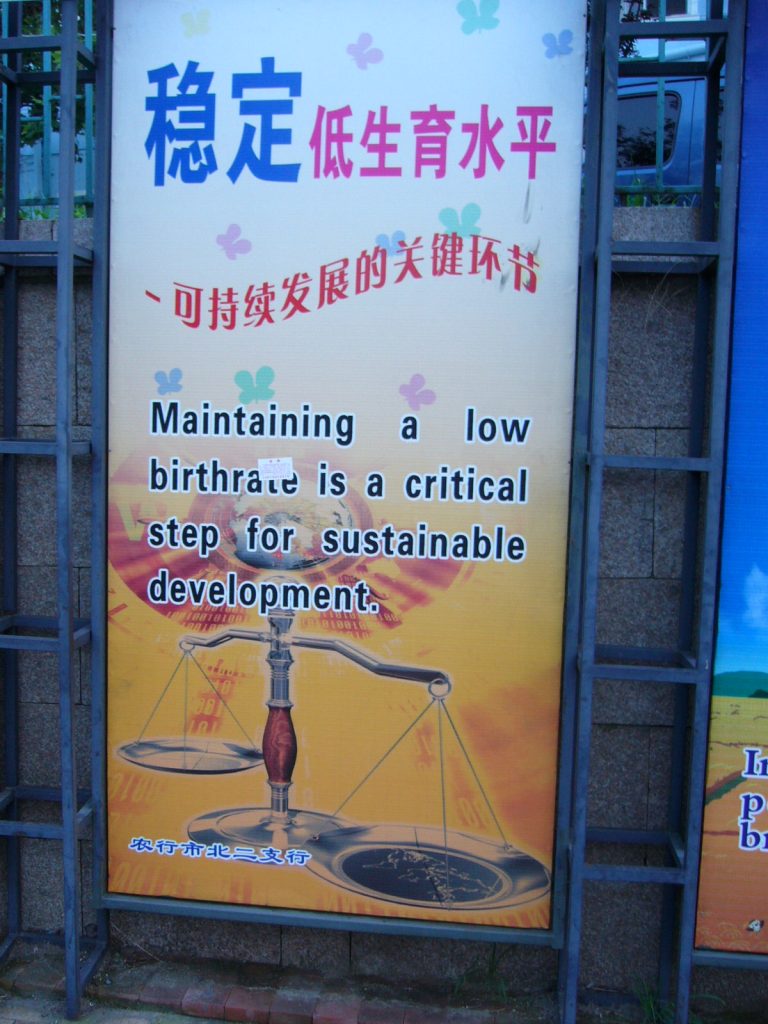
(Image source: Wikimedia Commons, a government family-planning sign in Jiangxi, by kafka4prez, CC BY-SA 2.0; substitute image — the widely circulated news photograph of Feng Jianmei is not freely licensed and is therefore not used)
(End of English body)