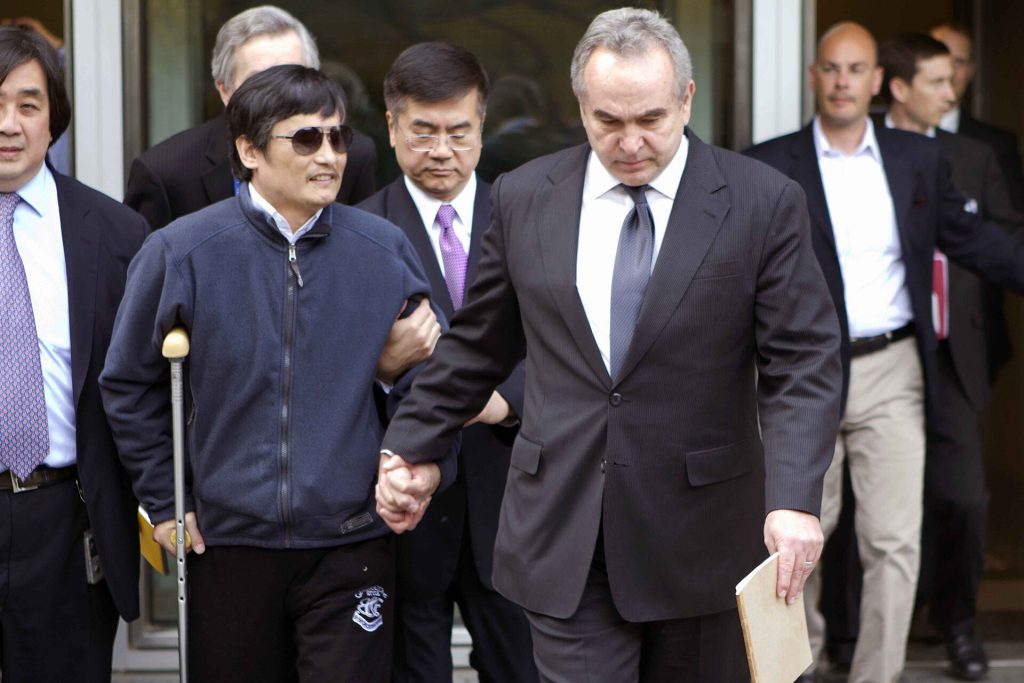
Chen Guangcheng was a self-taught, blind legal advocate from a poor village in Shandong whom his neighbours called a “barefoot lawyer.” He helped disabled people and farmers assert their rights under Chinese law — and, most consequentially, in 2005 he exposed violent enforcement of the one-child policy in Linyi: forced late-term abortions, forced sterilizations, and the detention and beating of relatives as hostages. Local authorities retaliated. He was placed under house arrest, then sentenced to four years and three months in prison for “damaging property” and “organizing a mob to disturb traffic.” When he completed his sentence on September 9, 2010, he did not go free: he and his wife Yuan Weijing were confined to their home in Dongshigu Village under an extralegal house arrest, watched around the clock by roughly a hundred guards, while would-be visitors were turned back, beaten and robbed. On the night of April 22, 2012, after feigning illness for weeks, Chen climbed over his courtyard wall, broke a foot in the fall, fell more than two hundred times as he groped his way through the dark, and — helped by a network of activists — reached Beijing and entered the U.S. Embassy. It was the eve of the fourth U.S.–China Strategic and Economic Dialogue, with Secretary of State Hillary Clinton and Treasury Secretary Timothy Geithner about to arrive. After days of emergency diplomacy, dramatic telephone testimony to a U.S. congressional hearing from a hospital bed, and a Chinese concession that he could apply to study abroad “like other Chinese citizens,” Chen flew to the United States with his family on May 19, 2012. His story showed the world what it could cost a Chinese citizen simply to ask his own government to obey its own laws.
Background and Causes
The man. Chen Guangcheng was born on November 12, 1971, in Dongshigu Village, Shuanghou Township, Yinan County, Linyi, Shandong Province, the youngest of five sons in a peasant family. At about six months old, a fever destroyed his optic nerves and left him blind, according to English Wikipedia and biographical reporting. He did not start school until age 18, entering the Linyi school for the blind. In 1998 he entered Nanjing University of Traditional Chinese Medicine, studying acupuncture and massage — then the only programmes open to blind students — while auditing law courses and teaching himself law. After graduating in 2001 he worked as a masseur at the Yinan County hospital. He met Yuan Weijing in 2001; they married in 2003 and had a son and a daughter.
The “barefoot lawyer.” As reported by The Washington Post and The New York Times, Chen first travelled to Beijing in 1996 to challenge taxes illegally levied on disabled people, and won. He went on to fight for free public transport for the disabled, against a paper mill polluting the Meng River, and against an unlawful land scheme. In 2002 Newsweek featured him in a cover story on China’s “barefoot lawyers.”
The Linyi family-planning abuses. In early 2005 Chen and his wife investigated birth-planning enforcement across Linyi. They documented women subjected to forced abortions months into pregnancy, couples forcibly sterilized, people detained in “study classes,” and relatives held and beaten until a wanted woman turned herself in. A report he prepared with legal scholar Teng Biao and others estimated that very large numbers had been swept into such classes; the exact scale remains disputed (see below). In June 2005 Chen travelled to Beijing to file a class-action lawsuit — the first such mass legal challenge to coercive family planning in China — and to brief the press. The suit was rejected, but the publicity forced the central government to act: the National Population and Family Planning Commission investigated and announced on September 19, 2005, that illegal practices violating people’s rights “do exist” in Linyi, and that responsible officials had been dismissed, investigated or detained (per Human Rights Watch’s chronology). Linyi officials, however, retaliated: in September 2005 Chen was seized in Beijing by Linyi personnel, returned home and kept under house arrest, beaten when he tried to leave, and smeared as a tool of “foreign anti-China forces.”
Course of Events
Trial and prison (2006–2010). According to Human Rights Watch, Amnesty International and contemporary reporting, Chen was taken away in March 2006 and formally detained in June on charges of damaging property and gathering a crowd to disturb traffic — officials said he had incited villagers to smash vehicles of the Shuanghou police station and township government, while witnesses and his lawyers argued that a man under round-the-clock surveillance could not have done so. On the eve of his August 18, 2006 trial, his three hired lawyers were briefly detained; the trial lasted about two hours, neither his lawyers nor his wife were admitted, and the court assigned him a defender at the last minute. On August 24, 2006, he was sentenced to four years and three months; after a retrial, the Linyi Intermediate Court upheld the sentence on January 12, 2007. Amnesty International designated him a prisoner of conscience. He was named to the Time 100 in 2006 and received the 2007 Ramon Magsaysay Award while in prison; when Yuan Weijing tried to collect it on his behalf, her passport was confiscated at Beijing airport.
Release into a larger prison (September 2010 – April 2012). Chen was released on September 9, 2010, and driven straight back into confinement at home. The house arrest had no legal basis; officials called him a free man. In fact, according to a Chinese Human Rights Defenders (CHRD) submission to the United Nations and Amnesty International’s November 2011 statement, local authorities employed close to 100 guards to watch the family around the clock, installed floodlights and cameras, cut telephone and internet access, searched his six-year-old daughter’s schoolbag, and denied him outside medical care. In February 2011 the U.S.-based group ChinaAid released a video Chen and Yuan had secretly recorded describing their confinement; after it appeared, CHRD and The New York Times reported, the couple were severely beaten. Through 2011, visiting Chen became a relay of civil resistance: netizens, journalists and lawyers travelled to Dongshigu and were almost invariably blocked, beaten or robbed. Nanjing activist He Peirong — “Pearl” — was among the most persistent campaigners. In November 2011 Secretary Clinton said publicly that the United States was “alarmed” by Chen’s treatment; the same month, Representative Chris Smith was refused permission to visit him. In December 2011 actor Christian Bale travelled with a CNN crew to see Chen; guards punched and shoved him, threw stones, and chased the crew’s van for more than forty minutes, as CNN broadcast worldwide. Bale said he had only wanted “to meet the man, shake his hand and say what an inspiration he is” (CNN; BBC).
The escape (April 22–26, 2012). As Chen later recounted, and as the Congressional Research Service (CRS) report of May 29, 2012 and reporting by The New York Times and the BBC established, he prepared for weeks by staying in bed feigning illness so the guards would lower their vigilance. On the night of April 22, helped by his wife, he climbed the wall around his house and broke his foot in the fall. He crossed the guarded river by his village — he later believed the guards were asleep — and, relying on childhood memory, fell more than 200 times before reaching a rendezvous point. A villager, Chen Hua, drove him out of Linyi; He Peirong met him in Xintai and drove him through the night to Beijing, where scholar Guo Yushan, activist Hu Jia and others moved him between hiding places. On April 25, with his foot swelling badly, his friends contacted the U.S. Embassy; after an overnight decision in Washington authorized by Secretary Clinton, an embassy car brought him in on April 26. He stayed six days. Linyi authorities discovered his absence only around April 26. In the early hours of April 27, guards raided the nearby home of his elder brother Chen Guangfu; Guangfu’s son — Chen’s nephew Chen Kegui — fought with knives against the intruders and wounded several before being seized. He Peirong and Guo Yushan were also taken in for questioning and later released. On April 27 Chen released an online video to Premier Wen Jiabao with three demands: prosecute the officials who had assaulted his family, guarantee his family’s safety, and prosecute corruption according to law.
Embassy negotiations and the hospital reversal (April 29 – May 4). Assistant Secretary Kurt Campbell arrived early in Beijing on April 29 and, with Legal Adviser Harold Koh and Ambassador Gary Locke, negotiated with Vice Foreign Minister Cui Tiankai and other Chinese officials. Clinton and Geithner arrived on May 2 for the Dialogue. That day Chen left the embassy with Locke for Beijing’s Chaoyang Hospital to treat his foot and reunite with his family. Under the arrangement announced by the U.S. side, China promised that Chen would be freed from confinement, relocated outside Shandong, allowed to study law at a Chinese university, and that the central government would investigate the “extralegal” persecution by Shandong authorities. Chen said he wished to remain in China as a free citizen; he had not asked for asylum. But that evening, after U.S. personnel left the hospital, Chen learned from his wife of the latest threats against the family, felt isolated behind a new cordon of guards, and reversed himself: on May 2–3 he told the AP, CNN and others that he regretted leaving and wanted to go to the United States. China demanded a U.S. apology for “interference”; a May 4 Beijing Daily editorial called Chen “a tool and a pawn for American politicians to denigrate China.” On May 3 Chen testified by mobile phone from his hospital bed to an emergency hearing of the Congressional-Executive Commission on China chaired by Representative Chris Smith — a moment broadcast live in the United States. On May 4, after Clinton met State Councillor Dai Bingguo, Beijing shifted: Chen could apply to study abroad “just like any other Chinese citizen,” and NYU’s law school promptly offered him a visiting scholarship, arranged by Professor Jerome A. Cohen of its U.S.–Asia Law Institute.
Departure (May 19). Chen remained at Chaoyang Hospital under guard while the paperwork was processed, and on May 15 he again phoned into a congressional hearing to plead for his nephew and relatives. On May 19, 2012, the family of four were issued U.S. visas, boarded a commercial flight in Beijing and arrived at Newark, New Jersey. Speaking at NYU that evening, Chen thanked those who had helped him and said he would work to “promote justice and fairness in China.” He settled with his family in NYU housing as a visiting scholar at the law school, studying English and law.
Key Figures and Reactions
Chen Guangcheng and Yuan Weijing. Throughout, Chen insisted he wanted only “the rights of every other Chinese citizen” — that the government obey its own laws. Yuan was his investigative partner as well as his wife: she interviewed victims, smuggled out letters, and was repeatedly beaten. In a May 29, 2012 New York Times op-ed, Chen condemned the “lawless punishment inflicted on me and my family over the past seven years” and wrote that those who handled his case had “openly flouted the nation’s laws.”
The activist relay. He Peirong, a Nanjing English teacher who had campaigned for Chen online and been beaten on earlier visits, drove the getaway car to Beijing. Guo Yushan, a Beijing scholar and co-founder of the Transition Institute think tank, organized Chen’s hiding in the capital after a call from Chen Guangfu (CRS report). Both were interrogated and briefly held; Guo was detained again in 2014 on a “picking quarrels” charge. Their fates show that the escape’s costs were borne by many ordinary people.
The United States. Clinton later described the case in her memoir as one of the hardest diplomatic problems of her tenure: Chen could neither be handed back nor be allowed to wreck the Strategic and Economic Dialogue. Campbell, Koh and Locke were the front-line negotiators. Representative Chris Smith had championed Chen for years and had nominated him for the Nobel Peace Prize; his May 3 hearing pushed the negotiation into the open. President Barack Obama, asked about the case on April 30, said only that he was aware of reports — a restraint Republicans criticized.
China. The Foreign Ministry first demanded an apology; state media branded Chen a U.S. “tool and pawn” and attacked Ambassador Locke personally. Shandong authorities continued to deny that the house arrest was unlawful. Notably, the central promise made in the negotiations — a central-level investigation of the Shandong abuses and safety for the family — was never publicly carried out: testifying to Congress in April 2013, Chen stated that China had not honoured its commitments (House Foreign Affairs Committee hearing record).
The wider world. Amnesty International and Human Rights Watch campaigned for Chen throughout and condemned the house arrest as unlawful; the EU, Britain and Germany voiced concern after the escape. Coming weeks after Wang Lijun’s flight into the U.S. consulate in Chengdu and the fall of Bo Xilai, the case dominated global headlines for days.
Disputed Figures and Accounts
How large were the Linyi abuses? The 2005 investigative report by Chen, Teng Biao and others estimated that some 130,000 Linyi residents had been forced into “study classes” and detained over family-planning violations (reported by Kyodo and The Washington Post); other accounts put the number subjected to forced abortion or sterilization at around 120,000. The National Population and Family Planning Commission’s September 2005 conclusion acknowledged only that illegal violations “do exist” and that some officials had been punished; it published no victim total, and Linyi authorities denied any systematic violence. The “130,000” figure should therefore be read as the rights investigators’ estimate — while the existence of widespread forced abortions, forced sterilizations and hostage-taking of relatives was publicly admitted by the central agency itself and independently documented by international media.
The cost of the cage. Estimates of the guard force range from “dozens” to the roughly 100 cited by CHRD and Amnesty International; some accounts mention up to 200 men at peak deployment. Chen said officials told him his house arrest had cost 60 million yuan (about $9.5 million); a separate Chinese report put the figure at 50 million yuan. No official accounts exist to verify either sum, but that the surveillance consumed extraordinary “stability maintenance” resources for 19 months is consistently reported.
Was the 2006 conviction justified? Xinhua reported that Chen incited villagers to smash vehicles and attack officials. His supporters and lawyers countered that he was under constant surveillance, that the charges contradicted that fact, and that the trial itself was grossly unfair — lawyers detained, family barred, a verdict in a two-hour hearing. The UN Working Group on Arbitrary Detention found his detention arbitrary in 2006, and Amnesty International deemed him a prisoner of conscience. China never accepted those findings.
May 2: voluntary exit or pressure? This remains the most contested episode. The U.S. account (spokesperson Victoria Nuland, Campbell, and Clinton’s memoir): Chen repeatedly said he wanted to stay in China, never requested asylum, and, asked twice by Locke whether he was ready to go, answered “zou” — “let’s go”; no U.S. official ever relayed any Chinese threat against his family. Chen’s account (to CNN and the AP): embassy officials lobbied him to leave; once at the hospital they soon departed, leaving him feeling abandoned, and he learned only afterwards of threats against his family. CRS and media reconstructions suggest a middle reading: his wish to stay rested on trust in the Chinese promises; finding the hospital ringed by guards who blocked U.S. access — and lawyer Jiang Tianyong beaten and held for nine hours when he tried to visit on May 3 — he concluded the promises were worthless. What is not disputed is the outcome: under the pressure of the televised congressional phone call, Beijing agreed on May 4 to let him study in the United States.
The NYU departure (2013). In June 2013 Chen issued a statement saying NYU was forcing him out under “great, unrelenting pressure” from the Chinese Communists, implicitly linked to NYU’s Shanghai campus. NYU’s spokesman flatly denied the claim, saying the fellowship had always been planned for about a year; Professor Cohen said the one-year transition had been the understanding from the start (Reuters; NPR; The New York Times, June 2013). Chen left NYU in autumn 2013 for posts including Distinguished Senior Fellow in Human Rights at the Witherspoon Institute and visiting fellow at the Catholic University of America. That dispute, too, remains unresolved.
Impact and Aftermath
Diplomacy survived; the symbolism endured. The Dialogue went ahead, and both governments avoided a rupture. Yet alongside the Wang Lijun affair, the case made Chinese human rights an issue in the 2012 U.S. election and earned a chapter in Clinton’s memoir Hard Choices. It is widely regarded as one of the most dramatic human-rights episodes in post–Cold War U.S.–China relations: a blind man besieged by a local party-state forced two superpowers to negotiate over one citizen’s freedom.
The family left behind kept paying. On November 30, 2012, the Yinan County Court tried Chen Kegui in proceedings of which his family had not been notified and at which his chosen lawyers were not present, and sentenced him to three years and three months for “intentional infliction of injury” — although he and his supporters maintained he had acted in self-defence when officials broke into the home at night and beat his parents. Human Rights Watch called the case retribution; the UN Working Group on Arbitrary Detention later found Kegui’s detention arbitrary. He was released in 2015. His parents and other relatives remained under surveillance; in November 2013 Chen Guangfu travelled with their mother to New York for a reunion with Chen.
Chen in America. At NYU he received the 2012 Lantos Human Rights Prize and the Human Rights First Award; his memoir The Barefoot Lawyer appeared in 2015. After NYU he held posts at conservative institutions and continued to campaign on Chinese human rights. On August 26, 2020, he addressed the Republican National Convention, calling the Chinese Communist Party “an enemy of humanity” and endorsing President Donald Trump — a highly partisan appearance that drew mixed reactions among his earlier supporters. On June 21, 2021, he was naturalized as a U.S. citizen in Baltimore; as the Associated Press reported, he said he was “very grateful that America, this free country, has welcomed us.” In 2023 the Institute of World Politics awarded him an honorary doctorate of laws. Inside China his name remains censored online. But for countless Chinese rights defenders, the blind man who climbed a wall in the dark in April 2012 remains an indelible symbol: the demand that power obey the law does not disappear just because those who voice it are punished.
Sources
Wikipedia (English): “Chen Guangcheng”; Wikipedia (Chinese): 《陈光诚》
Congressional Research Service: “U.S.-China Diplomacy Over Chinese Legal Advocate Chen Guangcheng,” May 29, 2012 (R42554)
Human Rights Watch: “Chronology of Chen Guangcheng’s Case” (2006) and statements on Chen Kegui (2013, 2015); Amnesty International, November 2011, and Urgent Action ASA 17/008/2013
Chinese Human Rights Defenders: submission to UN special procedures, November 28, 2011; Chinese rights reporting on the Linyi investigation and the National Population and Family Planning Commission’s September 2005 statement
The Washington Post (August 2005 investigation and 2006–2012 reporting); The New York Times, 2011–2013; CNN on Christian Bale’s blocked visit, December 2011; BBC, April–May 2012; Associated Press, May 2012 and July 2021; Reuters and AFP
Chen Guangcheng: “How China Flouts Its Laws,” The New York Times, May 29, 2012; The Barefoot Lawyer (2015)
CECC hearings, May 3 and 15, 2012; House Foreign Affairs Committee hearing, April 2013; Hillary Clinton, Hard Choices
(Image source: Wikimedia Commons, U.S. Department of State photo, public domain — Assistant Secretary Campbell with Chen Guangcheng, U.S. Embassy in Beijing, May 1, 2012)