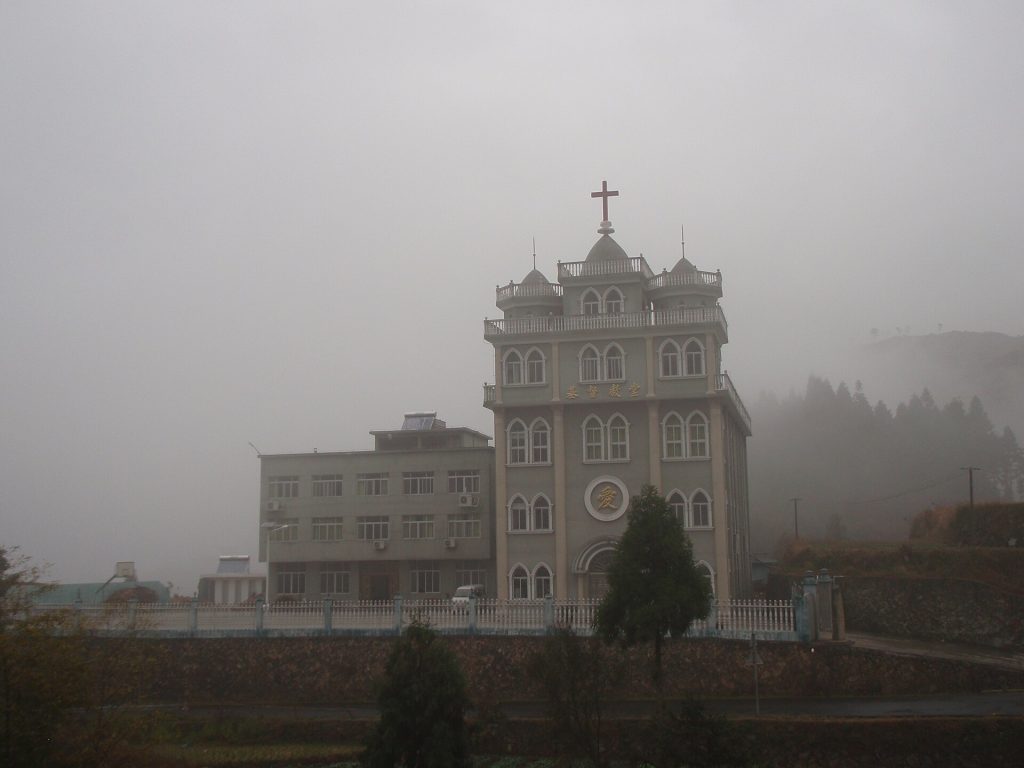
In the early hours of 28 April 2014, excavators moved in on the Sanjiang Church in Yongjia County, Wenzhou. The church — built with 20 to 30 million yuan raised by its congregation over nearly six years, seating two thousand worshippers — had that month become the focus of a province-wide standoff: thousands of Christians had taken turns standing guard through the night to stop its demolition. After weeks of negotiation, agreement and reversal, the entire church, red cross and all, was levelled in a single night.
Sanjiang was no isolated case. From 2014 to 2016, under the banner of a campaign against illegal construction, Zhejiang Province tore the crosses from the roofs of well over a thousand churches and demolished dozens of church buildings outright. A lawyer who advised the churches was seized in the night; the pastor of China’s largest official church was removed and arrested. Four years later the persecution changed form again. On 9 December 2018, more than a hundred members of Chengdu’s Early Rain Covenant Church were rounded up in a single night, and its pastor, Wang Yi, was sentenced a year later — after a secret trial for “inciting subversion” — to nine years in prison. From crosses bolted to buildings to the men and women who preached beneath them: that is the trajectory of a decade of escalating religious persecution in China.
Background and Causes
Under China’s system of religious management, religious activity may take place only at government-registered venues under officially recognised bodies — for Protestants, the Three-Self Patriotic Movement and the China Christian Council (the “two associations”). Unregistered congregations, known as “house churches,” are technically illegal. The irony of the Zhejiang campaign is that its targets were overwhelmingly the registered, official churches themselves.
Zhejiang has one of China’s largest Christian populations. Wenzhou, called “China’s Jerusalem,” counts well over a million believers by most estimates, many of them wealthy business owners — the “boss Christians.” Their churches kept growing, their red crosses glowing in rows against the night sky. In 2013 the province launched the “Three Rectifications and One Demolition” campaign, nominally against illegal structures in old districts, factory zones and urban villages. According to US Congressional-Executive Commission on China (CECC) reporting and extensive media coverage, provincial Party secretary Xia Baolong, after an inspection tour, considered church crosses “too conspicuous” and ordered them dealt with; in February 2014, the province’s ethnic and religious affairs chief, Feng Zhili, said publicly that Christianity in Zhejiang was growing “too excessive and too haphazard.” Internal documents spoke of curbing an “excess” of religious sites. A campaign nominally aimed at all illegal construction fell, in practice, almost exclusively on crosses.
The national climate was tightening in parallel: at the 2016 National Religious Work Conference, Xi Jinping stressed the “sinicization” of religion and Party leadership over religious affairs; on 1 February 2018, revised Regulations on Religious Affairs took effect, sharply raising penalties for unregistered religious activity and extending state control to online religious life. Against this backdrop, registered churches and house churches became targets in turn: the former were to lose their symbols, the latter their existence.
Course of Events
February–April 2014: demolition notices become a church-by-church roll. From early 2014, churches across Zhejiang received rectification and demolition notices; UCA News reported more than 400 religious sites earmarked for “rectification,” the overwhelming majority Christian churches. From late February, crosses came down one by one — some “voluntarily” removed by congregations under pressure, others cut away by cranes at night. By April, dozens of churches had been demolished or stripped of their crosses.
3–28 April 2014: the defence of Sanjiang Church. When the Sanjiang Church in Yongjia, Wenzhou — a registered Three-Self church — received notice that the whole building was to come down, thousands of believers travelled to guard it through the night. On 7 April the church reached an agreement with the authorities: only two floors of an annex would be demolished, sparing the main hall and its cross, and the crowds went home. On 21 April the authorities returned with heavy machinery; believers regrouped. Clearance began on 26 April, more than a dozen pastors and church workers were detained, and on 28 April the entire church was demolished. Its cost — 20 to 30 million yuan — and its excess floor area were real, but officials never explained why, of the province’s countless code violations, a church praised as a model project had to be first in line, and wholly destroyed.
Summer 2014–2015: spread and resistance. By 18 May, a partial list compiled by ChinaAid counted at least 64 churches demolished, stripped of crosses or served with notices. On 21 July, some 600 personnel descended before dawn on the Salvation Church in Shuitou, Pingyang County, to remove its cross; believers guarding the church were beaten and injured, including a 78-year-old man, Zhang Zhongsu, who suffered a serious head wound (per church accounts and overseas religious media). Thereafter the campaign spread province-wide, degenerating into a war of attrition: crosses removed, secretly reinstalled at night, and removed again.
May 2015–2016: regulations to bless the outcome, arrests to break the resistance. In May 2015, Zhejiang published draft rules for religious architecture: crosses would henceforth have to be affixed flat to a building’s façade and could not exceed one-tenth of the façade’s height — a legal varnish applied to a fait accompli. In July 2015, AFP reported that churches across Wenzhou had received ultimata: remove your crosses by 20 September, or have them removed. The human cost of resistance followed. Zhang Kai, a Christian rights lawyer advising more than a hundred churches, was seized in Wenzhou on the night of 25 August 2015 and held for nearly seven months under “residential surveillance at a designated location”; in March 2016 he appeared in a televised “confession” on Wenzhou television before being released. Wenzhou pastor Huang Yizi, who had organised believers to resist a demolition, was sentenced in March 2015 to a year in prison for “gathering a crowd to disrupt social order,” and was detained again after his release. And Gu Yuese, senior pastor of Hangzhou’s Chongyi Church — with some ten thousand members, the largest official church in China — who had publicly criticised the cross removals as a violation of religious freedom, was removed from his post by the two associations in late January 2016 and arrested on suspicion of embezzlement, becoming, in ChinaAid’s words, the highest-ranking national church leader arrested since the Cultural Revolution. His wife was also detained for a time. Gu was later released on bail and the case was not pursued.
9 December 2018: the night of Early Rain. The Early Rain Covenant Church in Chengdu, founded by former rights lawyer and law lecturer Wang Yi, was an unregistered house church with several hundred members and an outsized influence among China’s urban house churches. On 1 September 2018, Wang had launched a joint statement by house-church pastors, “A Declaration for the Sake of the Christian Faith,” protesting the persecution; its signatories eventually numbered in the hundreds. He also pre-wrote a personal statement, “My Declaration of Faithful Disobedience,” to be published if he was held for more than 48 hours. On the evening of Sunday, 9 December, Chengdu police moved across the city: Wang Yi and his wife, elders, staff and ordinary members were seized at meeting points, at home and on the street; more than a hundred people were detained in a single night, the church’s premises were sealed, and civil affairs authorities later declared the church an “illegal social organisation” and banned it. Wang’s declaration was published on schedule: “I am filled with anger and disgust at this regime’s persecution of the church… yet I hold no hatred toward anyone.”
2019: aftershocks and a secret trial. Most members were released over the following days and months — many to find bank accounts frozen, jobs terminated under pressure, and landlords evicting them. On 24 February 2019, police raided a gathering and detained 44 people, including children, and beat Wang Yi’s elderly mother, according to church statements. Wang’s wife, Jiang Rong, was released on bail in June 2019 after about six months in detention. On 29 November 2019, church elder Qin Defu was sentenced to four years for “illegal business operations.” On 26 December, Wang Yi’s trial was held in closed session at the Chengdu Intermediate People’s Court; neither his family nor his own lawyers were notified — his lawyer had never once been permitted to meet him. On 30 December the court announced the verdict: nine years’ imprisonment for “inciting subversion of state power” and “illegal business operations” (the latter for the church’s printing of books and materials), three years’ deprivation of political rights, and confiscation of 50,000 yuan in personal assets. Nine years was among the heaviest sentences imposed on a house-church pastor in years.
Key Figures and Reactions
Xia Baolong and the Zhejiang authorities insisted the campaign had nothing to do with religion: what was demolished was illegal construction, and all faiths were treated alike. But the internal language about Christianity growing “too excessive and too haphazard,” planning lists consisting almost entirely of churches, and the rarity with which other illegal structures were demolished in their entirety, made the claim hard to credit.
Wang Yi left a large body of writing. His “Declaration of Faithful Disobedience” invoked the apostle Peter — “We must obey God rather than men” — and insisted he bore the authorities no hatred: faithful disobedience, he wrote, was owed to faith alone. The text circulated widely among Christians in China and abroad.
International reaction. On 31 December 2019 the US State Department said it was “alarmed” that Wang Yi had been sentenced to nine years after a secret trial, demanded his immediate and unconditional release, and called the case “yet another example of Beijing’s intensification of repression of Chinese Christians and members of other religious groups.” The US Commission on International Religious Freedom (USCIRF) lists Wang Yi as a religious prisoner of conscience; Amnesty International designated him a prisoner of conscience and called the sentence “appalling and unjust.” China’s Foreign Ministry replied that the case had been handled according to law and that foreign governments had no right to interfere.
A divided church. In Zhejiang, official-church believers mounted a rare collective resistance to defend their crosses; after Early Rain, house-church pastors signed a public declaration — an almost unprecedented act of collective religious speech in the People’s Republic. On the other side, the official “two associations” cooperated throughout: it was they who removed Gu Yuese, and official church media that denounced Wang Yi as a lawbreaker. Registered or not, the chill reached both.
Disputed Figures and Accounts
How many crosses were torn down? The counts, side by side. Beijing has never published statistics; outside figures rest on case-by-case documentation by church networks and advocacy groups, and the calibres differ. ChinaAid’s 2014 annual report, citing statistics from Zhejiang church leaders, put the toll by the end of 2014 at 422 crosses removed, more than 30 churches demolished, more than 300 people taken into custody and at least 150 injured; unverified local reporting suggested the number of crosses removed in 2014 alone might have approached 1,000. In August 2015, The Guardian reported activists’ figure of more than 1,200 crosses removed. The New York Times cited workers at government-backed churches for at least 1,200 by the summer of 2015, with local estimates reaching some 1,700 by early 2016. Voice of America reported in February 2016 that more than 1,500 crosses had come down since 2013; ChinaAid in April 2016 put the figure since 2014 at more than 2,000. A scholarly synthesis in the journal Religions estimated about 1,500 churches affected and roughly 20 churches demolished entirely. What no dataset disputes: the order of magnitude is one to two thousand crosses, and the overwhelming majority of targets were legally registered churches.
“Illegal construction” or persecution? The official defence is not wholly without facts: Sanjiang Church did exceed its approved floor area, and many crosses had never been approved. But selective enforcement cannot be explained away: luxury clubs and factory violations across the province were seldom “treated” by total demolition. And the 2015 rules — crosses flat against the façade, no more than one-tenth of its height — show that the issue was never only legality: the silhouette of a cross on a roofline was itself what the authorities intended to erase.
Wang Yi’s “illegal business operations.” Half of Wang’s conviction rested on the church’s printing of gospel books and pamphlets. Supporters note that virtually every house church prints internal materials; criminalising the practice amounts to declaring all unregistered religious life punishable. Officials have never engaged that argument, insisting only that the publications were unlicensed. The trial itself is likewise unverifiable: held in secret, family excluded, defence counsel never admitted, and the full judgment never published.
Impact and Aftermath
The Zhejiang campaign’s model — religious repression packaged as administrative enforcement — was soon replicated nationwide: in 2018 crosses were torn down across Henan and minors barred from churches; in 2019 demolitions and closures followed in Anhui, Jiangxi and Shandong. Official churches were ordered to fly the national flag, sing patriotic songs, remove the Ten Commandments and replace them with leaders’ quotations, as “sinicization” turned from slogan into checklist. Major urban house churches — Beijing’s Shouwang and Zion churches, congregations in Guangzhou and Guiyang — were banned and sealed in a wave around 2018.
Early Rain has not disappeared. Its members still meet in small groups under surveillance, and around each 9 December anniversary, members are questioned or detained to forestall commemorations. Wang Yi remains in Jintang Prison, Chengdu, his sentence running to 2027. In October 2025, authorities detained some 30 leaders of the unregistered Zion Church across seven cities; in January 2026 the cross of the Yayang Church in Wenzhou was removed amid detentions, and Early Rain reported nine more of its members detained — twelve years after Sanjiang Church was levelled, the chain of persecution is still lengthening. Wang Yi closed his declaration with words that might serve as its epitaph: he would wait, “with hope, looking to the Lord who rules over all things and over history, for the end of all this to come.”
Sources
US Congressional-Executive Commission on China (CECC), “Zhejiang Government Launches Demolition Campaign, Targets Christian Churches” (2014), including the Sanjiang Church timeline
ChinaAid, 2014 annual report and Zhejiang case reporting (figures; the Zhang Kai and Gu Yuese cases)
The Guardian, “China arrests Christians who opposed removals of crosses” (August 2015); AFP reporting on the Wenzhou removal deadlines (30 July 2015)
The New York Times reporting on the cross-removal figures and the Gu Yuese case (2016); Voice of America, “Spate of Arrests in China’s Zhejiang Province” (11 February 2016)
Ian Johnson’s reporting on the campaign, and the academic estimate in Religions (MDPI), “Human Dignity as a Right and Virtue in Practice” (2018)
US State Department statement on Wang Yi’s sentencing (31 December 2019); USCIRF prisoner profile of Wang Yi; Chengdu Intermediate People’s Court notice (30 December 2019)
Early Rain Covenant Church’s published prayer letters and Wang Yi’s “My Declaration of Faithful Disobedience” (written September 2018, published December 2018)
AFP reporting on the October 2025 Zion Church detentions and the January 2026 Yayang Church and Early Rain developments
(Image source: Wikimedia Commons, by Jiangshang Qingfeng 1961, CC BY 3.0 — the Christian church of Dashiyang Village, Wenzhou area, Zhejiang)