On the evening of 18 November 2017, fire broke out at the Jufuyuan Apartments in Xinjian Village No. 2, Xihongmen, in Beijing’s southern Daxing District. The building — an illegally converted “three-in-one” block combining dormitory, workshop and warehouse — housed some 400 tenants, most of them migrant workers from other provinces. The blaze started in a basement cold-storage unit; smoke choked the stairwells. When it was over, the official toll stood at 19 dead and 8 injured. Of the dead, eight were children, and 17 were people without Beijing household registration — outsiders in the city they served.
The fire was a genuine tragedy. What followed turned tragedy into a second disaster. Two days later, Beijing launched a 40-day campaign of “major inspection, sweep and rectification” of fire hazards, with an official list of 25,395 hazardous sites. The inspections rapidly became a mass eviction of migrant settlements: notices giving residents a few hours to three days, water and electricity cut off, excavators tearing down buildings, all as night temperatures fell below freezing. Couriers, cleaners, waiters, builders and street vendors who had lived in Beijing for years — some for more than a decade — were put out on the street. An open letter signed by more than a hundred intellectuals called it an “extremely crude violation of the basic survival rights of people at the bottom of society.”
Background and Causes
To understand 2017, one must understand Beijing’s logic of population control. From 2014, central policy directed the capital to “relieve non-capital functions” — pushing wholesale markets, low-end manufacturing and logistics out of the city. The Beijing Master Plan for 2016–2035, approved in September 2017, set a hard cap: the permanent population was to be held to 23 million by 2020, with built-up land actually to shrink during the 13th Five-Year Plan period. In 2016, Beijing’s non-hukou migrant population numbered about 8.08 million, nearly 40 per cent of all residents — and in the planners’ eyes, the lower-income portion of those eight million was precisely the portion to be “relieved” out of the city.
The term “low-end population” (低端人口, diduan renkou) was not invented by internet users. Before the 2017 events it had appeared in official planning documents — 2016 planning texts for Shijingshan District, for example, spoke of removing “low-end industries” and thereby “low-end population,” wording unearthed and widely circulated by the media in November 2017. After the evictions, Beijing officials denied that the campaign targeted any “low-end population” and said the phrase had never been used. But the term’s presence in official documents, and the ground-level reality of clearance by hukou, income and occupation, made the denial ring hollow. Buildings like Jufuyuan were, to be fair, genuinely dangerous — illegally subdivided, without fire escapes, mixing living quarters with production and storage, and numbering in the tens of thousands across the city. The hazard was real. The question was whether curing it meant demolishing homes and expelling tenants, rather than making the buildings safe and the tenants housed.
Course of Events
18 November 2017: the Daxing fire. The fire broke out in the evening at the Jufuyuan Apartments in Xinjian No. 2 Village. The official cause was an electrical fault. Nineteen dead, eight injured — the figure that became the campaign’s point of departure. On 19 November, Party Secretary Cai Qi visited the scene and ordered a citywide inspection; he later also visited a temporary shelter for evicted residents.
20 November: the 40-day campaign opens. The Beijing Work Safety Administration issued its notice for a 40-day “major inspection, sweep and rectification” drive; the official hazard list contained 25,395 sites. Districts swung into action — Daxing, Chaoyang, Haidian, Changping, Tongzhou — and eviction notices went up across whole neighbourhoods of migrant apartments, subdivided rentals, basement dwellings and urban villages.
Late November: the evictions peak. The operation went far beyond “inspection”: some notices allowed three days, others only hours; water and power were cut, doors forced, belongings dumped on the roadside; some villages had their water and electricity severed wholesale to drive residents out. Xinjian Village was essentially emptied by around 25 November, its tenants — estimates of the village’s population varied widely — dispersed within days. In early-winter Beijing, with nights at or below zero, the evicted had nowhere to go: some slept with their children under bridges or in cars, some bought tickets home the same night, and volunteers and charities posting shelter information online saw their posts deleted and some aid points ordered shut.
25 November: the scholars’ letter. An open letter to Beijing’s Party and government authorities, signed by more than one hundred intellectuals and scholars, circulated online. It called the campaign illegal and unconstitutional, “an extremely crude violation of the basic survival rights of people at the bottom of society,” and demanded an immediate halt to forced evictions. Appeals from Tsinghua University alumni and other groups circulated alongside it. The letter’s focal word was “low-end population”: by what right, the signatories asked, could a city sustained by these workers’ labour define them as “low-end” and expel them into the winter with a single notice?
27 November: an official softening. At an internal meeting, Cai Qi said grassroots implementation should not be simplistic or one-size-fits-all, and that people being moved should be given reasonable time to relocate (as translated by the Made in China Journal). The pace of clearances eased somewhat thereafter, but they did not stop.
December: footage, protest, arrest. The artist Hua Yong spent days filming the clearances in Daxing and elsewhere on his phone; the videos spread widely on overseas social media. On 15 December he was arrested in Tianjin; on 18 December he was released on bail, in time to be home for his daughter’s third birthday — both his detention and release drew international media coverage. On 10 December, Human Rights Day, hundreds of tenants protested in Feijia Village, Chaoyang District, under banners reading “violent evictions violate human rights” (reported by the Paris-based Information Center for Human Rights and Democratic Movement in China). Feijia Village was cleared anyway.
2018: the numbers and the aftermath. Beijing’s statistics bureau announced that the city’s permanent population at the end of 2017 was 21.707 million, down 22,000 — the first decline in about twenty years; in 2018 it fell again, to 21.542 million. Behind the “achievement” of a shrinking population stood that winter’s expulsions. On 24 April 2018, United Nations special rapporteurs wrote to the Chinese government (communication AL CHN 8/2018) raising the forced evictions that followed the Daxing fire, noting that some tenants had received as little as three hours’ notice. Beijing’s clearance machinery thereafter went quiet and routine — but it did not disappear, as later events such as the 2020 demolition of Xiangtang Village in Changping would show.
Key Figures and Reactions
Cai Qi, the municipal Party secretary, was the campaign’s highest decision-maker. He ordered the citywide inspection the day after the fire, and, after the public outcry, instructed officials not to act in a “one-size-fits-all” way and to allow reasonable moving time. Defenders of the campaign argued that the brutality was grassroots overreach — local officials racing to exceed quotas. Critics replied that in a system of campaign-style governance, with targets set from above and careers staked on speed, the outcome was determined from the start; blaming the grassroots afterwards is a fixed part of the script.
The hundred-plus scholars produced the event’s most important act of public speech. Their letter asked why workers who had contributed so enormously to Beijing’s construction and daily life were denied the citizenship rights and human dignity promised by the Constitution. The letter and related appeals were swiftly deleted from WeChat and other platforms, but survived abroad.
Beijing’s official line never changed: the campaign targeted fire hazards, not people or hukou; the authorities had never used the term “low-end population” and urged the media “not to hype” the story. State media covered relief efforts and stressed the necessity of the rectification drive, while never addressing the documented facts of cut utilities and hours-long deadlines.
Ordinary Beijingers were divided. Some mourned the 19 dead and carried food and clothing to evicted neighbours; others held that the city was simply too crowded and the clean-up overdue. But one observation was shared everywhere: the people being expelled were the same people who delivered the city’s parcels, swept its streets, served its tables and minded its children — and within a week of their departure, breakfast stalls had closed, deliveries had stalled, and cleaning shifts went unfilled. The city had run a live experiment on how dispensable its “low-end population” really was.
Disputed Figures and Accounts
How many people were driven out? No one knows the total. Beijing never published a figure for the evicted. A submission to the UN Committee on the Elimination of Racial Discrimination stated that “tens of thousands” had been expelled; The Art Newspaper, reporting Hua Yong’s case, cited estimates “ranging from several thousand to hundreds of thousands.” Because clearances proceeded building-by-building and vast numbers of tenants simply vanished overnight without registering anywhere, the true number may be permanently unknowable. What is certain: Xinjian Village alone accounted for people in the tens of thousands (on varying counts of its population), and the 25,395 listed hazard sites sheltered far more.
Cause and responsibility. The official finding on the fire was an electrical fault. Critics pursued the chain of responsibility: the building had operated illegally for years, reportedly despite complaints — why had regulators looked away, and why, after the fire, did the harshest consequences fall not on negligent officials but on tenants of similar buildings? Seventeen of the 19 dead were migrants and eight were children: they were the hazards’ victims. The city’s way of memorialising them was to expel everyone who resembled them.
Was “low-end population” an official term? Beijing officials denied it publicly. But the district-level planning documents unearthed by the media — Shijingshan’s among them — show the phrase in official use; after the events, “low-end population” became a heavily censored term, scrubbed en masse from the domestic internet. Beneath the quarrel over wording lies the substance: whatever the term, the campaign operated by deciding, on the basis of hukou, income and occupation, who could stay and who had to go.
Did the fire cause the evictions? Supporters of the rectification drive argue that without the fire there would have been no political will to clear tens of thousands of “three-in-one” hazards, and that the campaign prevented further tragedies. Opponents note that the population-reduction targets were set before the fire, which merely opened a “window of opportunity,” and that genuine safety governance would mean upgrading, regulating and rehousing — not demolishing homes in midwinter. Both claims are still argued today; but it is worth noting that no Chinese city has since repeated a winter expulsion on this scale — perhaps the clearest trace the public outcry left behind.
Impact and Aftermath
The event’s most durable legacy is four Chinese characters: “low-end population.” Lifted out of the footnotes of planning documents, it became the starkest label for social stratification and hukou discrimination in contemporary China, quoted again years later whenever a city moves against migrants or shared rentals. Beijing in the winter of 2017 is now the fixed reference point for every such debate.
For Beijing itself, the population targets were “achieved”: the permanent population fell year after year, and “relief” entered the ledger of accomplishments. The other side of the ledger arrived more slowly: chronic labour shortages and rising living costs, with domestic services, logistics, catering and cleaning repeatedly reported short of hands. A city that treats people as a number to be reduced eventually pays for it in its daily functioning.
For the evicted, there has been no apology, no compensation, and no list recording who they were. Many eventually drifted back to Beijing — the city cannot do without them, and they have nowhere else to go. But they still live at the city’s edge, in the next “hazard inspection” list. In November 2017, nineteen people died in a fire. In the forty days that followed, tens of thousands of the living were treated as the hazard itself, and swept away.
Sources
US Congressional-Executive Commission on China (CECC), 2018 Annual Report, entry on the Beijing evictions (including the Feijia Village protest and the composition of the fire’s victims)
United Nations human rights special procedures, communication AL CHN 8/2018 to the Government of China (24 April 2018), on forced evictions and notice periods
Open letter of more than one hundred intellectuals and scholars to Beijing’s Party and government authorities (25 November 2017)
The Guardian, “China’s capital accused of ‘violation of human rights’ over evictions” (27 November 2017); BBC reporting on Hua Yong’s detention and release (December 2017)
The Art Newspaper, reporting on Hua Yong and estimates of the number evicted; the Information Center for Human Rights and Democratic Movement in China (Paris) on the Feijia Village protest
Beijing Master Plan (2016–2035), population provisions (Beijing Municipal Government, September 2017); Beijing Municipal Bureau of Statistics figures for the 2017 and 2018 permanent population
Made in China Journal, translations and account of Cai Qi’s remarks and the campaign’s course
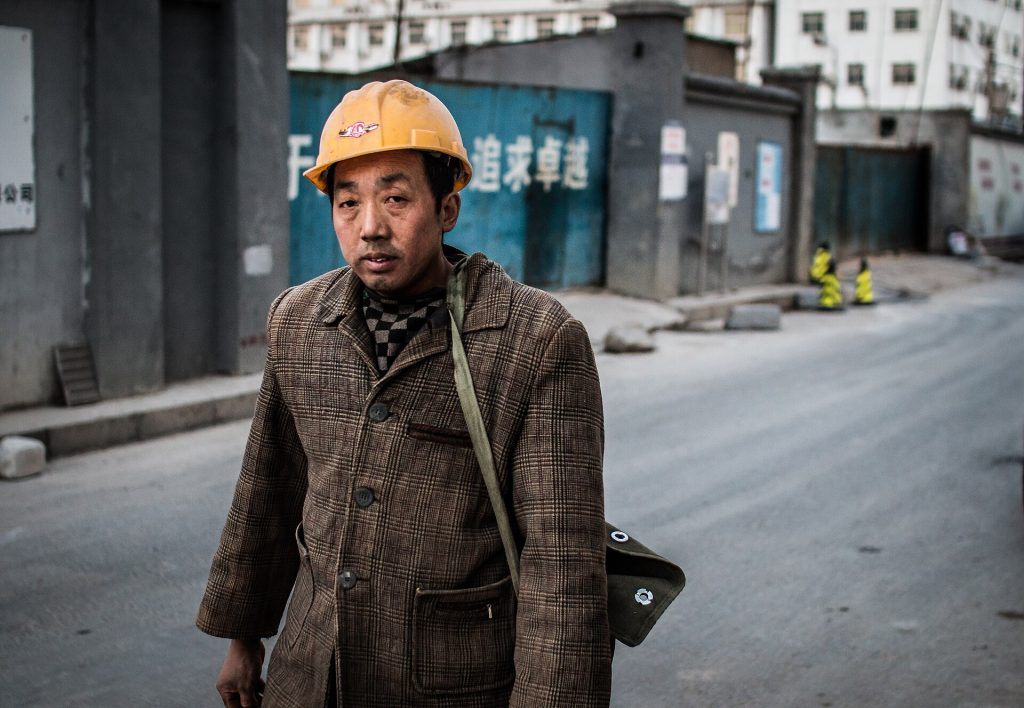
(Image source: Wikimedia Commons, by Matt Ming, CC BY 2.0 — a migrant worker portrait; an illustrative image, not a photo of the event)