On March 11, 2018, the National People’s Congress (NPC) adopted an amendment to China’s constitution by 2,958 votes to 2, with 3 abstentions. Its most consequential provision deleted from Article 79 the clause stating that the President and Vice-President of the People’s Republic of China “shall serve no more than two consecutive terms.” The change removed the ceiling on tenure that the 1982 constitution had placed on the head of state, allowing Xi Jinping to remain president beyond the end of his second term in 2023. The amendment was accompanied by a sweeping wave of online censorship: discussion of the change was scrubbed from Chinese social media, and retired journalists, lawyers, students and ordinary internet users who voiced dissent were detained, warned or silenced. The 2018 amendment is widely regarded as a fundamental turning point in the political system China had built since the reform era.
Background and Causes
The presidential term limit in the 1982 constitution grew directly out of reflection on the Cultural Revolution. Lifetime tenure was blamed for enabling Mao Zedong’s personal rule and catastrophic, uncorrectable decisions in his later years. Under Deng Xiaoping, who pushed to abolish life tenure for leading cadres, the 1982 constitution expressly capped the presidency at two consecutive terms. For more than three decades, that cap worked in tandem with the de facto two-term norm for the Communist Party general secretary and the chairmanship of the Central Military Commission: Jiang Zemin and Hu Jintao each handed over power after roughly ten years, producing a regularized succession order that scholars considered a rare instance of institutionalization in an authoritarian system.
It is worth noting the asymmetry that later made the 2018 change so significant: of the three posts that together constitute China’s top leadership — party general secretary, chairman of the Central Military Commission, and state president — only the presidency carried a constitutional term limit. The party charter and military rules set no limit at all. The 1982 cap on the presidency thus functioned less as a direct restraint on the real levers of power than as the public, legal symbol of the post-Mao consensus against lifelong rule; removing it meant removing that symbol.
After Xi Jinping became party general secretary in 2012 and president in 2013, power concentrated rapidly in his hands. He came to chair more than a dozen newly created leading groups and commissions; in 2016 he was designated the “core” of the party leadership; and at the 19th Party Congress in 2017 “Xi Jinping Thought” was written into the party charter. The congress produced no clear heir apparent, and outside observers widely speculated that Xi intended to rule for an extended period. In January 2018, the second plenum of the 19th Central Committee approved a proposal to amend the constitution, setting the formal process in motion.
Course of Events
January 18–19, 2018 — The second plenum of the 19th Central Committee meets in Beijing and approves the Party Central Committee’s proposal for amending parts of the constitution.
January 26, 2018 — The Central Committee formally submits the amendment proposal to the NPC Standing Committee.
February 25, 2018 — Xinhua publishes the full proposal. The deletion of the presidential term limit is publicly revealed for the first time and immediately becomes a global news story.
February 26, 2018 — Li Datong, a retired senior editor of the China Youth Daily, publishes an open letter urging Beijing’s 55 NPC deputies to vote against removing the term limit, calling it a reversal of history.
March 11, 2018 — The first session of the 13th NPC adopts the constitutional amendment: of 2,980 deputies present, 2,958 vote in favor, 2 against, 3 abstain, and 1 ballot is invalid. The package of 21 articles writes “Xi Jinping Thought on Socialism with Chinese Characteristics for a New Era” into the constitution’s preamble; adds to Article 1 the sentence that Communist Party leadership is “the defining feature of socialism with Chinese characteristics”; creates a constitutional oath of office; establishes a new National Supervisory Commission; and deletes the two-term limit for president and vice-president in Article 79(3). Notably, term limits for the premier and the NPC Standing Committee chair were left in place.
March 17, 2018 — Xi Jinping is re-elected president unanimously, by 2,980 votes to 0, and takes the first presidential constitutional oath in the history of the People’s Republic.
Censorship and repression unfolded in parallel. According to records kept by China Digital Times and other monitors, searches for the word “immigration” (移民) on Baidu spiked roughly tenfold within three hours of the announcement. Weibo blocked searches for terms including “Xi Jinping” and “life tenure” (终身制); banned terms extended to “emperor,” “Yuan Shikai” (the early-Republic strongman who tried to restore the monarchy), “I disagree,” and even, briefly, the Latin letter “N.” Wuhan rights activist Huang Fangmei was detained over a satirical “reversing the car” video alluding to turning back the clock. The justice bureau of Lengshuijiang, Hunan, issued a notice barring lawyers from taking cases opposing the amendment. Former prosecutor Shen Liangqing was briefly detained and his electronic devices seized. On March 7, law students at Tsinghua University hung a banner playing on a love song — “I love you with no term limit; if there were one, I’d delete it” — which was swiftly removed. The Q&A platform Zhihu’s app was ordered pulled from app stores for rectification in the same period.
Key Figures and Reactions
Xi Jinping was both the driver and the direct beneficiary of the change. The official line, carried by Xinhua and the People’s Daily, held that removing the limit “helps uphold the authority and centralized, unified leadership of the Party Central Committee with Comrade Xi Jinping at its core” and improves the state leadership system, while insisting that the amendment did not amount to restoring life tenure.
Dissent came mainly from the margins of the establishment and from abroad. According to multiple media reports, Tsinghua law professor Xu Zhangrun published a lengthy essay in July 2018, “Our Present Fears and Expectations,” criticizing the amendment and the trend toward personal rule; he was suspended by Tsinghua in 2019. On March 3, 2018, U.S. President Donald Trump told a closed-door fundraising event, according to a recording reported by CNN: “He’s now president for life… And look, he was able to do that. I think it’s great. Maybe we’ll have to give that a shot some day.” The remark drew wide controversy. Western media generally described the amendment in terms of a “president for life” or an imperial restoration, and read it as the end of the collective leadership and orderly succession norms established in the Deng era.
Disputed Figures and Accounts
Officials said the amendment proposal was formed through “extensive consultation and full democracy,” and pointed to the 2,958-to-2 vote as evidence of high consensus. Critics countered that NPC votes are routinely near-unanimous and reveal little about genuine public opinion. A 2023 academic study by Nicholson and Huang, using indirect survey techniques designed to elicit honest answers, estimated true public support for removing term limits at about 37 percent, compared with 59.6 percent support when respondents were asked directly — a gap the researchers interpreted as evidence of widespread “preference falsification” under political pressure. A second persistent point of dispute is the asymmetry of the change: the party general secretaryship and the military commission chairmanship never had formal term limits, so the deletion applied to the state presidency alone — widely understood as tailoring the rules to one man’s indefinite tenure. The surge in “immigration” searches within hours of the announcement was read by many commentators as an anxious, voting-with-their-feet reaction among part of the public; officials never addressed it. Even the two “no” votes became international news — a measure of how completely scripted NPC voting is understood to be: in a chamber of nearly three thousand deputies, the identity of the two dissenters was never disclosed, and state media coverage of the vote emphasized unanimity of purpose rather than deliberation. Defenders of the amendment within China argued that the presidency is a largely ceremonial office and that the change merely aligned the three top posts; critics answered that this was precisely the point — if the office mattered so little, the leadership would not have needed to amend the constitution to keep it, and the deletion’s real function was to announce that no formal clock would run on Xi’s tenure in any of his roles.
Impact and Aftermath
The amendment moved together with the 2018 party-and-state institutional overhaul and the creation of the National Supervisory Commission, which extended party disciplinary oversight to all public employees; the phrase affirming party leadership entered the main text of the constitution for the first time. On March 10, 2023, at the first session of the 14th NPC, Xi Jinping was unanimously elected to a third presidential term by 2,952 votes, becoming the first president of the People’s Republic to serve more than ten years — the open-ended arrangement made in 2018 was formally realized. With the succession question indefinitely shelved, analysts generally describe China’s power structure as consolidated around a single leader with no designated successor. International scholarship routinely lists the abolition of term limits as a landmark of China’s authoritarian retrenchment, discussed alongside the Xinjiang detentions and the Hong Kong National Security Law. Within China, the episode is rarely discussed publicly at all: the censored vocabulary of March 2018 — “emperor,” “life tenure,” even the letter “N” — remains a standing illustration, in studies of Chinese internet control, of how thoroughly a single political moment can be erased from a nation’s conversation with itself.
Sources
Xinhua: “Proposal of the CPC Central Committee on Amending Parts of the Constitution” (February 25, 2018); text of the Constitutional Amendment adopted March 11, 2018
National People’s Congress: official vote tally for the amendment (2,958 in favor, 2 against, 3 abstentions)
China Media Project: Li Datong’s open letter (February 26, 2018)
China Digital Times: records of censored terms during the 2018 amendment period
Reuters, BBC News, The New York Times: coverage of the March 2018 amendment
Nicholson & Huang (2023), indirect-survey study of public support for removing presidential term limits
Xinhua: Xi Jinping elected president with 2,952 votes (March 10, 2023)
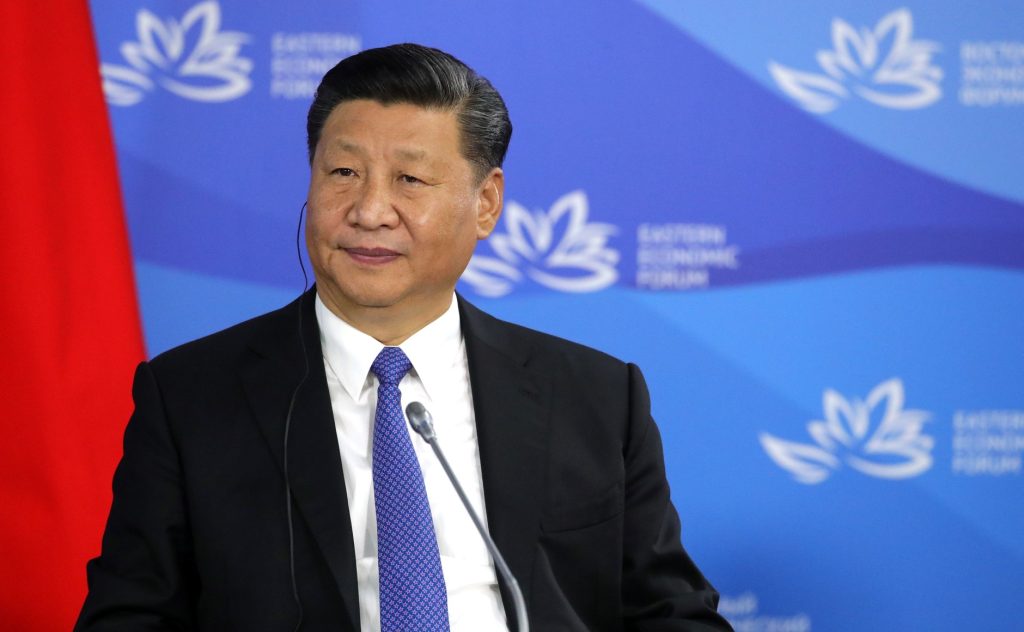
(Featured image: Xi Jinping in September 2018, by the Presidential Press and Information Office of Russia (kremlin.ru), CC BY 4.0, via Wikimedia Commons)
This is an exceptionally well-articulated discussion on “2018年修宪:国家主席任期限制被取消”. Looking forward to reading more of your insightful perspectives and follow-up work on this topic!
The perspective outlined regarding “The 2018 Constitutional Amendment: Presidential…” provides meaningful clarity on the subject. Looking forward to reading more of your insightful perspectives and follow-up work on this topic!