At the end of August 2020, China’s Inner Mongolia Autonomous Region rolled out a new “bilingual education” policy: from September 1, first-graders in Mongolian-medium schools would be taught the Chinese language subject from nationally unified textbooks, in Mandarin, with politics and history classes to follow in subsequent years. Mongolian parents and students responded with the largest protest the region had seen in decades — a mass school boycott that the Southern Mongolian Human Rights Information Center estimated involved some 300,000 students. The authorities answered with wanted notices, arrests, workplace pressure on parents, the shutdown of the region’s only Mongolian social-media platform, and claims that the unrest was incited by “foreign forces.” The protests were suppressed, and Mongolian-medium education has contracted sharply ever since.
Background and Causes
Inner Mongolia is the principal home of China’s ethnic Mongols and long maintained a genuine bilingual school system: Mongolian children could attend schools where Mongolian was the main language of instruction and textbooks were printed in the traditional vertical Mongolian script — a script inseparable from Mongolian cultural identity. Under Xi Jinping, however, Beijing moved toward what scholars call a “second-generation ethnic policy,” emphasizing assimilation over the relative autonomy of the past, under the slogan of forging “a strong sense of community for the Chinese nation.” Mandarin and “nationally unified textbooks” became the chosen instruments. The same textbook policy had already been imposed in Xinjiang in 2017 and in Tibet in 2018; Inner Mongolia was the last large minority region to be brought under it.
On August 26, 2020, the regional education department announced that from the autumn semester beginning September 1, 2020, the language subject in grade one of Mongolian-medium schools would switch to the nationally compiled Yuwen textbook taught in Mandarin; the morality-and-law subject would follow in autumn 2021, and junior-high history in autumn 2022. To calm fears, officials issued a “five no-changes” pledge: the language of instruction for other subjects, textbooks, and teaching models would supposedly remain unchanged. Parents were unconvinced. If the core language subject switched to Mandarin, they reasoned, the Mongolian-medium system would be hollowed out step by step. Events later proved that fear well founded.
Course of Events
August 26, 2020 — The Inner Mongolia education department announces the new policy and the “five no-changes” reassurance.
From August 30, 2020 — Protests erupt across the region. Parents gather at school gates; many simply refuse to send their children to register for the new school year, producing a de facto region-wide strike. According to the BBC, at one Mongolian-medium school in Naiman Banner only about 40 students registered, against roughly 1,000 in a normal year. The Southern Mongolian Human Rights Information Center estimated some 300,000 students were boycotting classes across the region.
September 2, 2020 — Police in Horqin District, Tongliao, issue four batches of wanted and public-assistance notices naming 129 people, offering a reward of 1,000 yuan per person and framing the protests as “picking quarrels and provoking trouble.” On September 3, police in Bayannur publicly vow a crackdown. Officials and state media attribute the unrest to incitement by “foreign forces.”
September 2020 crackdown — Mongolian lawyer Hu Baolong is taken away by police in Tongliao; activist Yangjin Dulimaa and her husband are arrested. Parents are pressured through their workplaces: from September 8, Bairin Right Banner threatens public employees whose children stay away with suspension; on September 13, three teachers in East Ujimqin Banner are suspended; localities threaten fines of up to 5,000 yuan and expulsion of students; two cadres in Zhenglan Banner are disciplined for implementing the policy too slowly.
Information lockdown — Bainu, the only Mongolian-language social platform in China, with some 400,000 users, is shut down in late August. A Mongolian-language newspaper, the Inner Mongolia Life Weekly, ceases publication. Los Angeles Times reporter Alice Su is detained for more than four hours in Hohhot on September 3–4 and expelled from the region. Public Security Minister Zhao Kezhi tours Inner Mongolia stressing the fight against separatism.
On casualties, Radio Free Asia and the Southern Mongolian Human Rights Information Center reported that on August 30 a student in Horqin Left Rear Banner died after jumping from a school building, and that his mother was detained outside the school; overseas outlets also reported the suicide of a Mongolian mother in Tongliao. None of these reports was ever confirmed by Chinese officials, who published no casualty figures at all.
Key Figures and Reactions
The movement had no public leaders; it was made up of ordinary parents and students whose demand was simply to keep Mongolian-medium schooling, chanting slogans such as “save the Mongolian language.” Reaction in neighboring Mongolia was intense. Former Mongolian president Tsakhiagiin Elbegdorj wrote to Xi Jinping urging respect for Mongolian language rights; on September 25 the Chinese embassy in Ulaanbaatar returned the letter unopened. Protesters rallied in Ulaanbaatar on August 31, on September 15 during Chinese foreign minister Wang Yi’s visit, and again on October 1; solidarity demonstrations were also held in Washington (September 7) and Tokyo (November 24–25). The U.S. Congressional-Executive Commission on China issued a statement in September 2020 condemning the crackdown and the assimilationist policy. On October 12, the Nantes History Museum in France cancelled a planned Genghis Khan exhibition, saying Chinese authorities had demanded censorship of the exhibition’s contents, including the words “Genghis Khan” — a spillover of the same language-and-culture dispute.
Beijing’s position never wavered: adopting nationally compiled textbooks was described as “a major decision of the Party and the state” meant to raise educational quality and spread the national common language; the protests were the work of a few people incited from abroad and would be handled according to law.
Disputed Figures and Accounts
The central disputed figure is the scale of detention, on which Chinese officials have never published any number at all. The Wikipedia entry on the protests records “dozens arrested and one suicide death,” while the Southern Mongolian Human Rights Information Center, cited by Radio Free Asia, estimated that some 8,000 to 10,000 people were placed under some form of police custody or control during the crackdown. The two figures differ by orders of magnitude and neither can be independently verified — a gap produced by the authorities’ blanket information blockade: the Mongolian social platform shut down, foreign reporters expelled, and state media confined to a single official line.
The blockade was integral to the crackdown rather than incidental to it. Bainu’s closure cut off the main channel through which Mongolian speakers had organized and shared news; the expulsion of the Los Angeles Times correspondent signaled that outside scrutiny would not be tolerated; and domestic coverage presented the policy as an uncontroversial education reform, with the boycott itself barely acknowledged. Most Chinese citizens outside the region learned of the protests, if at all, through social-media fragments that were deleted within hours. The absence of reliable numbers is therefore not a gap in the record but a product of the response itself — and it parallels the absence of any official figure for the boycott’s scale, which state media never reported. The boycott’s size likewise rests on activist estimates (around 300,000 students) with no independent count. A second dispute concerns the policy’s substance. Officials called it a limited adjustment under a “five no-changes” guarantee; scholars and Mongolian activists replied that language, politics and history are precisely the core of linguistic and identity education, and that switching all three to Mandarin started a countdown for the entire Mongolian-medium system.
Impact and Aftermath
In December 2020, the Legislative Affairs Commission of the NPC Standing Committee used its filing-review mechanism to declare local regulations on minority-language teaching inconsistent with Article 19 of the constitution, which mandates promotion of Putonghua — a legalistic endorsement that hollowed out the “five no-changes” pledge. According to an October 2023 Radio Free Asia report, Hohhot ordered all of its schools to teach in Putonghua from September 1, 2023, and Mongolian language classes were cut from seven periods a week to one. Mongolian’s place in schooling, media and public life has continued to shrink. The 2020 boycott stands as the largest open resistance to Xi-era assimilation policy, discussed internationally alongside the parallel campaigns in Xinjiang and Tibet as part of a systematic effort to reshape minority identity through language education. Its chilling effects extended well beyond the classroom: Mongolian-language publishing, broadcasting and online life all contracted in the years that followed, public discussion of minority language policy narrowed across China, and the once-distinct textbook regimes of Xinjiang, Tibet and Inner Mongolia were fully unified under the national model. For many Mongolian families, the lesson of 2020 was that even a peaceful, single-issue defense of their children’s mother tongue would be treated as a separatist threat — a lesson that continues to shape the region’s silence.
Sources
Inner Mongolia Department of Education: notice on the bilingual education policy and the “five no-changes” pledge (August 26, 2020)
BBC News: coverage of the Inner Mongolia protests, including registration figures at the Naiman Banner school (September 2020)
Horqin District Public Security Bureau, Tongliao: public-assistance notices naming 129 people, with a 1,000-yuan reward (September 2, 2020)
Radio Free Asia: reporting on the protests, arrests, and the 2023 Hohhot teaching-language changes
Southern Mongolian Human Rights Information Center (SMHRIC): estimates of boycott and custody figures
U.S. Congressional-Executive Commission on China (CECC): statement on the crackdown (September 2020)
Los Angeles Times: detention and expulsion of reporter Alice Su in Hohhot
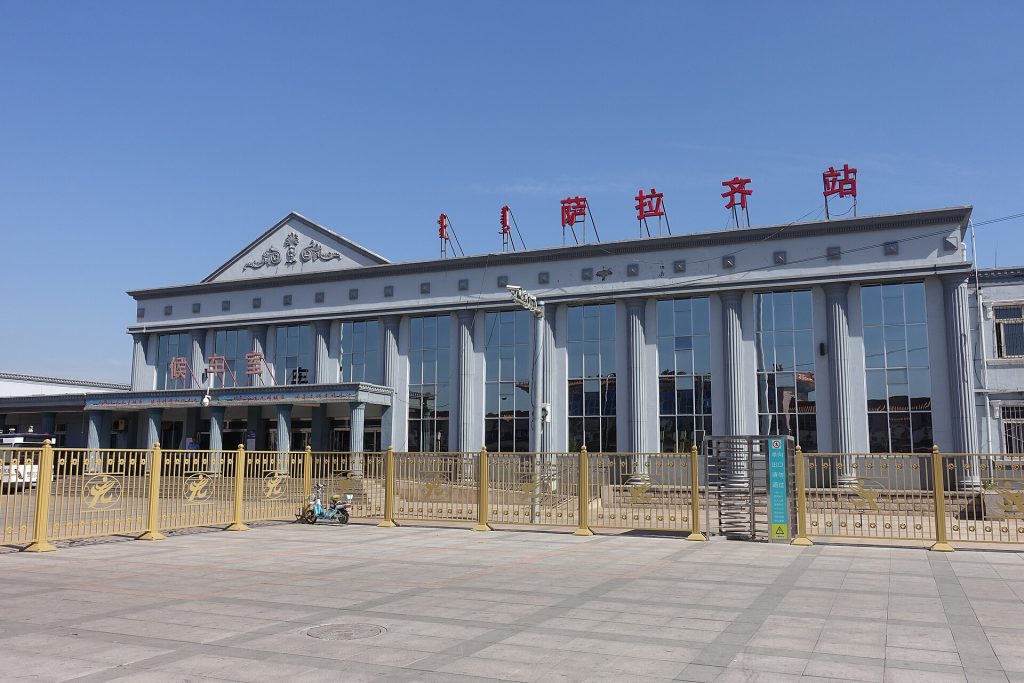
(Featured image: the station nameboard at Salaqi Station, Baotou, Inner Mongolia — the station name shown in Mongolian script alongside Chinese; by Pkkj, CC BY-SA 4.0, via Wikimedia Commons)