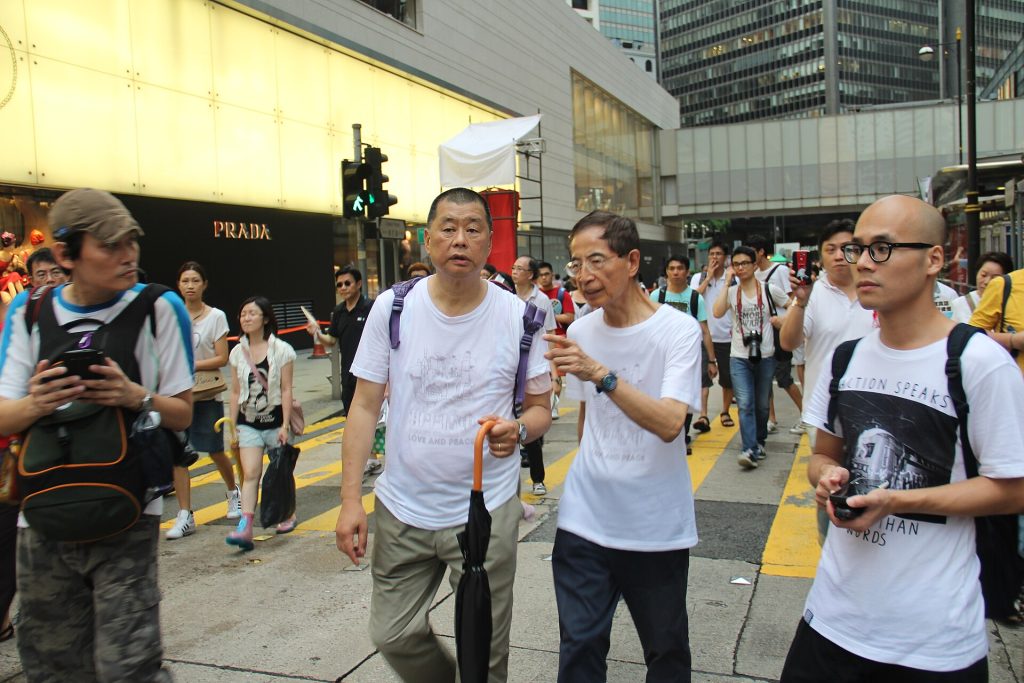
In the early hours of June 24, 2021, Hongkongers stood in the rain in long queues at newsstands across the city to buy a newspaper’s final edition. Apple Daily printed one million copies that day — more than ten times its normal run — and still sold out by about 8:30 in the morning, a single-day sales record for a Hong Kong newspaper. A week earlier, more than 500 police officers had raided the paper’s headquarters under the National Security Law, arrested five senior executives, and frozen HK$18 million of its assets. Unable to pay its staff, the 26-year-old paper announced it would close. The destruction of Apple Daily became the emblematic episode in the collapse of press freedom in Hong Kong. Its founder, Jimmy Lai, was convicted on December 15, 2025, of conspiring to collude with foreign forces and to publish seditious material, and on February 9, 2026, he was sentenced to 20 years in prison — the heaviest sentence imposed under the National Security Law (status as of October 2026).
Background and Causes
Apple Daily was founded on June 20, 1995, by businessman Jimmy Lai as part of his Next Media group. Lai, born in Canton (Guangzhou) on December 8, 1947, had arrived in Hong Kong as a child stowaway and built a fortune from nothing, first with the Giordano clothing chain and then in media — a biography that made him both a symbol of Hong Kong’s possibilities and, in Beijing’s telling, a traitor to his country of birth. Known for its populist style, its pro-democracy stance, and its sharp criticism of Beijing and the Hong Kong government, it normally printed around 80,000 to 86,000 copies a day and was the city’s most influential pro-democracy newspaper. From its launch it had shaken up Hong Kong’s newspaper market with aggressive pricing and promotion, building a mass readership that made it, for its supporters, a daily plebiscite on the city’s freedoms — and, for Beijing, a platform that had to be neutralized once the legal tools existed. Lai himself was a longtime supporter and financier of the democracy movement with close ties to Western political circles. During the 2019 anti-extradition protests, the paper’s position was unmistakable. After the Hong Kong National Security Law took effect on June 30, 2020, pro-Beijing media singled out Lai and Apple Daily as archetypal “troublemakers,” and the authorities’ campaign against the paper began.
Course of Events
August 10, 2020 — Around 200 police officers raid the Next Media headquarters in Tseung Kwan O; Jimmy Lai is arrested. The next day’s Apple Daily prints 550,000 copies as supporters queue overnight to buy it.
December 2020 — Lai is charged first with fraud and then with collusion with foreign forces under the National Security Law, becoming the first person charged with that offence. On February 9, 2021, the Court of Final Appeal revokes his bail in the security case; he remains in custody from then on.
June 17, 2021 — More than 500 police raid the Apple Daily building again and arrest five executives: Next Digital CEO Cheung Kim-hung, chief operating officer Chow Tat-kuen, Apple Daily editor-in-chief Ryan Law Wai-kwong, associate publisher Chan Pui-man, and executive editor Cheung Chi-wai. Police freeze HK$18 million in assets of three companies, including Apple Daily Limited, saying dozens of articles published since 2019 had called for foreign sanctions against China and Hong Kong.
June 23, 2021 — Columnist Yeung Ching-kee (pen name Li Ping) is arrested. That evening the board announces that, with assets frozen and wages unpayable, the paper will publish its last edition the next day and shut its website and apps.
June 24, 2021 — The final edition appears with a print run of one million copies under the front-page headline “Hongkongers bid a painful farewell in the rain.” Queues form across the city and the edition is essentially sold out by about 8:30 a.m. On June 27, English-edition executive editor Fung Wai-kwong is arrested at the airport as he attempts to leave Hong Kong; in July, former executive editor Lam Man-chung is arrested and charged. Several of the arrested executives later pleaded guilty.
The Lai trials — In a separate fraud case, Lai is sentenced on December 10, 2022, to five years and nine months in prison and a HK$2 million fine. His National Security Law trial opens on December 18, 2023, in the High Court before three designated national security judges — Esther Toh, Susana D’Almada Remedios and Alex Lee — sitting without a jury. On December 15, 2025, the court delivers its verdict (case [2025] HKCFI 6291): Lai is guilty on all three counts — two of conspiracy to collude with a foreign country or external elements, and one of conspiracy to publish seditious publications.
February 9, 2026 — Lai is sentenced to 20 years in prison, the heaviest National Security Law sentence to date. The court adopted 15-year starting points for the collusion offences and raised Lai’s term on account of his role as the case’s mastermind, ordering 18 years of the sentence to run consecutively to his fraud term (the fraud convictions were subsequently quashed on appeal — see below). Five accomplice witnesses — Cheung Kim-hung, Chan Pui-man, Yeung Ching-kee, Andy Li Yu-hin and Chan Tsz-wah — receive terms of six years three months to seven years three months; Ryan Law, Lam Man-chung and Fung Wai-kwong receive ten years each.
February 26, 2026 — The Court of Appeal quashes Lai’s fraud convictions; the Department of Justice subsequently takes no further action in that case. By the March 9, 2026 appeal deadline, Lai himself had not appealed the national security case; only Fung Wai-kwong and Lam Man-chung sought leave to appeal their sentences. In April 2026 the Hong Kong government applied to confiscate Lai’s crime-related property. Media calculations of his earliest release year diverge — ranging from 2040 to 2046 depending on the assumptions used — and no figure is settled.
Key Figures and Reactions
Jimmy Lai refused repeated opportunities to leave Hong Kong and testified in his own defense. In 2021 the Committee to Protect Journalists gave him its Gwen Ifill Press Freedom Award. On the day the paper closed, U.S. President Joe Biden called it “a sad day for media freedom”; the UN human rights office said the police raid on a newsroom sent a “chilling message” for press freedom. According to Hong Kong media reports, U.S. President Donald Trump raised Lai’s release with Xi Jinping during their meeting on the sidelines of the APEC summit on October 30, 2025. Chinese and Hong Kong officials maintain the case was handled strictly according to law, describe Lai as an “anti-China agitator” and a foreign agent, and insist foreign governments have no right to interfere. According to a State Council white paper issued on February 10, 2026, a total of 98 people had been prosecuted and 78 convicted under the National Security Law as of January 2026. The closure reverberated in Japan as well: Chief Cabinet Secretary Katsunobu Kato publicly expressed deep concern, and the Sankei Shimbun front-paged the shutdown with an editorial headlined in Chinese, “Friend Apple, we are waiting for your return!”
Disputed Figures and Accounts
The core dispute is whether journalism can be a crime. The prosecution alleged that Lai and his executives conspired — through newspaper articles, lobbying and meetings with foreign politicians — to invite foreign sanctions, blockades or hostile acts against China and Hong Kong. The defense, echoed by international press-freedom organizations, argued that the articles cited as evidence were ordinary news and commentary and that criminalizing them, together with the chilling effect that shuttered other independent outlets (Stand News and Citizen News both closed within the following six months), amounted to outlawing independent journalism itself. Procedural features are also contested: security cases are heard by judges designated by the Chief Executive, without juries, under a bail threshold so strict that Lai spent more than five years in custody before conviction. The prosecution’s case rested in part on testimony from five of Lai’s own former executives and associates, who appeared as accomplice witnesses after pleading guilty — an arrangement defense sympathizers describe as the predictable product of prolonged pre-trial detention and the law’s severe penalties, and prosecutors describe as insiders confirming the conspiracy from within. How those guilty pleas were obtained, and how much weight such testimony should carry, remains one of the case’s most argued questions outside the courtroom; inside it, the three judges accepted the accomplice evidence as credible and central. Those who support the sentence reply that Lai’s public contacts with foreign governments are documented and that the term reflects the gravity of the offences. His health and his prolonged solitary confinement have drawn continuing concern from his family and international rights groups.
Impact and Aftermath
After closure, Apple Daily‘s 26-year archive vanished from public view with its website, and Hong Kong was left without a mass-circulation pro-democracy print newspaper. Next Digital itself subsequently entered liquidation, its Tseung Kwan O headquarters emptied. Lai’s son Sebastien Lai has campaigned internationally for his father’s release, keeping the case before Western governments and parliaments even as his father, by then in his late seventies, remained in a maximum-security cell. According to media reports, Taiwan’s Apple Online also ceased updating on August 31, 2022, ending the Next Media empire. Lai’s case became a standing item in U.S.–China and U.K.–China friction, with the British government repeatedly requesting consular access to Lai, a British citizen, and calling for his release. Together with the broader enforcement of the National Security Law, the case is cited by Reporters Without Borders and other monitors as a principal cause of Hong Kong’s precipitous fall in world press-freedom rankings. For Hong Kong, the death of Apple Daily and Lai’s 20-year sentence remain the most potent symbols of how far speech and press space have narrowed under “one country, two systems.”
Sources
Hong Kong Police Force, National Security Department: announcement of the June 17, 2021 raid and arrests (five arrested; HK$18 million in assets frozen)
Hong Kong Judiciary: verdict and sentencing in the Jimmy Lai case, [2025] HKCFI 6291 (verdict December 15, 2025; sentencing February 9, 2026)
RTHK, Ming Pao, The Witness (法庭线): coverage of the closure and of the Lai trial, sentencing and appeal deadline
State Council white paper (February 10, 2026): 98 prosecuted and 78 convicted under the National Security Law as of January 2026
Associated Press, Reuters, BBC News: coverage of the closure and the Lai case
Committee to Protect Journalists: 2021 Gwen Ifill Press Freedom Award announcement
The White House: President Biden’s statement on the closure of Apple Daily (June 24, 2021)
(Featured image: Jimmy Lai, photo by Hai Yan for Voice of America, public domain, via Wikimedia Commons)