Introduction
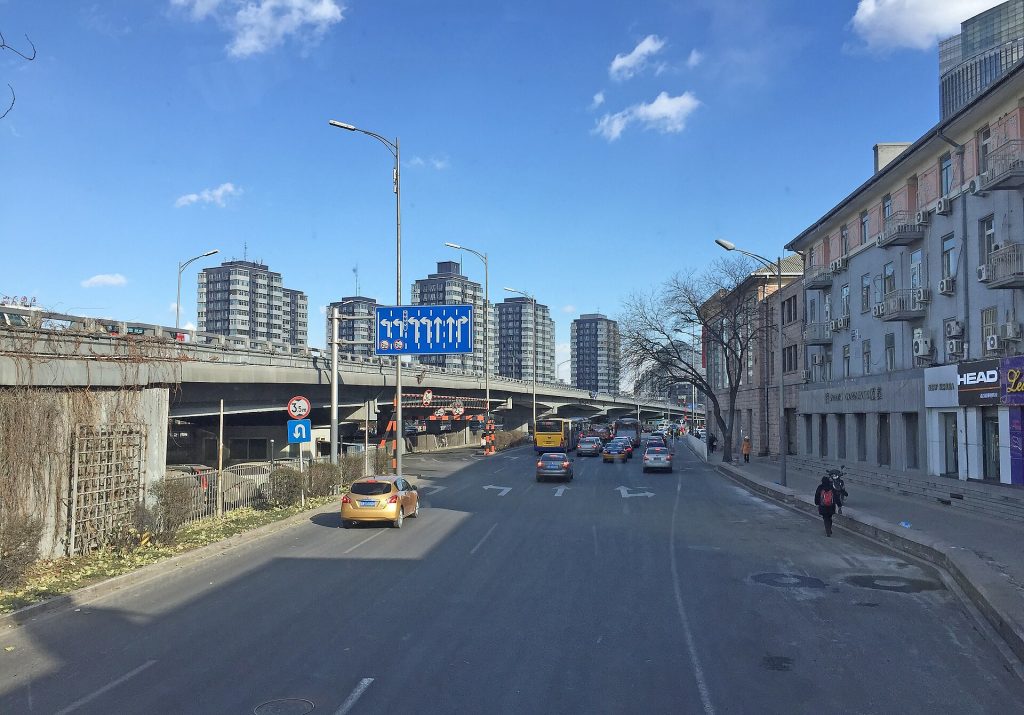
At midday on 13 October 2022, on the Sitong Bridge, an overpass on Beijing’s North Third Ring Road in Haidian District, a lone man hung two large white banners with hand-written red slogans, set fire to tyres to raise a column of black smoke, and broadcast slogans on a loop through a loudspeaker, openly calling for the removal of Chinese Communist Party General Secretary Xi Jinping. The protest came just three days before the opening of the CCP’s 20th National Congress, when security in the capital was at its tightest. He was taken away by police at the scene and has never been seen in public again. The Chinese authorities have never released his name, any charges, or his whereabouts. Reporting by the Wall Street Journal, Radio Free Asia and others identifies the protester as Peng Lifa (online name “Peng Zaizhou”), a 48-year-old physics researcher — though this identity has never been officially confirmed. BBC News called the act “one of the most significant acts of Chinese protest seen under Mr Xi’s rule.” One month later, the words on his banners were being chanted in the White Paper protests across China.
Background: The 20th Congress and the End of Zero-COVID
The protest stood at the intersection of two storylines. The first was succession: Xi Jinping had led the CCP since 2012, and after China’s legislature abolished presidential term limits in 2018, he was widely expected to break post-reform convention and take a third term at the 20th Congress, opening on 16 October 2022. The Seventh Plenary Session of the 19th Central Committee had closed on the evening of 12 October; congress delegates were arriving in Beijing and the city’s security apparatus was on its highest footing.
The second was the pandemic regime. Since August 2021 China had pursued “dynamic zero-COVID”: mass testing, lockdowns and centralised quarantine as everyday facts of life. Shanghai’s two-month lockdown in the spring of 2022 had produced widespread hardship and resentment, and controls showed no sign of relaxing as the Congress approached. In May 2022, WHO Director-General Tedros Adhanom Ghebreyesus publicly called the zero-COVID policy unsustainable; his remarks were promptly deleted from Chinese social media. In that climate, public dissent carried extreme risk, and street protest had all but vanished.
Peng’s action was carefully prepared. According to multiple reports, he had previously posted the same slogans on Twitter and had published, under the name Peng Zaizhou on the academic site ResearchGate, a 23-page document, “A Letter to Fellow Countrymen,” calling for nationwide strikes and class boycotts to begin on 16 October, the day the Congress opened, along with actions such as mass car-horn honking. The document also appealed to soldiers and police not to “sell their lives for a dictator,” and set out the demand for a one-person, one-vote election of the country’s leader. BBC reporters checked with a village in Heilongjiang identified as his home; a village cadre confirmed that a man of the same name had lived there.
What Happened
Around midday on 13 October, the protester — wearing a yellow hard hat and an orange work vest, disguised as a municipal construction worker — climbed onto the Sitong Bridge, a busy overpass near Zhongguancun and Renmin University. He hung the two hand-written banners from the side of the bridge and set tyres alight; the thick black smoke initially led some onlookers to think a self-immolation was under way. A loudspeaker he had set up played his recorded slogans on repeat.
Police and firefighters arrived quickly. According to reports, at about 12:30 p.m. he was handcuffed and put into a police car; the banners and loudspeaker were removed and the fire extinguished. Foreign journalists who reached the scene that afternoon found only heavy police patrols stopping passersby for ID checks. An Associated Press reporter at the scene was stopped and checked three times, while police refused to acknowledge that anything had happened.
The official response was silence. At the Foreign Ministry’s regular press briefing on 14 October, a reporter asked about the protester’s fate; spokesperson Mao Ning replied that she was “not aware of the situation,” and the exchange did not appear in the official transcript published on the ministry’s website. Radio Free Asia’s calls to several Haidian police departments were met with “no comment” or claims of ignorance.
One detail suggested he had planned for his own arrest: at 9 a.m. on 16 October, one hour before the Congress opened, his Twitter account — which had been emptied — suddenly posted a quotation from the last testament of Sun Yat-sen. The post was widely believed to have been scheduled in advance.
The Banners’ Demands
The two banners and the loudspeaker recording are the core texts of the event. The left banner read:
“We don’t want nucleic acid tests, we want food to eat; we don’t want lockdowns, we want freedom; we don’t want lies, we want dignity; we don’t want a Cultural Revolution, we want reform; we don’t want leaders, we want votes; we don’t want to be slaves, we want to be citizens.”
(不要核酸要吃饭,不要封控要自由,不要谎言要尊严,不要文革要改革,不要领袖要选票,不做奴才做公民)
The right banner read:
“Strike at school and work, remove the dictator and national traitor Xi Jinping! Arise, you who refuse to be slaves of the dictator! Oppose dictatorship, oppose authoritarianism, save China — one person, one vote to elect the president!!!”
(罢课罢工罢免独裁国贼习近平。起来,不愿意做独裁者奴隶的人们!反独裁反专制救中国,一人一票选主席)
(The lower part of the right banner was blown up by the wind and obscured in photographs; the wording above is restored from the manifesto he had published beforehand, and matches multiple media reports.)
The loudspeaker repeated: “We want food, we want freedom, we want votes! Strike at school and work, remove the dictatorial national traitor Xi Jinping!”
The six parallel “we don’t want / we want” couplets placed the survival grievances of late zero-COVID — food, freedom from lockdown — alongside explicitly political demands: votes, citizenship, an end to the leader cult. The second banner aimed directly at Xi Jinping personally and named a method: strikes at school and work, and a one-person, one-vote election. Read together with his manifesto, this was a deliberate political protest, not merely an outburst against lockdowns.
Censorship and Suppression
Photographs from the bridge spread across overseas social media that afternoon, and the authorities responded with intensive censorship. Images and videos were swiftly deleted from WeChat, Weibo and other platforms, and many accounts that shared them were suspended permanently or for fixed terms. One user was banned for 60 days for a post consisting only of the words “I saw it”; a Weibo hashtag of the same phrase was deleted after more than 180,000 views. According to Bloomberg, the list of restricted keywords kept growing: “Sitong Bridge,” “Haidian,” “brave man,” “courage” — and at points even “Beijing” and “bridge.” Comment sections under related videos on Bilibili were shut, a 2018 song literally titled “Sitong Bridge” by the band Bu Youya Xiansheng was pulled from music platforms, and comment sections for Eason Chan’s “Lonely Warrior” and No Party for Cao Dong’s “Brave Man” were censored.
People who forwarded or echoed the protest were punished. Radio Free Asia reported that Gu Guoping, a retired teacher in Shanghai, was detained for ten days for posting protest clips on Twitter; a man in Hainan was detained ten days for forwarding images and given ten more for missing COVID tests while in custody. In Hong Kong, a mainland-born engineer who put up a solidarity poster at the Legislative Council’s protest area was arrested by Hong Kong police on a charge of seditious intent.
The erasure extended offline and onto the map. After the protest, Beijing reportedly began recruiting dedicated “bridge watchers” to monitor the city’s bridges around the clock in shifts — reportedly paid 320 yuan a day — and purchases of cloth longer than a metre, and even paint, were reported to require real-name registration. In late May 2023, just before the June 4 anniversary, the Sitong Bridge road sign was removed, and “Sitong Bridge” could no longer be found on Baidu Maps or Amap; only bus stops such as “Sitong Bridge South” and “Sitong Bridge East” retained the name.
Apple’s AirDrop was drawn in as well: protest material had been passed handset-to-handset via the feature, and some universities told students to switch it off. On 10 November 2022, Apple’s iOS 16.1.1 update limited the “Everyone” mode of AirDrop to ten minutes at a time on iPhones sold in mainland China; in December the change was extended worldwide. Apple said the change was meant to reduce unwanted images from strangers; Bloomberg reported that it was made at the Chinese government’s request.
Solidarity and Echoes
Censorship did not stop the slogans from travelling. Within days, solidarity posters appeared on campuses in the United States — Harvard, Yale, Stanford, Princeton, MIT, UC Berkeley among them — and at universities in Britain, Canada, the Netherlands, South Korea, Japan, Singapore and Italy. According to a tally by an Instagram-based tracking account cited by the New York Times, by 23 October it had received more than 1,500 reports of anti-Xi slogans from 328 universities worldwide. On 16 October, protesters unfurled banners echoing Peng’s outside Utrecht Central Station and at the Chinese consulate in Los Angeles. The sinologist Perry Link commented that one man’s denunciation could symbolise far wider discontent — “a single spark can start a prairie fire.” Many dissidents compared Peng to the “Tank Man” of 1989, calling him a “new Tank Man.”
Inside China, people improvised quieter relays: his slogans appeared hand-written in public toilet stalls in several cities — a phenomenon dubbed the “toilet revolution” — and protest images were passed around by AirDrop in subways and streets. On the night of 23 October, two people marched through Shanghai’s Xiangyang North Road carrying a white banner inscribed three times with the characters for “don’t want / want,” singing the Internationale; some media called it “Sitong Bridge 2.0.”
Six weeks later the echoes peaked. On 24 November 2022, a fire in a locked-down residential block in Ürümqi killed ten people and ignited the White Paper protests in cities across China. In the early hours of 27 November, crowds on Shanghai’s Urumqi Road chanted “Communist Party, step down” and “Xi Jinping, step down” — and “No COVID tests, we want freedom,” a line lifted straight from the Sitong Bridge banner. Peng’s words had travelled from one bridge into a nationwide movement.
The Fate of Peng Lifa
From the day he was taken away, Peng Lifa has been forcibly disappeared: the Chinese authorities have never confirmed holding him, and have published no charge, trial or verdict. His family has been unable to speak out.
Human rights groups and journalists have assembled fragments. Radio Free Asia reported in October 2023 that he was still alive but his whereabouts “unclear,” with his family under close surveillance. A Voice of America exclusive the same month, citing sources inside China, confirmed he remained detained at an unknown location, with relatives under varying degrees of monitoring. Chinese Human Rights Defenders (CHRD) reported that police had placed his wife and two daughters under house arrest in Beijing, that his siblings and his wife’s relatives in his home village in Tailai County, Heilongjiang, had been summoned, warned and watched, and that the entire village had reportedly been sealed off. The magazine Bitter Winter cited an anonymous source claiming he was held in a psychiatric hospital, while itself acknowledging there was no hard evidence; that claim remains unverified.
In July 2025 a new account emerged. On 8 July, “Yesterday,” a social-media channel covering Chinese human rights, reported that after more than two years of secret detention Peng had been sentenced to nine years in prison on charges including “picking quarrels and provoking trouble” and “arson,” and had been transferred to prison in May 2025 to serve the sentence. ChinaAid relayed the report on 15 July. But no official document, judgment or family statement has confirmed the sentence, and this column treats it as an unverified report.
Impact and Aftermath
Measured by its immediate demands, the protest failed: on 23 October 2022 Xi was re-elected CCP general secretary at the First Plenary Session of the 20th Central Committee, and in March 2023 he was re-elected state president for a third term. But the protest’s symbolic force far outlasted its minutes on the bridge. It broke the silence of late zero-COVID — the sense that no one dared speak aloud — and showed that even at the most heavily guarded moment, in one of the capital’s most sensitive locations, someone was willing to trade his freedom for a few sentences on a banner.
Policy shifted within two months. After the White Paper protests, the State Council issued the “New Ten Measures” on 7 December 2022; mass testing and lockdowns stopped almost overnight, and the nearly three-year zero-COVID regime effectively ended. Analysts differ on causation, but many regard Sitong Bridge as one of the starting points of that collapse. Peng himself received international recognition: in 2023 he was named to Time magazine’s TIME 100 list of the world’s most influential people, and in June 2023 the bipartisan leadership of the US Congressional-Executive Commission on China nominated him, together with Zhang Zhan and Li Kangmeng, for the 2023 Nobel Peace Prize.
Imitators kept coming. In February 2023, slogans reading “Down with the Communist Party, down with Xi Jinping” were projected onto the wall of a shopping mall in Jinan, Shandong, remotely triggered by a man named Chai Song while he was leaving the country; friends he left behind were subsequently unreachable. In July 2024, 22-year-old Fang Yirong hung near-identical banners and played the same loudspeaker slogans from an overpass in Xinhua County, Loudi, Hunan. In April 2025, three banners calling for political reform appeared on an overpass at a bus station in Chengdu. Banners can be taken down and a bridge’s name can be wiped from the map; but the sentences shouted at midday on 13 October 2022 remain a marker of the zero-COVID era — and of the will to resist it.
Sources
- Chinese Wikipedia, “四通桥事件” (Sitong Bridge incident) and “彭立发” (Peng Lifa); English Wikipedia, “2022 Beijing Sitong Bridge protest” and “Peng Lifa”
- BBC News, “China congress: How one man on a bridge marred Xi Jinping’s big moment” (21 October 2022); “China’s ‘Bridge Man’ inspires Xi Jinping protest signs around the world” (18 October 2022)
- Reuters, “Rare political protest banners removed in Chinese capital” (13 October 2022)
- Associated Press, “China quashes social media about protest banners in Beijing” (13 October 2022)
- The New York Times: Li Yuan, “China’s Protest Prophet” (7 December 2022), and reporting on censorship and campus solidarity posters
- The Wall Street Journal, “Beijing Protester’s Battle Cry Sends Ripples Worldwide” (22 October 2022)
- Bloomberg News, reporting on the censorship of keywords including “Beijing” and “bridge,” and on Apple’s AirDrop restriction (October–November 2022)
- Radio Free Asia, “One year on, where is China’s lone ‘Bridge Man’ protester?” (16 October 2023), and reporting on detentions of people who shared protest material, including Gu Guoping
- Voice of America, “Bridge protester still detained a year later, family under surveillance” (12 October 2023)
- Chinese Human Rights Defenders (CHRD), reporting on the surveillance of Peng Lifa’s family and the cutting of their contacts
- US Congressional-Executive Commission on China (CECC), statement nominating Peng Lifa and others for the 2023 Nobel Peace Prize (June 2023)
- Time magazine, TIME 100 (2023)
- ChinaAid, report on the alleged nine-year sentence (15 July 2025, citing the “Yesterday” channel; not officially confirmed)
- Cover image: Wikimedia Commons (see file page for license)