Introduction
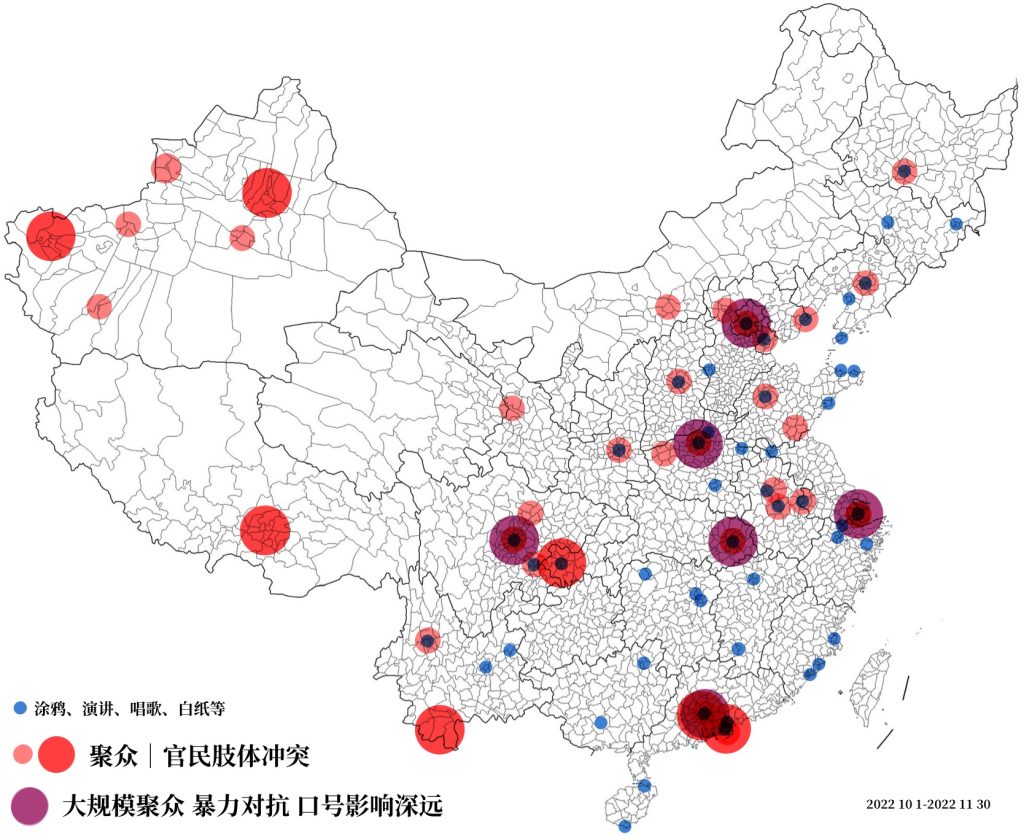
On the evening of 24 November 2022, fire swept through a locked-down high-rise apartment block in Ürümqi, Xinjiang. The official toll was ten dead and nine injured. Within three days, protests had spread from a university campus in Nanjing to the streets of Shanghai, from the banks of Beijing’s Liangma River to Chengdu, Wuhan and Guangzhou — dozens of Chinese cities in all. The demonstrators carried no placards. They held up single blank sheets of A4 paper: in a system of pervasive censorship, the blankness was the message. Human rights groups and news organisations regard the wave as the most geographically widespread protest movement in China since 1989.
The immediate demand was an end to “dynamic zero-COVID.” But in Shanghai and elsewhere, according to Reuters and other outlets, voices in the crowd chanted “Communist Party, step down” and “Xi Jinping, step down” — a direct public call for the country’s top leader to resign, all but unheard of on Chinese streets since 1949. Ten days after the protests began, on 7 December 2022, the State Council’s joint prevention and control mechanism issued the “New Ten Measures,” and zero-COVID — enforced for nearly three years — effectively ended. The street protests subsided, but the reckoning that followed lasted for months: participants were detained and sentenced, and some remain in prison today.
Background: The Last Months of Zero-COVID
From early 2020, China pursued a “dynamic zero-COVID” policy: any outbreak triggered lockdowns of housing compounds or entire cities, backed by mass testing, centralised quarantine and health-code checks. In 2022, as the highly transmissible Omicron variant spread, the cost of the policy climbed steeply. Shanghai, a city of 25 million, was locked down for roughly two months in the spring, with widespread reports of food shortages and delayed medical care. By the autumn, city after city was under rolling restrictions; contemporary reporting put the number of people under some form of lockdown at several hundred million in November.
Grievances accumulated through the second half of 2022. On 18 September, a bus transferring people to quarantine overturned on a Guizhou highway, killing 27. On 1 November, a three-year-old boy in Lanzhou died after lockdown measures delayed his emergency treatment, provoking public fury; on 4 November, a woman in Hohhot fell to her death while her daughter’s pleas at a sealed compound gate were filmed and widely shared. On 11 November the authorities issued “twenty measures” meant to curb excessive enforcement, but implementation was chaotic and lockdowns did not meaningfully ease. On 22–23 November, workers at the Foxconn plant in Zhengzhou clashed with police in large-scale unrest over COVID rules and pay. And on 13 October, a lone protester had hung banners from Beijing’s Sitong Bridge denouncing lockdowns and demanding votes and freedom (see this column’s article on the Sitong Bridge protest) — slogans that would be heard again, a month later, in streets across the country.
By late November 2022, “enough” was a sentiment shared across regions and classes. All that was missing was a spark.
The Spark: The Ürümqi Fire
At 7:49 p.m. on 24 November 2022, fire broke out in a high-rise residential building in the Jixiangyuan compound in Ürümqi’s Tianshan District. According to the official account, the blaze began with a power strip in a 15th-floor bedroom, spread to the 17th floor, and sent smoke up to the 21st; the flames were put out at about 10:35 p.m. The official toll was ten dead — among them several children — and nine injured.
Ürümqi had been locked down since 10 August; its residents had been confined at home for more than a hundred days. After the fire, online questioning was immediate: the compound was under lockdown — were unit doors and escape routes sealed? Did fences and barriers delay the fire engines? Why could trapped residents not get out? Videos circulating online appeared to show fire trucks obstructed and water cannons falling short of the burning floors.
The authorities rejected these claims. At a press conference on 25 November, Ürümqi officials said Jixiangyuan was a “low-risk” compound whose residents could go downstairs in staggered shifts, that unit doors were not locked or wired shut, and that the fire engines had been hindered by the compound’s narrow roads and parked cars; they added that some residents had a “weak capacity for self-rescue.” The explanation did not quiet the doubts. A Radio Free Asia fact-check concluded that at least five of the dead had been trapped at home by pandemic controls; the authorities maintained that the deaths were unrelated to the lockdown. The death toll itself was disputed: the official figure stood at ten dead and nine injured, while higher figures circulated online without verification — and a 24-year-old woman was given ten days’ administrative detention for spreading what officials called false information about the toll in a WeChat group.
On 25 November, residents of several Ürümqi compounds took to the streets demanding an end to the lockdown, with crowds converging near the municipal government and confronting city officials. That evening, Ürümqi’s mayor, Mamtimin Kadir, apologised to the city for the fire and promised accountability; on 26 November the city announced a phased reopening of low-risk areas. But the anger had already outgrown Xinjiang.
What Happened
26 November, Nanjing. A female student at the Communication University of China, Nanjing, stood alone on the steps of her campus holding a blank sheet of A4 paper in silent protest. According to reporting and video from the scene, a university staff member took the paper from her hands; that evening, hundreds of students gathered on campus, holding up blank sheets and phone lights and chanting slogans including “Long live the people.” The scene spread across social media, and the blank page became the movement’s emblem.
26–27 November, Shanghai. From late on 26 November, residents gathered on Ürümqi Middle Road, on the border of Jing’an and Xuhui districts, lighting candles and laying flowers beneath the street sign for the victims of the fire. The vigil turned into protest: crowds chanted “Lift the Xinjiang lockdown” and “We want freedom, not COVID tests,” and — according to Reuters, Agence France-Presse, the BBC and other outlets — some chanted “Communist Party, step down” and “Xi Jinping, step down”; the crowd also sang the national anthem and the Internationale. In the early hours of 27 November, police sealed the road and cleared the crowd, taking people away. Through the day and evening of the 27th, crowds returned to Ürümqi Middle Road and nearby streets; police arrested dozens and dispersed them by force. The Chinese Wikipedia, citing CNN, records one protester’s estimate that 80 to 110 people were arrested on the night of the 26th alone; the authorities never published arrest figures for Shanghai. On the 27th, photographs of the “Ürümqi Middle Road” street sign being removed spread online, and the removal itself became a symbol of protest; by the 28th, the street was lined with blue barricades and heavy police deployments.
27 November, Beijing. That night, thousands of residents gathered along the Liangma River near Liangma Bridge in Chaoyang District, holding blank paper and candles, chanting “We want freedom, not COVID tests” and “End zero-COVID,” and at one point marching along the riverbank. According to the BBC and Reuters, police handled the scene through negotiation, officials promised to ease lockdowns, and the crowd dispersed peacefully in the early hours without mass arrests — though, as later events showed, only for the moment. The same day, hundreds of Tsinghua University students rallied on campus holding blank sheets; at Peking University, students gathered around midnight after a slogan appeared on a campus wall, and dispersed after university staff addressed them.
27–29 November: the spread. On the evening of the 27th, crowds filled Wangping Street in Chengdu, chanting “We want freedom, not COVID tests” and marching along the river; gatherings and vigils were reported the same day or soon after in Wuhan, Guangzhou, Shenzhen, Xi’an, Kunming, Changsha, Nanjing and Hangzhou, with even small cities such as Dali in Yunnan seeing marches of dozens. Universities were the second front: research published in the journal Sociologica documented protests or vigils at no fewer than 51 universities, while organisations such as PEN International, relaying contemporary tallies, put the number of cities with protests that weekend at at least 31. There is no reliable count of total participants; estimates range from tens of thousands upward, and this site reports the sourced figures side by side rather than choosing one.
28–30 November: the streets empty. On 28 November, Foreign Ministry spokesman Zhao Lijian told a regular briefing that “people with ulterior motives” had linked the Ürümqi fire to COVID policy, and reaffirmed commitment to dynamic zero-COVID. That evening, police pre-emptively occupied planned gathering points in Beijing and Shanghai; spot checks of phones were reported on Beijing streets and in the subway, and barriers sealed off streets in Shanghai. On the night of the 29th, Guangzhou’s Haizhu District saw one of the wave’s most violent episodes: according to AFP and other outlets, protesters confronted police and threw objects, and police fired tear gas. After that, open street protest effectively ceased.
The Blank Page: Symbol and Spread
Why did a sheet of paper with nothing on it become a protest banner? The logic, as widely explained at the time, ran like this: the words people wanted to say could not be written down — writing them meant deletion and punishment — so holding up a blank page was itself the most complete statement. There was no “content” for the censors to delete, yet everyone present, and everyone watching, understood what it meant. The blank page was also an indictment by irony: protesters had “said nothing,” and still the authorities moved to disperse and arrest them — demonstrating precisely what they were protesting.
The form had precedents. During Hong Kong’s 2019–2020 protests, demonstrators held blank sheets after the National Security Law made slogans themselves legally perilous; after Russia’s invasion of Ukraine in 2022, Russian anti-war protesters were detained for holding blank signs. In China, the symbol fitted everyday experience with uncanny precision: blocked keywords, deleted posts and banned accounts had made “what cannot be said” a shared condition for hundreds of millions of people, so the blank page needed no explanation.
The movement spread through the cracks of the censorship system. Videos appeared briefly on Weibo and WeChat before deletion, then re-entered China from overseas platforms; “Ürümqi Middle Road” trended, then was throttled. In early November 2022, an Apple software update had limited the “Everyone” setting of AirDrop on iPhones sold in China to ten minutes — AirDrop had been one of the tools protesters used to pass information around internet censorship, and the timing drew widespread criticism. Official discourse, meanwhile, blamed the protests on “foreign forces,” a charge that recurred throughout the interrogations that followed.
The Response: Arrests After the Fact
The authorities’ response ran on two tracks: rapid policy concession (see the next section) and a delayed, quiet crackdown.
Once the streets had emptied, police across the country used surveillance footage, phone location data and cell-site records to identify participants retroactively. People were summoned, warned at their homes, or made to sign pledges; university students were called in by counsellors; spot checks of phones were reported in several cities. In early December, Guangzhou police took away dozens of participants; a recurring question in interrogations, as later recounted by detainees’ friends and lawyers, was whether they had been “paid to hold up white paper” or directed by foreign forces.
The best-documented case is that of four young women who had attended the 27 November vigil on the Liangma River in Beijing: Cao Zhixin, a publishing editor; Li Siqi, a writer; Li Yuanjing, an accountant; and Zhai Dengrui, a teacher. Summoned and released on 29 November, with their phones confiscated, all four were criminally detained between 18 and 23 December. Before her own detention, Cao Zhixin recorded a video — released by her friends in January 2023 — saying that her friends had been made to sign criminal detention notices with the charge left blank, and asking: “We young people were simply mourning our compatriots — why must we pay the price of being disappeared?” On 19 January 2023 the four were formally arrested for “picking quarrels and provoking trouble”; people familiar with the matter said more than twenty Beijing participants were approved for arrest that night. On 8 March 2023, PEN International and 24 other organisations issued a joint statement demanding their release. On 19 April 2023, after roughly four months in custody, the four women were released on bail.
The total number of arrests was never officially disclosed, and the estimates diverge. Human Rights Watch’s January 2023 statement spoke of “dozens” detained; the BBC, working through friends and lawyers, verified twelve arrests in Beijing alone; activist groups and the website Weiquanwang continued adding names for months; and a 2025 retrospective by Chinese Human Rights Defenders put the number of people arrested in connection with the protests at more than 100, with the status of many still unknown.
Known sentences include: Kamile Wayit, a young Uyghur student, who received a three-year prison term for “promoting extremism” after reposting a protest video online (according to Human Rights Watch); and Chen Pinlin, a Shanghai documentary filmmaker who edited protest footage into the film Urumqi Middle Road and released it on the protests’ first anniversary — he was detained in November 2023 and, on 6 January 2025, sentenced by Shanghai’s Baoshan District Court to three and a half years for “picking quarrels and provoking trouble” (according to Reporters Without Borders). More than a dozen Chinese lawyers had publicly offered free legal aid to detainees; several were subsequently pressured by justice bureaus and police.
The End of Zero-COVID
The sequence of events is difficult to separate from the protests. On 30 November, Guangzhou announced the lifting of temporary control measures across multiple districts; Chongqing and Beijing signalled easing the same day. On 1 December, Vice Premier Sun Chunlan, speaking at a National Health Commission meeting, stressed “optimising” the response — and did not mention “dynamic zero-COVID” at all. On 7 December came the “New Ten Measures”: no more mass testing, no health-code checks for domestic travel, home isolation permitted for asymptomatic and mild cases, and health codes abolished outside designated venues — the core machinery of zero-COVID dismantled in a single document. On 26 December, the National Health Commission announced that from 8 January 2023 COVID would be managed as a Class B disease and border quarantine would end. The government never acknowledged any connection to the protests, presenting the shift as a scientific adjustment based on the virus’s evolution and accumulated experience. But outside observers — including major news organisations and human rights groups — broadly concluded that the street protests were the final straw: they showed the leadership that the political cost of continuing lockdowns had overtaken the cost of letting go. Because the exit came without preparation, December 2022 and January 2023 brought a nationwide infection wave that overwhelmed pharmacies and hospitals; its full cost has never been officially tallied.
Impact and Aftermath
The White Paper protests lasted only days, but their tail is long. They were the public debut of the “blank paper generation”: participants were mostly in their late teens and twenties, many on the street for the first time. The movement had no leaders, no organisation and no programme — only a sheet of paper and a shared predicament. That leaderlessness let it ignite simultaneously under conditions of censorship and surveillance; it also made it impossible to sustain.
Solidarity abroad was nearly simultaneous: according to Human Rights Watch and other organisations, Chinese students and diaspora communities held vigils and rallies in dozens of cities across more than a dozen countries — London, New York, Paris, Tokyo, Sydney, Toronto among them — and the blank page became a transnational symbol of protest. On 28 November 2022, the White House National Security Council issued a statement supporting the right to protest peacefully, and the UN Human Rights Office urged China to handle the protests in line with human rights standards.
At home, commemoration itself became taboo. Around the first anniversary in November 2023, police presence was reinforced at sensitive locations in Beijing and Shanghai and memorial posts were scrubbed from social media; at Halloween 2023, young people in Shanghai took to the streets in costumes — some covered in blank sheets of paper — in a veiled act of remembrance. In the official narrative, the movement barely exists: no reporting, no verdict documents, no anniversaries — only detention records and court sentences testify that it happened. And the manner of zero-COVID’s end — a total policy, declared immovable for nearly three years, abandoned within ten days and without explanation — has become a standard case study in discussions of how China is governed.
Three years on, the questions the blank pages posed have not gone away: when expression itself is treated as a danger, a single empty sheet is enough to alarm a state. What happened in those few days — the fire, the vigils, the white paper, the chants, the arrests, the U-turn — has become part of the shared political memory of a generation of young Chinese.
Sources
- Chinese Wikipedia, “White Paper Movement” (白纸运动), “2022 Ürümqi high-rise fire” (2022年新疆乌鲁木齐高层住宅楼火灾), “2022 Shanghai Ürümqi Middle Road protest” (2022年上海乌鲁木齐中路抗议) and “Cao Zhixin” (曹芷馨); English Wikipedia, “2022 COVID-19 protests in China”
- Reuters, coverage of the Shanghai and Beijing protests, 26–28 November 2022 (source of the “Communist Party, step down” / “Xi Jinping, step down” chant reports); AFP, reporting on the 29 November 2022 clashes in Guangzhou
- BBC News: “The protesters who’ve gone missing as China deepens crackdown” (February 2023); BBC Chinese coverage of the second anniversary
- Human Rights Watch: “China: Free ‘White Paper’ Protesters” (26 January 2023); “The Legacy of the White Paper Protests” (November 2025)
- Chinese Human Rights Defenders: “China’s ‘White Paper’ Protests: 3 Years Later” (26 November 2025) — more than 100 arrested
- PEN International and 24 other organisations, joint statement of 8 March 2023 on Cao Zhixin, Li Siqi, Li Yuanjing and Zhai Dengrui
- Radio Free Asia: fact-check on the Ürümqi fire; reporting on the Cao Zhixin case
- Reporters Without Borders: statement on the sentencing of Chen Pinlin to three and a half years (January 2025)
- Research article in the journal Sociologica: protests and vigils documented at no fewer than 51 universities
- State Council joint prevention and control mechanism: “Notice on Further Optimising and Implementing COVID-19 Prevention and Control Measures” (the “New Ten Measures,” 7 December 2022); National Health Commission announcement of 26 December 2022 on Class B management
- Tianshan Net / Xinhua: official report on the Ürümqi fire (10 dead, 9 injured) and the Ürümqi municipal press conference of 25 November 2022
- Cover image: Wikimedia Commons (see file page for license)